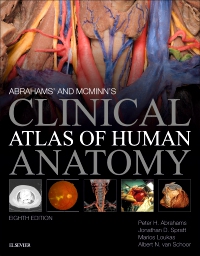

Abrahams' and McMinn's Clinical Atlas of Human Anatomy - Elsevier eBook on VitalSource, 8th Edition
Elsevier eBook on VitalSource
Now $64.79
**Selected for 2026 Doody's Core Titles as an Essential Purchase in Anatomy/Embryology**
Abrahams' and McMinn’s Clinical Atlas of Human Anatomy, 8th Edition delivers the straightforward visual guidance you need to perform confidently in all examinations and understand spatial relationships required during your medical training, while also acquiring the practical anatomical knowledge needed for your future clinical career. Respected authority Prof. Peter Abrahams and his team of leading international anatomists and radiologists link a vast collection of clinical images to help you master all the essential correlations between the basic science of anatomy and its clinical practice.
-
- See what to look for and how to proceed thanks to an unsurpassed collection of labelled dissection photographs, supported by clear, explanatory diagrams and modern imaging
- Correlate anatomy to clinical practice with a wealth of MR, CT, DSA, radiographic, endoscopic, and operative images that demonstrate how structures are viewed today in the clinical setting
- Thoroughly revised and updated throughout, including:
- brand new dissections, to further improve clarity and consistency throughout the book in every region
- all new colour overlays added to selected dissections making it even easier to identify key nerves, arteries, veins and especially lymphatics
- fully revised neuroanatomy content reflects the latest understanding of functional neuroanatomy as seen with modern 3D and functional imaging
- updated and coloured and a unique lymphatics section
-
Includes access to the complete, enhanced eBook – unlocking a huge, carefully-selected collection of BONUS CLINICAL material, integrated throughout on almost every page to enhance your study and help make those essential clinical / anatomical connections
- This sets Abrahams' and McMinn’s apart from any other atlases of human anatomy!
- 200+ 3D scans,– allowing you to view the body in a more dynamic way to aid your understanding of dynamic anatomy.
- Master the 500 clinical conditions every physician should know by reviewing the associated clinical topics - featuring over 2000 additional clinical photos, radiological images, and case presentations not found in the printed book. Learn from the culmination of over 45 years international clinical experience of Prof. Abrahams and over 100 of his colleagues worldwide who have contributed to this unique collection of clinical anatomy images.
-
1. Head, Neck and Brain
2. Vertebral Column and Spinal Cord
3. Upper Limb
4. Thorax
5. Abdomen and Pelvis
6. Lower Limb
7. Lymphatics -
-
Ways of Reading
- The appearance of the text and page layout can be modified according to the capabilities of the reading system (font family and font size, spaces between paragraphs, sentences, words, and letters, as well as color of background and text)
- This e-publication is accessible to the full extent that the file format and types of content allow, on a specific reading device, by default, without necessarily including any additions such as textual descriptions of images or enhanced navigation
- No information about nonvisual reading is available
-
Conformance
- No information is available
-
Navigation
- Table of contents to all chapters of the text via links
- Page list to go to pages from the print source version
-
Rich Content
- No information is available
-
Hazards
- No information is available
-
Product Content
- No information is available
-
Legal Considerations
- No information is available
-
Additional Accessibility Information
- Page breaks included from the original print source
- For readers with color vision deficiency, use of color (e.g., in diagrams, graphics and charts, in prompts, or on buttons inviting a response) is not the sole means of graphical distinction or of conveying information
- E-publication includes basic navigation (usually less detailed than TOC-based navigation)
- Where links, controls or buttons are included in the content, the purpose or functionality of each link, control or button is apparent from the associated text alone - or where it is unclear, separate link, control or button descriptions are provided
- All (or substantially all) textual matter is arranged in a single logical reading order (including text that is visually presented as separate from the main text flow, e.g., in boxouts, captions, tables, footnotes, endnotes, citations, etc.). Non-textual content is also linked from within this logical reading order. (Purely decorative non-text content can be ignored).
- The language of the text has been specified (e.g., via the HTML or XML lang attribute) to optimise text-to-speech (and other alternative renderings), both at the whole document level and, where appropriate, for individual words, phrases or passages in a different language.
-
Ways of Reading


 as described in our