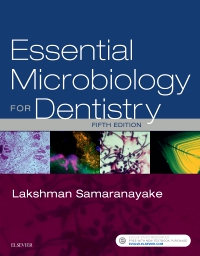

Essential Microbiology for Dentistry - Elsevier eBook on VitalSource, 5th Edition
Elsevier eBook on VitalSource
Now $56.69
The latest edition of this essential textbook continues to support a new generation of dental students in their understanding of microbiom and oral microbiota, basic immunology, oral and systemic infections and cross-infection control.
Fully updated throughout with the latest developments in oral microbiology, microbiomics, disease prevention and control, Essential Microbiology for Dentistry will be essential for all undergraduates studying dentistry as well as anyone undertaking postgraduate training.
New Edition Expected Availability: 05-14-2026

Samaranayake’s Essential Microbiology for Dentistry - Elsevier E-Book on VitalSource
-
- Friendly, accessible writing style helps readers engage with key information
- Helpful self-assessment – in the style of both dental school and RCS exams –enables students to monitor their progress
- Evidenced-based throughout to help facilitate safe clinical practice
- Ample use of artwork helps explain complex structures, physiological processes and the effect of drug intervention
- Helpful use of italics for clinically relevant facts and emboldened key words to highlight important information
- Presents the latest national and international guidelines
- ‘Key Fact’ boxes at the end of each chapter help summarize core information
- Contains a comprehensive glossary and abbreviations list
-
1. Why study microbiology?
PART 1: GENERAL MICROBIOLOGY
2. Bacterial structure and taxonomy
3. Bacterial physiology and genetics
4. Viruses and prions
5. Pathogenesis of microbial disease
6. Diagnostic microbiology and laboratory methods
7. Antimicrobial chemotherapy
PART 2: BASIC IMMUNOLOGY
8. The immune system and the oral cavity
9. The immune response
10. Immunity and infection
PART 3: MICROBES OF RELEVANCE TO DENTISTRY
11. Streptococci, staphylococci and micrococci
12. Lactobacilli, corynebacteria and propionibacteria
13. Actinomycetes, clostridia and Bacillus species
14. Neisseriaceae, Veillonella, parvobacteria and Capnocytophaga
15. Enterobacteria
16. Vibrios, campylobacters and Wolinella
17. Bacteroides, Tannerella, Porphyromonas and Prevotella
18. Fusobacteria, Leptotrichia and spirochaetes
19. Mycobacteria and legionellae
20. Chlamydiae, rickettsiae and mycoplasmas
21. Viruses of relevance to dentistry
22. Fungi of relevance to dentistry
PART 4: INFECTIONS OF RELEVANCE TO DENTISTRY
23. Infections of the respiratory tract
24. Infections of the cardiovascular system
25. Infections of the central nervous and locomotor systems
26. Infections of the gastrointestinal tract
27. Infections of the genitourinary tract
28. Skin and wound infections
29. Viral hepatitis
30. Human immunodeficiency virus infection, AIDS and infections in compromised patients
PART 5: ORAL MICROBIOLOGY
31. Oral microbiome and the oral ecosystem
32. Microbiology of dental caries
33. Microbiology of periodontal disease
34. Dentoalveolar and endodontic infections
35. Oral mucosal and salivary gland infections
PART 6: CROSS INFECTION AND CONTROL
36. Principles of infection control
37. Infection control procedures in dentistry: personal protection, sharps injuries protocol, and immunization
38. Infection control procedures in dentistry: sterilization, disinfection and antisepsis -
-
Ways of Reading
- The appearance of the text and page layout can be modified according to the capabilities of the reading system (font family and font size, spaces between paragraphs, sentences, words, and letters, as well as color of background and text)
- This e-publication is accessible to the full extent that the file format and types of content allow, on a specific reading device, by default, without necessarily including any additions such as textual descriptions of images or enhanced navigation
- No information about nonvisual reading is available
-
Conformance
- No information is available
-
Navigation
- Table of contents to all chapters of the text via links
- Page list to go to pages from the print source version
-
Rich Content
- No information is available
-
Hazards
- No information is available
-
Product Content
- No information is available
-
Legal Considerations
- No information is available
-
Additional Accessibility Information
- Page breaks included from the original print source
- For readers with color vision deficiency, use of color (e.g., in diagrams, graphics and charts, in prompts, or on buttons inviting a response) is not the sole means of graphical distinction or of conveying information
- E-publication includes basic navigation (usually less detailed than TOC-based navigation)
- Where links, controls or buttons are included in the content, the purpose or functionality of each link, control or button is apparent from the associated text alone - or where it is unclear, separate link, control or button descriptions are provided
- All (or substantially all) textual matter is arranged in a single logical reading order (including text that is visually presented as separate from the main text flow, e.g., in boxouts, captions, tables, footnotes, endnotes, citations, etc.). Non-textual content is also linked from within this logical reading order. (Purely decorative non-text content can be ignored).
- The language of the text has been specified (e.g., via the HTML or XML lang attribute) to optimise text-to-speech (and other alternative renderings), both at the whole document level and, where appropriate, for individual words, phrases or passages in a different language.
-
Ways of Reading

 as described in our