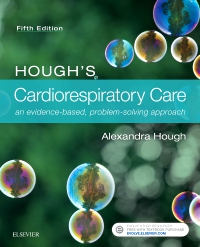

Hough’s Cardiorespiratory Care Elsevier eBook on VitalSource, 5th Edition
Elsevier eBook on VitalSource
The textbook covers a wide range of cardiorespiratory conditions and discusses treatment of patients in different clinical settings such as critical care, the ward area and out-patient departments. It begins with physiology and pathology and progresses into a detailed patient assessment section and a discussion of specific respiratory and cardiac conditions. The final section covers different groups of people who may require physiotherapy such as infants, children, and adults with specific conditions including a considered section on palliative care.
Critical thinking is facilitated by clinical reasoning boxes in the text, and problem-solving is aided by case studies at the end of each chapter. There are also relevant practice tips to enable transfer of learning into the clinical environment. The text is supported by over 280 line drawings and diagrams along with over 70 x-rays and photographs to further illustrate the points under discussion.
New Edition Expected Availability: 08-12-2026

Hough’s Cardiorespiratory Care - Elsevier eBook on VitalSource
-
- Q & A case studies, with scans and x-rays
- Outcome measures for problems and diseases
- Boxes with learning and practice tips to encourage reflection
- Tables with definitions, normal values and comparisons
- Practical techniques described with precision
-
-
-
 Hough’s Cardiorespiratory CarePaperback
-
-
Part 1 Physiology and pathology
1. Physiological basis of clinical practice
2. Assessment
3. Respiratory disorders
4. Cardiovascular disorders
5. General management
Part 2 Physiotherapy techniques
6. Physiotherapy to increase lung volume
7. Physiotherapy to clear secretions
8. Physiotherapy to decrease the work of breathing
9. Pulmonary rehabilitation
10. Physiotherapy for people with cardiovascular disorders
11. Cardiac rehabilitation
Part 3 Surgery
12. Complications
13. Physiotherapy for surgical patients
14. Modifications for different types of surgery
Part 4 Physiotherapy for specific groups of people
15. Infants
16. Children
17. Hyperventilation syndrome
18. Elders with cardiorespiratory disease
19. Palliative respiratory physiotherapy
Part 5 Critical care
20. Critical care, support and monitoring
21. Physiotherapy for critically ill patients
22. Modifications for different disorders
Part 6 Evaluation of cardiorespiratory physiotherapy
23. Does it work?
Glossary of abbreviations, definitions, symbols and values -
-
Ways of Reading
- The appearance of the text and page layout can be modified according to the capabilities of the reading system (font family and font size, spaces between paragraphs, sentences, words, and letters, as well as color of background and text)
- This e-publication is accessible to the full extent that the file format and types of content allow, on a specific reading device, by default, without necessarily including any additions such as textual descriptions of images or enhanced navigation
- No information about nonvisual reading is available
-
Conformance
- No information is available
-
Navigation
- Table of contents to all chapters of the text via links
- Page list to go to pages from the print source version
-
Rich Content
- No information is available
-
Hazards
- No information is available
-
Product Content
- No information is available
-
Legal Considerations
- No information is available
-
Additional Accessibility Information
- Page breaks included from the original print source
- For readers with color vision deficiency, use of color (e.g., in diagrams, graphics and charts, in prompts, or on buttons inviting a response) is not the sole means of graphical distinction or of conveying information
- E-publication includes basic navigation (usually less detailed than TOC-based navigation)
- Where links, controls or buttons are included in the content, the purpose or functionality of each link, control or button is apparent from the associated text alone - or where it is unclear, separate link, control or button descriptions are provided
- All (or substantially all) textual matter is arranged in a single logical reading order (including text that is visually presented as separate from the main text flow, e.g., in boxouts, captions, tables, footnotes, endnotes, citations, etc.). Non-textual content is also linked from within this logical reading order. (Purely decorative non-text content can be ignored).
- The language of the text has been specified (e.g., via the HTML or XML lang attribute) to optimise text-to-speech (and other alternative renderings), both at the whole document level and, where appropriate, for individual words, phrases or passages in a different language.
-
Ways of Reading

 as described in our