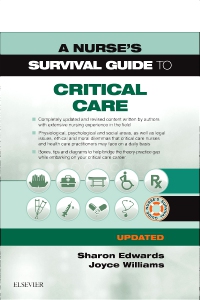

A Nurse's Survival Guide to Critical Care - Updated Edition Elsevier eBook on Vitalsource, 1st Edition
Elsevier eBook on VitalSource
Are you a starting work in critical care? Are you an experienced nurse but need to check guidelines and best practices?
This is the indispensable guide to daily procedures and problems faced by nurses working in this specialty.
This book will help you to
- Organise your job and yourself
- Assess patients and communicate with them
- Get clinical information on a wide range of conditions
- What to do in emergency
This UPDATED edition:
- Completely updated and revised content written by authors with extensive nursing experience in the field
- Physiological, psychological and social areas, as well as legal issues, ethical and moral dilemmas that critical care nurses and health care practitioners may face on a daily basis
- Boxes, tips and diagrams to help bridge the theory-practice gap while embarking on your critical care career.
Part of the A Nurse’s Survival Guide series
-
- Completely updated and revised content written by authors with extensive nursing experience in the field
- Physiological, psychological and social areas, as well as legal issues, ethical and moral dilemmas that critical care nurses and health care practitioners may face on a daily basis
- Boxes, tips and diagrams to help bridge the theory-practice gap while embarking on your critical care career
-
Section 1 - General principles of critical care
1.1. Introduction to critical care nursing
1.2. Health and Safety
1.3. Emergencies and life-threatening conditions
1.4. Life threatening complications/ outcomes
Section 2 - Patient assessment and investigations
2.1. Identification of patient needs/problems
2.2. Assessment
2.3. Haemodynamic monitoring
2.4. Diagnostic procedures
Section 3 - Critical care interventions
3.1. Medium-technology life-support interventions
3.2. High-technology life-support interventions
3.3. Caring for a critical care patient
3.4. Intubation and ventilation
3.5. Transfer of critical care patients
Section 4 - Common conditions/reasons for admission
4.1. Physiological processes common to all medical and surgical conditions
4.2. Neurological
4.3. Endocrine disorders
4.4. Respiratory
4.5. Cardiovascular
4.6. Renal
4.7. Gastrointestinal (GIT)
4.8. Immunological
4.9. Burns
4.10. Poisoning/overdose
Section 5 - Psychological and ethical care
5.1. Mental effects of critical care
5.2. Death and dying in critical care
5.3. Professional practice issues
Section 6 - Pharmacology
6.1. Medication management
6.2. Pharmacokinetics and pharmacodynamics
6.3. Classification of drugs used in critical care
6.4. Drug calculations
6.5. Nurse prescribing
References
Further Reading
Appendix
1. Units of measurement
2. Normal values
3. Drug measurement and calculations -
-
Ways of Reading
- The appearance of the text and page layout can be modified according to the capabilities of the reading system (font family and font size, spaces between paragraphs, sentences, words, and letters, as well as color of background and text)
- This e-publication is accessible to the full extent that the file format and types of content allow, on a specific reading device, by default, without necessarily including any additions such as textual descriptions of images or enhanced navigation
- No information about nonvisual reading is available
-
Conformance
- No information is available
-
Navigation
- Table of contents to all chapters of the text via links
- Page list to go to pages from the print source version
-
Rich Content
- No information is available
-
Hazards
- No information is available
-
Product Content
- No information is available
-
Legal Considerations
- No information is available
-
Additional Accessibility Information
- Page breaks included from the original print source
- For readers with color vision deficiency, use of color (e.g., in diagrams, graphics and charts, in prompts, or on buttons inviting a response) is not the sole means of graphical distinction or of conveying information
- E-publication includes basic navigation (usually less detailed than TOC-based navigation)
- Where links, controls or buttons are included in the content, the purpose or functionality of each link, control or button is apparent from the associated text alone - or where it is unclear, separate link, control or button descriptions are provided
- All (or substantially all) textual matter is arranged in a single logical reading order (including text that is visually presented as separate from the main text flow, e.g., in boxouts, captions, tables, footnotes, endnotes, citations, etc.). Non-textual content is also linked from within this logical reading order. (Purely decorative non-text content can be ignored).
- The language of the text has been specified (e.g., via the HTML or XML lang attribute) to optimise text-to-speech (and other alternative renderings), both at the whole document level and, where appropriate, for individual words, phrases or passages in a different language.
-
Ways of Reading

 as described in our