ISBN:
9780702076909
Copyright:
2021
Publication Date:
03-23-2020
Page Count:
528
Imprint:
Elsevier
List Price:
$73.99

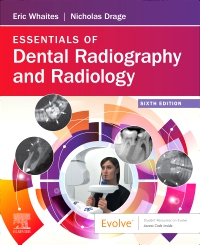
Essentials of Dental Radiography and Radiology Elsevier eBook on Vitalsource, 6th Edition
by Eric Whaites, MSc BDS(Hons) FDSRCS(Edin) FDSRCS(Eng) FRCR DDRRCR and Nicholas Drage, BDS, FDS RCS(Eng), FDS RCPSG, DDR RCR
Elsevier eBook on VitalSource
ISBN:
9780702076909
Copyright:
2021
Publication Date:
03-23-2020
Page Count:
528
Imprint:
Elsevier
List Price:
$73.99
Most review copies are eBooks – how fast!
A review copy request is most likely to be fulfilled as an eBook on VitalSource rather than a print product, unless no eBook is available. eBooks become available in as little as a few hours. Print products will take between 7 and 10 days to arrive. To request a print copy, please contact us through the Evolve Support Center for further assistance or contact your Elsevier Sales Rep.
This highly popular text presents everything that an undergraduate dental student, postgraduate student or general dental practitioner needs to know in order to safely capture high-quality clinical images and accurately interpret their findings.
In this latest edition, both traditional methods of imaging and new modalities are explored - specifically cone beam CT - and a new author has been brought on board to bring a fresh approach to the subject area.
Written in an accessible manner, which avoids unnecessary detail, each page spread has been carefully designed to ensure clarity of understanding by the reader to facilitate both examination success and confidence and safety in the clinical situation. Topics address the whole BDS curriculum and range from the physics of imaging and radiation protection to infection control and regional image interpretation.
Perfect for undergraduate students, post-graduate students, specialist trainees and general dental practitioners alike, Essentials of Dental Radiography and Radiology has become the ‘must-have’ volume for all readers who practise or who intend to practise clinical dentistry.
In this latest edition, both traditional methods of imaging and new modalities are explored - specifically cone beam CT - and a new author has been brought on board to bring a fresh approach to the subject area.
Written in an accessible manner, which avoids unnecessary detail, each page spread has been carefully designed to ensure clarity of understanding by the reader to facilitate both examination success and confidence and safety in the clinical situation. Topics address the whole BDS curriculum and range from the physics of imaging and radiation protection to infection control and regional image interpretation.
Perfect for undergraduate students, post-graduate students, specialist trainees and general dental practitioners alike, Essentials of Dental Radiography and Radiology has become the ‘must-have’ volume for all readers who practise or who intend to practise clinical dentistry.
New Edition Expected Availability: 01-20-2026

Whaites’ Essentials of Dental Radiography and Radiology - Elsevier E-Book on VitalSource
Elsevier eBook on VitalSource
ISBN: 9780443505836
-
- Provides a comprehensive account of the radiology and radiography topics usually examined at undergraduate and postgraduate level
- Clear and accessible approach to the subject makes learning especially easy
- More than 1100 illustrations – many of them updated - present clinical, diagnostic and practical information in an accessible manner
- Contains recent classifications and advanced imaging modalities including cone beam CT imaging techniques
-
Part 1 Introduction
1. The radiographic image
Part 2 Radiation physics, equipment and radiation protection
2. The production, properties and interactions of X-rays
3. Dental X-ray generating equipment
4. Image receptors
5. Imaging processing
6. Radiation dose, dosimetry and dose limitation
7. The biological effects associated with X-rays, risk and practical radiation protection
Part 3 Radiography
8. Dental radiography - general patient considerations including control of infection
9. Periapical radiography
10. Bitewing radiography
11. Occlusal radiography
12. Oblique lateral radiography
13. Skull and maxillofacial radiography
14. Cephalometric radiography
15. Tomography and panoramic radiography
16. Cone beam computed tomography (CBCT)
17. The quality of radiographic images and quality assurance
18. Alternative and specialized imaging modalities
Part 4 Radiology
19. Introduction to radiological interpretation
20. Dental caries and the assessment of restorations
21. The periapical tissues
22. The periodontal tissues and periodontal disease
23. Implant assessment
24. Developmental abnormalities
25. Radiological differential diagnosis - describing a lesion
26. Differential diagnosis of radiolucent lesions of the jaws
27. Differential diagnosis of lesions of variable radiopacity in the jaws
28. Bone diseases of radiological importance
29. Trauma to the teeth and facial skeleton
30. The temporomandibular joint
31. The maxillary antra
32. The salivary gland -
-
Ways of Reading
- The appearance of the text and page layout can be modified according to the capabilities of the reading system (font family and font size, spaces between paragraphs, sentences, words, and letters, as well as color of background and text)
- This e-publication is accessible to the full extent that the file format and types of content allow, on a specific reading device, by default, without necessarily including any additions such as textual descriptions of images or enhanced navigation
- No information about nonvisual reading is available
-
Conformance
- No information is available
-
Navigation
- Table of contents to all chapters of the text via links
- Page list to go to pages from the print source version
-
Rich Content
- No information is available
-
Hazards
- No information is available
-
Product Content
- No information is available
-
Legal Considerations
- No information is available
-
Additional Accessibility Information
- Page breaks included from the original print source
- For readers with color vision deficiency, use of color (e.g., in diagrams, graphics and charts, in prompts, or on buttons inviting a response) is not the sole means of graphical distinction or of conveying information
- E-publication includes basic navigation (usually less detailed than TOC-based navigation)
- Where links, controls or buttons are included in the content, the purpose or functionality of each link, control or button is apparent from the associated text alone - or where it is unclear, separate link, control or button descriptions are provided
- All (or substantially all) textual matter is arranged in a single logical reading order (including text that is visually presented as separate from the main text flow, e.g., in boxouts, captions, tables, footnotes, endnotes, citations, etc.). Non-textual content is also linked from within this logical reading order. (Purely decorative non-text content can be ignored).
- The language of the text has been specified (e.g., via the HTML or XML lang attribute) to optimise text-to-speech (and other alternative renderings), both at the whole document level and, where appropriate, for individual words, phrases or passages in a different language.
-
Ways of Reading
Most review copies are eBooks – how fast!
A review copy request is most likely to be fulfilled as an eBook on VitalSource rather than a print product, unless no eBook is available. eBooks become available in as little as a few hours. Print products will take between 7 and 10 days to arrive. To request a print copy, please contact us through the Evolve Support Center for further assistance or contact your Elsevier Sales Rep.

 as described in our