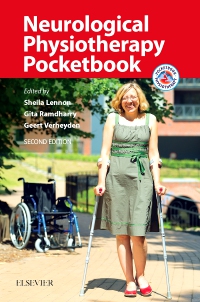

Neurological Physiotherapy Pocketbook Elsevier eBook on VitalSource, 2nd Edition
Elsevier eBook on VitalSource
Now $23.09
The second edition of the Neurological Physiotherapy Pocketbook is the only book for physiotherapists that provides essential evidence-based information in a unique and easy-to-use format for the current evidence in clinical settings.
Written by new international editors and contributors, this pocketbook provides quick and easy access to essential clinical information.
Key feature:
- Pocketbook size for when out on clinical placement or working in clinical practice
- Revised and brand new chapters on neurological rehabilitation and essential components
- Concentrates on the six most common conditions, including stroke, traumatic brain and spinal cord injury
- Use of case studies to illustrate specifics of assessment, management and recommended measurement tools
Together with the textbook Physical Management for Neurological Conditions 4E, it presents all essential components and conditions for undergraduates and therapists working in neurological clinical practice.
-
- Background Knowledge including common neurological conditions, neural plasticity, and common motor impairments and their impact on activity
- Clinical Decision Making including assessment and treatment of the acute patient before and during stabilisation; the acute patient with potential for recovery; and the patient with degenerative disease
- Respiratory, communication, cognitive and orthotic management
- Medical investigations and drug treatments
- A glossary of terms and abbreviations
-
-
 Neurological Physiotherapy PocketbookPaperback
-
-
Section 1. Background Knowledge
1. Guiding principles of neurorehabilitation
2. Motor control: structure & function of the nervous system
3. Motor training
4. Neurological assessment
5. Clinical Neurology & Neurological Investigations
6. Management of Common Neurological Impairments, and their impact on activity.
7. Respiratory management
Section 2. Management of common clinical problems: precis from physical management book
8. Stroke
9. Traumatic brain Injury
10. Spinal cord injury
11. Multiple sclerosis
12. Parkinson's disease
13. Guillain barre syndrome -
-
Ways of Reading
- The appearance of the text and page layout can be modified according to the capabilities of the reading system (font family and font size, spaces between paragraphs, sentences, words, and letters, as well as color of background and text)
- This e-publication is accessible to the full extent that the file format and types of content allow, on a specific reading device, by default, without necessarily including any additions such as textual descriptions of images or enhanced navigation
- No information about nonvisual reading is available
-
Conformance
- No information is available
-
Navigation
- Table of contents to all chapters of the text via links
- Page list to go to pages from the print source version
-
Rich Content
- No information is available
-
Hazards
- No information is available
-
Product Content
- No information is available
-
Legal Considerations
- No information is available
-
Additional Accessibility Information
- Page breaks included from the original print source
- For readers with color vision deficiency, use of color (e.g., in diagrams, graphics and charts, in prompts, or on buttons inviting a response) is not the sole means of graphical distinction or of conveying information
- E-publication includes basic navigation (usually less detailed than TOC-based navigation)
- Where links, controls or buttons are included in the content, the purpose or functionality of each link, control or button is apparent from the associated text alone - or where it is unclear, separate link, control or button descriptions are provided
- All (or substantially all) textual matter is arranged in a single logical reading order (including text that is visually presented as separate from the main text flow, e.g., in boxouts, captions, tables, footnotes, endnotes, citations, etc.). Non-textual content is also linked from within this logical reading order. (Purely decorative non-text content can be ignored).
- The language of the text has been specified (e.g., via the HTML or XML lang attribute) to optimise text-to-speech (and other alternative renderings), both at the whole document level and, where appropriate, for individual words, phrases or passages in a different language.
-
Ways of Reading

 as described in our