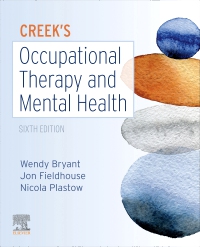

Creek's Occupational Therapy and Mental Health Elsevier eBook on VitalSource, 6th Edition
Elsevier eBook on VitalSource
Now $47.59
Promoting and maintaining mental health continues to be a key challenge in the world today. Creek's Occupational Therapy and Mental Health is essential reading for students and practitioners across a wide range of health professions, capturing contemporary practice in mental health settings. Now fully updated in its sixth edition, it retains the clarity and scholarship associated with the renowned occupational therapist Jennifer Creek while delivering new knowledge in a fresh perspective.
Here readers can find everything they need on mental health for learning, practice, and continuing professional development. Complex topics are presented in an accessible and concise style without being oversimplified, aided by summaries, case studies, and questions that prompt critical reflection. The text has been carefully authored and edited by expert international educators and practitioners of occupational therapy, as well as a diverse range of other backgrounds. Service users have also co-authored chapters and commentaries. Evidence-based links between theory and practice are reinforced throughout.
This popular title will be an indispensable staple that OTs will keep and refer to time and again.
-
- Relevant to practice - outlines a variety of therapeutic interventions and discusses the implications of a wide range of contexts
- New chapters on eating disorders, cognitive/learning-based approaches and being a therapist
- Extended service user commentaries
- Expanded scope to accommodate diverse psychosocial perspectives and culturally-sensitive practices
- New questions for readers in every chapter
- Key reading and reference lists to encourage and facilitate in-depth study
-
Section 1 INFORMING PHILOSOPHY AND THEORY
1. A HISTORY OF OCCUPATIONAL THERAPY AND PSYCHIATRY IN IRELAND
2. THE GROUNDS FOR OCCUPATIONAL THERAPY
3. BEING A THERAPIST
Section 2 THE OCCUPATIONAL THERAPY PROCESS
4. STRUCTURING PRACTICE
5. ASSESSMENT AND OUTCOME MEASUREMENT
6. PLANNING AND IMPLEMENTING INTERVENTIONS
Section 3 THE CONTEXT OF OCCUPATIONAL THERAPY
7. MANAGEMENT AND LEADERSHIP
8. PROFESSIONAL ACCOUNTABILITY
9. ETHICS IN PRACTICE AND RESEARCH
10. PERSPECTIVES ON USING SERVICES
11. TEACHING AND LEARNING
12. INTERSECTIONALITY
Section 4 OCCUPATIONS
13. PHYSICAL ACTIVITY
14. LIFE-LONG LEARNING
15. CLIENT-CENTRED GROUPS
16. CREATIVE ACTIVITIES
17. PLAY
18. SELF-CARE
19. NATURE-BASED PRACTICE
20. WORK
Section 5 PEOPLE AND SETTINGS
21. THE ACUTE SETTING
22. COMMUNITY PRACTICE
23. OLDER PEOPLE
24. CHILDREN AND YOUNG PEOPLE
25. INTELLECTUAL (LEARNING)DISABILITIES
26. FORENSIC AND PRISON SERVICES
27. SUBSTANCE USE
28. EATING DISORDERS
29. WORKING ON THE MARGINS -
-
Ways of Reading
- The appearance of the text and page layout can be modified according to the capabilities of the reading system (font family and font size, spaces between paragraphs, sentences, words, and letters, as well as color of background and text)
- This e-publication is accessible to the full extent that the file format and types of content allow, on a specific reading device, by default, without necessarily including any additions such as textual descriptions of images or enhanced navigation
- No information about nonvisual reading is available
-
Conformance
- No information is available
-
Navigation
- Table of contents to all chapters of the text via links
- Page list to go to pages from the print source version
-
Rich Content
- No information is available
-
Hazards
- No information is available
-
Product Content
- No information is available
-
Legal Considerations
- No information is available
-
Additional Accessibility Information
- Page breaks included from the original print source
- For readers with color vision deficiency, use of color (e.g., in diagrams, graphics and charts, in prompts, or on buttons inviting a response) is not the sole means of graphical distinction or of conveying information
- E-publication includes basic navigation (usually less detailed than TOC-based navigation)
- Where links, controls or buttons are included in the content, the purpose or functionality of each link, control or button is apparent from the associated text alone - or where it is unclear, separate link, control or button descriptions are provided
- All (or substantially all) textual matter is arranged in a single logical reading order (including text that is visually presented as separate from the main text flow, e.g., in boxouts, captions, tables, footnotes, endnotes, citations, etc.). Non-textual content is also linked from within this logical reading order. (Purely decorative non-text content can be ignored).
- The language of the text has been specified (e.g., via the HTML or XML lang attribute) to optimise text-to-speech (and other alternative renderings), both at the whole document level and, where appropriate, for individual words, phrases or passages in a different language.
-
Ways of Reading


 as described in our