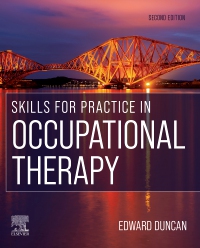

Skills for Practice in Occupational Therapy Elsevier eBook on VitalSource, 2nd Edition
Elsevier eBook on VitalSource
Now $36.39
Skills for Practice in Occupational Therapy is an essential companion for all students and newly qualified practitioners working in the complicated field of occupational therapy.
Written by Edward Duncan of the University of Stirling, the book provides a practical and pragmatic guide to becoming a successful practitioner. It covers everything from thinking and judgement to decision making, evidence-based practice and research skills, and leadership and management. It also guides the reader toward effective career advancement, getting their work noticed, and staying up to date in their field.
This book is a companion to Duncan’s Foundations for Practice in Occupational Therapy, and provides the practical applications of the theory covered in that text.
-
- Completely updated to align with current practice in occupational therapy
- Chapters structured for easy navigation
- Practical examples and/or vignettes bring the text to life
- Highlight boxes demystify concepts for students new to the area
- Easy to read and engaging throughout
- Well-referenced, links practice to theory and evidence
- New content on goal setting, social media and implementation research
-
1. Introduction
SECTION 1 Thinking, Judgement and Decision Skills for Practice
2. Judgement and Decision-Making Skills for Practice
3. Shared Decision-Making Skills in Practice
4. Doing Reflective Practice: Being a Reflective and Resilient Practitioner
SECTION 2 Professional Skills for Practice
5. Assessment Skills for Practice
6. Activity Analysis
7. Goal Setting in Occupational Therapy: A Client-Centred Perspective
8. Therapeutic Use of Self: A Model of the Intentional Relationship
9. Problem Solving
10. Group Skills for Practice in Occupational Therapy
11. Record and Report Writing
SECTION 3 Evidence-Based and Research Skills for Practice
12. Finding and Appraising the Evidence
13. Implementation Science
SECTION 4 Leadership, Supervision and Management Skills for Practice
14. Improvement Science in Practice
15. Developing Research Skills in Practice
16. Presentation and Publication Skills
17. Self-Care and Self-Management
18. Leadership Skills
19. Practice Education—Skills for Students and Educators
20. Clinical Supervision Skills
21. Professional Use of Social Media -
-
Ways of Reading
- The appearance of the text and page layout can be modified according to the capabilities of the reading system (font family and font size, spaces between paragraphs, sentences, words, and letters, as well as color of background and text)
- This e-publication is accessible to the full extent that the file format and types of content allow, on a specific reading device, by default, without necessarily including any additions such as textual descriptions of images or enhanced navigation
- No information about nonvisual reading is available
-
Conformance
- No information is available
-
Navigation
- Table of contents to all chapters of the text via links
- Page list to go to pages from the print source version
-
Rich Content
- No information is available
-
Hazards
- No information is available
-
Product Content
- No information is available
-
Legal Considerations
- No information is available
-
Additional Accessibility Information
- Page breaks included from the original print source
- For readers with color vision deficiency, use of color (e.g., in diagrams, graphics and charts, in prompts, or on buttons inviting a response) is not the sole means of graphical distinction or of conveying information
- E-publication includes basic navigation (usually less detailed than TOC-based navigation)
- Where links, controls or buttons are included in the content, the purpose or functionality of each link, control or button is apparent from the associated text alone - or where it is unclear, separate link, control or button descriptions are provided
- All (or substantially all) textual matter is arranged in a single logical reading order (including text that is visually presented as separate from the main text flow, e.g., in boxouts, captions, tables, footnotes, endnotes, citations, etc.). Non-textual content is also linked from within this logical reading order. (Purely decorative non-text content can be ignored).
- The language of the text has been specified (e.g., via the HTML or XML lang attribute) to optimise text-to-speech (and other alternative renderings), both at the whole document level and, where appropriate, for individual words, phrases or passages in a different language.
-
Ways of Reading


 as described in our