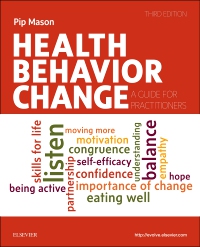

Health Behavior Change Elsevier eBook on VitalSource, 3rd Edition
Elsevier eBook on VitalSource
Now $26.59
Based upon a tried and tested framework of intervention, Health Behavior Change, third edition, brings together the field of communication, the study of motivation and how people change, and insights derived from listening to and observing patients over many years, to provide a helpful source of advice on how to encourage individuals to embrace behaviour change and then maintain it.
This popular paperback is written in a friendly and accessible writing style, and contains an abundance of ‘real-life’ clinical cases, sample interviews, and the latest evidence-base regarding best practice. The book also contains information on learning the necessary techniques, overcoming personal barriers to success, and how to use the techniques in a wide variety of settings. Learning aids include ‘Useful Questions’ boxes, to help learners structure consultations, ‘Key Points’ boxes, to summarise the crucial ‘take home’ message, and ‘What to Avoid’ boxes, which give the benefit of extensive experience.
The new edition now comes with an EVOLVE© website which contains a helpful video demonstration of a successful interview, an explanatory transcript of which is given within the book, and downloadable Patient Worksheets.
Suitable for a wide-ranging readership ranging from primary care physicians and nurses to physiotherapists and sports therapists, this book will be perfect for use in the primary care setting, inpatient or outpatient departments, community health projects, the A&E department, leisure facilities and occupational health clinics.
-
- NEW! Nora AI - an AI-powered learning assistant exclusive to Elsevier ebooks on VitalSource's Bookshelf® platform - offers built-in AI learning support that provides personalized answers based on content from the Elsevier ebook
- Perfect for brief consultations in the healthcare and sports setting
- Abundance of practical examples – showing both good and bad practice – illustrate how the techniques can be used to optimum effect even with patients who are ‘difficult to reach’
- Useful ‘dialogue’ between practitioner and patient illustrate points of theory
- Contains a chapter on how to learn the technique, including potential barriers to success
- Discusses the frustrations encountered in practice and provides practical tips on how to control emotion
- Ideal for use in the primary care setting, inpatient or outpatient departments, community health projects, the A&E department, leisure facilities or occupational health clinics
-
1. Introduction
2. Principles
3. Getting started; rapport and agendas
4. Assessing importance, confidence and readiness
5. Exploring importance and building confidence
6. Exchanging information
7. Reducing resistance
8. Ending the consultation
9. Common clinical encounters
10. Learning to practice this approach
11. Calls from the consulting room
12. Example of a consultation
Appendices: Practitioner and Patient Worksheets -
-
Ways of Reading
- The appearance of the text and page layout can be modified according to the capabilities of the reading system (font family and font size, spaces between paragraphs, sentences, words, and letters, as well as color of background and text)
- This e-publication is accessible to the full extent that the file format and types of content allow, on a specific reading device, by default, without necessarily including any additions such as textual descriptions of images or enhanced navigation
- No information about nonvisual reading is available
-
Conformance
- No information is available
-
Navigation
- Table of contents to all chapters of the text via links
- Page list to go to pages from the print source version
-
Rich Content
- No information is available
-
Hazards
- No information is available
-
Product Content
- No information is available
-
Legal Considerations
- No information is available
-
Additional Accessibility Information
- Page breaks included from the original print source
- For readers with color vision deficiency, use of color (e.g., in diagrams, graphics and charts, in prompts, or on buttons inviting a response) is not the sole means of graphical distinction or of conveying information
- E-publication includes basic navigation (usually less detailed than TOC-based navigation)
- Where links, controls or buttons are included in the content, the purpose or functionality of each link, control or button is apparent from the associated text alone - or where it is unclear, separate link, control or button descriptions are provided
- All (or substantially all) textual matter is arranged in a single logical reading order (including text that is visually presented as separate from the main text flow, e.g., in boxouts, captions, tables, footnotes, endnotes, citations, etc.). Non-textual content is also linked from within this logical reading order. (Purely decorative non-text content can be ignored).
- The language of the text has been specified (e.g., via the HTML or XML lang attribute) to optimise text-to-speech (and other alternative renderings), both at the whole document level and, where appropriate, for individual words, phrases or passages in a different language.
-
Ways of Reading


 as described in our