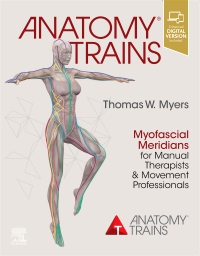

Anatomy Trains - Elsevier eBook on VitalSource, 4th Edition
Elsevier eBook on VitalSource
Now $82.79
Get a multi-dimensional understanding of musculoskeletal anatomy with Anatomy Trains: Myofascial Meridians for Manual Therapists & Movement Professionals, 4th Edition. This hugely successful, one-of-a-kind title continues to center on the application of anatomy trains across a variety of clinical assessment and treatment approaches — demonstrating how painful problems in one area of the body can be linked to a "silent area" away from the problem, and ultimately giving rise to new treatment strategies. This edition has been fully updated with the latest evidence-based research and includes new coverage of anatomy trains in motion using Pilates-evolved movement, anatomy trains in horses and dogs, and the updated fascial compendium on elements, properties, neurology, and origins of the fascial system. It also offers a new, larger library of videos, including animations and webinars with the author. In all, this unique exploration of the role of fascial in healthy movement and postural distortion is an essential read for physical therapists, massage therapists, craniosacral therapists, yoga instructors, osteopathologists, manual therapists, athletic and personal trainers, dance instructors, chiropractors, acupuncturists, and any professional working in the field of movement.
-
- New photos and images of fascial tissues, adhesions, and layers provide a better understanding of text content
- Revised and expanded content reflects the most up-to-date research and latest evidence for the scientific basis of common clinical findings
- New, larger library of videos includes animations and webinars with the author
- New Anatomy Trains in Motion section by guest author Karin Gurtner uses Pilates-evolved movement to explore strength and plasticity along myofascial meridians
- New addition: Anatomy Trains in Quadrupeds (horses and dogs) is mapped for equine and pet therapies by Rikke Schultz, DVM, Tove Due, DVM, and Vibeke Elbrønd, DVM, PhD
- New appendix: Updated fascial compendium on elements, properties, neurology, and origins of the fascial system
- NEW! enhanced eBook version is included with print purchase, which allows students to access all of the text, figures, and references from the book on a variety of devices
-
- Revolutionary approach to the study of human anatomy provides a holistic map of myoanatomy to help improve the outcomes of physical therapies that are traditionally used to manage pain and other musculoskeletal disorders
- Relevant theory descriptions are applied to all common types of movement, posture analysis, and physical treatment modalities
- Intuitive content organization allows students to reference the concept quickly or gain a more detailed understanding of any given area according to need
- Section on myofascial force transmission in gait dynamics is written by guest author James Earls
- Robust appendices discuss the relevance of the Anatomy Trains concept to the work of Dr Louis Schultz (Meridians of Latitude), Ida Rolf (Structural Integration), and correspondences with acupuncture meridians
-
-
 Evolve Resources for Anatomy TrainsResources
 -
 Anatomy TrainsPaperback
-
-
Video list
1. Laying the Railbed
2. The Rules of the Road
3. The Superficial Back Line
4. The Superficial Front Line
5. The Lateral Line
6. The Spiral Line
7. The Arm Lines
8. The Functional Lines
9. The Deep Front Line
10. Anatomy Trains in Training
With contributions by James Earls and Karin Gurtner
11. BodyReading® – Structural Analysis
Appendix 1: Fascia and Biomechanical Regulation
Appendix 2: A Note on the Meridians of Latitude
Appendix 3: Structural Integration
Appendix 4: Myofascial Meridians and Asian Medicine
Appendix 5: Anatomy Trains in Quadrupeds - Initial investigations
By Rikke Schultz, Tove Due, and Vibeke Elbrønd
Anatomy Trains Terms
Bibliography -
-
Ways of Reading
- The appearance of the text and page layout can be modified according to the capabilities of the reading system (font family and font size, spaces between paragraphs, sentences, words, and letters, as well as color of background and text)
- This e-publication is accessible to the full extent that the file format and types of content allow, on a specific reading device, by default, without necessarily including any additions such as textual descriptions of images or enhanced navigation
- No information about nonvisual reading is available
-
Conformance
- No information is available
-
Navigation
- Table of contents to all chapters of the text via links
- Page list to go to pages from the print source version
-
Rich Content
- No information is available
-
Hazards
- No information is available
-
Product Content
- No information is available
-
Legal Considerations
- No information is available
-
Additional Accessibility Information
- Page breaks included from the original print source
- For readers with color vision deficiency, use of color (e.g., in diagrams, graphics and charts, in prompts, or on buttons inviting a response) is not the sole means of graphical distinction or of conveying information
- E-publication includes basic navigation (usually less detailed than TOC-based navigation)
- Where links, controls or buttons are included in the content, the purpose or functionality of each link, control or button is apparent from the associated text alone - or where it is unclear, separate link, control or button descriptions are provided
- All (or substantially all) textual matter is arranged in a single logical reading order (including text that is visually presented as separate from the main text flow, e.g., in boxouts, captions, tables, footnotes, endnotes, citations, etc.). Non-textual content is also linked from within this logical reading order. (Purely decorative non-text content can be ignored).
- The language of the text has been specified (e.g., via the HTML or XML lang attribute) to optimise text-to-speech (and other alternative renderings), both at the whole document level and, where appropriate, for individual words, phrases or passages in a different language.
-
Ways of Reading

 as described in our