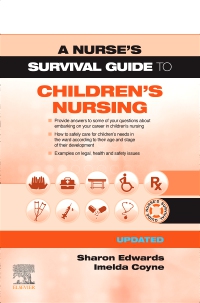

A Survival Guide to Children's Nursing - Updated Edition Elsevier eBook on VitalSource, 1st Edition
Elsevier eBook on VitalSource
Now $23.09
Are you working as a children’s nurse or doing a placement on a children’s ward? Are you studying to become a great professional involved in nursing children and young people? This user friendly, easy to carry textbook is a practical and evidence-based guide which provides those in the early stages of their careers with clinical information and insights.
This book will help you to:
- Gather all the information you need to work with patients, in a concise and structure way;
- Obtain the knowledge required and clinical skills needed on a wide range of conditions;
- Have an excellent starting point and great revision aid to refer to when in doubt;
What will you find in this UPDATED edition:
- Answers to some of your questions about embarking on your career into children’s nursing;
- How to satisfy children’s requirements and needs in the ward according to their age and stage of their development;
- Examples on legal, health and safety issues;
- Completely updated and revised content written by authors with extensive nursing experience in the field.
Part of the A Nurse’s Survival Guide series
-
What will you find in this UPDATED edition:
- Answers to some of your questions about embarking on your career into children’s nursing
- How to safely care for children’s needs in the ward according to their age and stage of their development
- Examples on legal, health and safety issues
- Completely updated and revised content written by authors with extensive nursing experience in the field.
Part of the A Nurse’s Survival Guide series
-
1 General principles of children’s nursing
1.1: Introduction
1.2: Health and Safety
1.3: Emergency care of a child
1.4: Life threatening complications
2 Assessment and investigations of a child
2.1: Paediatric scoring systems
2.2: Assessment of a child
2.3: Haemodynamic monitoring of a child
2.4: Diagnostic procedures
3 Children’s nursing interventions
3.1: General interventions
3.2: Specific interventions
3.3: Caring for a child in a variety of situations
3.4: Caring for a child in a variety of settings
4 Common conditions in children and reasons for admission
4.1: General condition in children: a systems approach
4.2: Other conditions observed in children
4.3: Mental health conditions in children
5 Psychological and ethical care
5.1: Professional and practice issues
5.2: Psychosocial issues
5.3: Palliative care of a child
6 Drug administration
6.1: General aspects
6.2: Pharmacokinetics and pharmacodynamics
6.3: Classification of drugs used in children
6.4: Medication management
Appendix
1. Normal vital signs
2. Units of measurement
3. Drug measurement and calculations -
-
Ways of Reading
- The appearance of the text and page layout can be modified according to the capabilities of the reading system (font family and font size, spaces between paragraphs, sentences, words, and letters, as well as color of background and text)
- This e-publication is accessible to the full extent that the file format and types of content allow, on a specific reading device, by default, without necessarily including any additions such as textual descriptions of images or enhanced navigation
- No information about nonvisual reading is available
-
Conformance
- No information is available
-
Navigation
- Table of contents to all chapters of the text via links
- Page list to go to pages from the print source version
-
Rich Content
- No information is available
-
Hazards
- No information is available
-
Product Content
- No information is available
-
Legal Considerations
- No information is available
-
Additional Accessibility Information
- Page breaks included from the original print source
- For readers with color vision deficiency, use of color (e.g., in diagrams, graphics and charts, in prompts, or on buttons inviting a response) is not the sole means of graphical distinction or of conveying information
- E-publication includes basic navigation (usually less detailed than TOC-based navigation)
- Where links, controls or buttons are included in the content, the purpose or functionality of each link, control or button is apparent from the associated text alone - or where it is unclear, separate link, control or button descriptions are provided
- All (or substantially all) textual matter is arranged in a single logical reading order (including text that is visually presented as separate from the main text flow, e.g., in boxouts, captions, tables, footnotes, endnotes, citations, etc.). Non-textual content is also linked from within this logical reading order. (Purely decorative non-text content can be ignored).
- The language of the text has been specified (e.g., via the HTML or XML lang attribute) to optimise text-to-speech (and other alternative renderings), both at the whole document level and, where appropriate, for individual words, phrases or passages in a different language.
-
Ways of Reading


 as described in our