ISBN:
9780702080050
Copyright:
2023
Publication Date:
09-16-2022
Page Count:
222
Imprint:
Elsevier
List Price:
$37.99

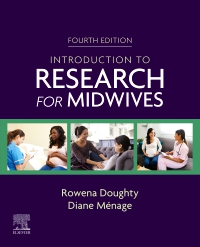
Introduction to Research for Midwives - Elsevier eBook on VitalSource, 4th Edition
by Rowena Doughty and Diane Ménage
Elsevier eBook on VitalSource
ISBN:
9780702080050
Copyright:
2023
Publication Date:
09-16-2022
Page Count:
222
Imprint:
Elsevier
List Price:
$37.99
Was
$37.99
Now $26.59
Or $0.00 with a valid access code
With an increasing expectation that all health professionals, including midwives, will base their practice on evidence, this popular book demystifies the world of research for midwives in the UK.
Introduction to Research for Midwives is a highly regarded resource that helps the reader develop their research skills and guides them toward using evidence effectively in their clinical work. Written clearly and simply, it covers research methods and processes, critical evaluation of research, and application of research to practice.
This book is suitable for both students and practising midwives, whether they are producers or end-users of research, or simply need to understand how to critique research articles and produce literature reviews.
-
- NEW! Nora AI - an AI-powered learning assistant exclusive to Elsevier ebooks on VitalSource's Bookshelf® platform - offers built-in AI learning support that provides personalized answers based on content from the Elsevier ebook
- Simple language, clear writing and structure – can be dipped into or read from cover to cover
- Extensive guidelines on critiquing research articles and producing successful literature reviews
- Student friendly – includes tips for producing successful assignments
- New chapter on ‘How to Write an Undergraduate Dissertation’
- ‘Conducting Research’ and ‘Critiquing Research’ sections in each chapter – suitable for midwives using research in different ways
- Reflection prompts to encourage readers to engage with the narrative
- Reader activities to enhance learning and understanding
- Comprehensive and fully updated throughout
- Glossary to provide clear explanations of research jargon
- Linked to the NMC Standards and Proficiencies for Midwives, and can support professional revalidation
-
-
 Introduction to Research for MidwivesPaperback
-
-
1. Midwifery, research and evidence-based practice
2. Key concepts in research
3. The basic framework of research
4. Qualitative research approaches
5. Critiquing research articles
6. Reviewing the literature
7. The research question
8. Ethics and research
9. Surveys and questionnaires
10. Interviews
11. Observation
12. Experiments
13. Statistics in research
14. Sampling methods
15. Writing an undergraduate dissertation
16. The challenge for the future -
-
Ways of Reading
- The appearance of the text and page layout can be modified according to the capabilities of the reading system (font family and font size, spaces between paragraphs, sentences, words, and letters, as well as color of background and text)
- This e-publication is accessible to the full extent that the file format and types of content allow, on a specific reading device, by default, without necessarily including any additions such as textual descriptions of images or enhanced navigation
- No information about nonvisual reading is available
-
Conformance
- No information is available
-
Navigation
- Table of contents to all chapters of the text via links
- Page list to go to pages from the print source version
-
Rich Content
- No information is available
-
Hazards
- No information is available
-
Product Content
- No information is available
-
Legal Considerations
- No information is available
-
Additional Accessibility Information
- Page breaks included from the original print source
- For readers with color vision deficiency, use of color (e.g., in diagrams, graphics and charts, in prompts, or on buttons inviting a response) is not the sole means of graphical distinction or of conveying information
- E-publication includes basic navigation (usually less detailed than TOC-based navigation)
- Where links, controls or buttons are included in the content, the purpose or functionality of each link, control or button is apparent from the associated text alone - or where it is unclear, separate link, control or button descriptions are provided
- All (or substantially all) textual matter is arranged in a single logical reading order (including text that is visually presented as separate from the main text flow, e.g., in boxouts, captions, tables, footnotes, endnotes, citations, etc.). Non-textual content is also linked from within this logical reading order. (Purely decorative non-text content can be ignored).
- The language of the text has been specified (e.g., via the HTML or XML lang attribute) to optimise text-to-speech (and other alternative renderings), both at the whole document level and, where appropriate, for individual words, phrases or passages in a different language.
-
Ways of Reading
Was
$37.99
Now $26.59
Or $0.00 with a valid access code

 as described in our