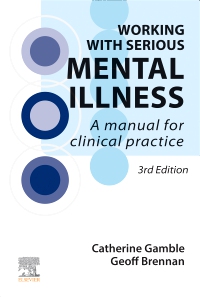

Working With Serious Mental Illness, 3rd Edition
Elsevier eBook on VitalSource
Now $35.99
When working in the field of mental illness, the best evidence is people’s lived experience. The third edition of Working with Serious Mental Illness maintains its focus on research data, but this is framed by clients’ personal perspectives to provide clear, practical advice for practitioners.
Aimed at nurses and healthcare practitioners working with mental illnesses such as severe depression, bi-polar disorder and psychosis, this book provides solutions for engaging and working with clients and their families. It vividly presents lived experience and the recommendations of clients, then proceeds through developing and implementing effective interventions and how to reflect on client relationships to ensure sustained success.
Easy to read and packed full of practical tips and strategies, this is the ideal book for all healthcare practitioners working with patients with serious mental illness, their families and their carers. It will also be valuable reading for staff working in acute and community mental care settings who lack specialist training in serious mental health disorders, for nursing students, mental health nurses and general nurses working in mental health, primary care and community settings.
-
- Focuses on the lived experiences, observations and recommendations for practitioners of people who use mental health services
- Combines theory and practice in a skills and intervention-based approach
- Presents down-to-earth intervention ideas designed for practitioners working at the front line
- Practical advice is provided in a user-friendly, clearly accessible way
- Contributions from experts and editors who are leaders in their field
-
-
 Working With Serious Mental IllnessPaperback
-
-
SECTION 1 Promoting Understanding
1. The User’s Voice: What We Need to Hear
2. Social Participation
3. Stress Vulnerability Model of Serious Mental Illness
4. Working With the Principles of Trauma-Informed Care
5. Where Does PSI Fit With Recovery?
SECTION 2 Engaging, Assessing, and Agreeing Care
6. Building Relationships
7. Assessment in Practice: Diagnosis
8. Consolidating the Assessment Process
9. Parity of Esteem
SECTION 3 Working With the Person
10. Modern Risk Management
11. Dealing With Voices and Strange Thoughts
12. Assisting the Person With Motivation
13. Assisting Families and Informal Carers
14. Assisting the Person With Drug and Alcohol Issues
15. Working With Anger in the Context of Serious Mental Illness
16. Working With Complex Cases
17. Assisting the Person With Medication
18. Recovery: Assisting the Person to Stay Well
SECTION 4 Considerations for Effective Practice
19. Understanding the Cultural Context
20. Looking After Ourselves: Wellbeing, Resilience, and Self-help Strategies -
-
Ways of Reading
- The appearance of the text and page layout can be modified according to the capabilities of the reading system (font family and font size, spaces between paragraphs, sentences, words, and letters, as well as color of background and text)
- This e-publication is accessible to the full extent that the file format and types of content allow, on a specific reading device, by default, without necessarily including any additions such as textual descriptions of images or enhanced navigation
- No information about nonvisual reading is available
-
Conformance
- No information is available
-
Navigation
- Table of contents to all chapters of the text via links
- Page list to go to pages from the print source version
-
Rich Content
- No information is available
-
Hazards
- No information is available
-
Product Content
- No information is available
-
Legal Considerations
- No information is available
-
Additional Accessibility Information
- Page breaks included from the original print source
- For readers with color vision deficiency, use of color (e.g., in diagrams, graphics and charts, in prompts, or on buttons inviting a response) is not the sole means of graphical distinction or of conveying information
- E-publication includes basic navigation (usually less detailed than TOC-based navigation)
- Where links, controls or buttons are included in the content, the purpose or functionality of each link, control or button is apparent from the associated text alone - or where it is unclear, separate link, control or button descriptions are provided
- All (or substantially all) textual matter is arranged in a single logical reading order (including text that is visually presented as separate from the main text flow, e.g., in boxouts, captions, tables, footnotes, endnotes, citations, etc.). Non-textual content is also linked from within this logical reading order. (Purely decorative non-text content can be ignored).
- The language of the text has been specified (e.g., via the HTML or XML lang attribute) to optimise text-to-speech (and other alternative renderings), both at the whole document level and, where appropriate, for individual words, phrases or passages in a different language.
-
Ways of Reading

 as described in our