ISBN:
9780702080609
Copyright:
2020
Publication Date:
02-13-2019
Page Count:
808
Imprint:
Elsevier
List Price:
$67.99

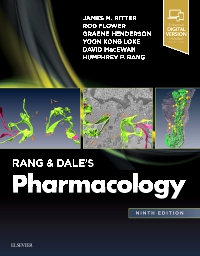
Rang & Dale's Pharmacology Elsevier E-Book on VitalSource, 9th Edition
by James M. Ritter, DPhil FRCP FBPhS FMedSci, Rod J. Flower, PhD DSc FBPhS FMedSci FRS, Graeme Henderson, BSc PhD FBPhS FSB, Yoon Kong Loke, MB, BS, MRCP, MD, David MacEwan, PhD, FRSB, FBPhS, SFHEA and Humphrey P. Rang, MB BS MA DPhil Hon FBPharmacolS FMedSci FRS
Elsevier eBook on VitalSource
ISBN:
9780702080609
Copyright:
2020
Publication Date:
02-13-2019
Page Count:
808
Imprint:
Elsevier
List Price:
$67.99
Was
$67.99
Now $61.19
Or $0.00 with a valid access code
Comprehensive yet easy to use, Rang and Dale’s Pharmacology has been providing core basic and clinical science information to students and healthcare practitioners worldwide for more than 25 years. The fully revised 9th Edition keeps you up to date with all that’s new in the field, including new and emerging drugs and recent studies. From cover to cover, you’ll progressively increase your knowledge of all relevant aspects of pharmacology, from a molecular understanding of receptors and drug actions through clinical uses of key groups of drugs.
New Edition Expected Availability: 08-16-2023

Rang & Dale's Pharmacology Elsevier E-Book on VitalSource
Elsevier eBook on VitalSource
ISBN: 9780443108648
-
- Keeps you up-to-date with new information in this fast-changing field, including significantly revised coverage of CNS drugs, cognitive enhancers, anti-infectives, biologicals/biopharmaceuticals, lifestyle drugs, and more
- Includes access to unique features online, including more than 100 brand new chapter-specific multiple-choice questions and 6 new cases for immediate self-assessment
- Features a color-coded layout for faster navigation and cross-referencing
- Clarifies complex concepts with Key Points boxes, Clinical Uses boxes and full-color illustrations throughout
- Enhanced eBook version included with purchase. Your enhanced eBook allows you to access all of the text, figures, and references from the book on a variety of devices
-
Section 1. General principles
1. What is pharmacology?
2. How drugs act: general principles
3. How drugs act: molecular aspects
4. How drugs act: cellular aspects excitation, contraction and secretion
5. Biopharmaceuticals and gene therapy
6. Cell proliferation, apoptosis, repair and regeneration
7. Cellular mechanisms: host defence
8. Method and measurement in pharmacology
9. Absorption and distribution of drugs
10. Drug metabolism and elimination
11. Pharmacokinetics
12. Individual Variation, Pharmacogenomics and Personalised Medicine
Section 2. Chemical Mediators
13. Chemical mediators and the autonomic nervous system
14. Cholinergic transmission
15. Noradrenergic transmission
16. 5-Hydroxytryptamine and the Pharmacology of Migraine
17. Purines
18. Local Hormones 1: Histamin and the Biologically Active Lipids.
19. Local Hormones 2: Peptides and Proteins
20. Cannabinoids
21. Nitric oxide and other gaseous mediators
Section 3. Drugs affecting major organ systems
22. The heart
23. The vascular system
24. Atherosclerosis and lipid metabolism
25. Haemostasis and thrombosis
26. Haemopoietic system
27. Anti-inflammatory and immunosuppressant drugs
28. Skin
29. Respiratory system
30. The Kidney and urinary system
31. The Gastrointestinal tract
32. The control of blood glucose and drug treatment of diabetes mellitus
33. Obesity
34. The Pituitary and the adrenal cortex
35. Thyroid
36. The reproductive system
37. Bone metabolism
Section 4. Nervous System
38. Chemical transmission and drug action in the nervous system
39. Amino acid transmitters
40. Other transmitters and modulators
41. Neurodegenerative diseases
42. General anaesthetic agents
43. Analgesic drugs
44. Local anaesthetics and other drugs affecting sodium channels
45. Anxiolytic and hypnotic drugs
46. Antiepileptic drugs
47. Antipsychotic drugs
48. Antidepressant drugs
49. CNS stimulants and psychotomimetic drugs
50. Drug addiction, dependence and abuse
Section 5. Drugs used for the treatment of infections and cancer
51. Basic principles of antimicrobial chemotherapy
52. Antibacterial drugs
53. Antiviral drugs
54. Antifungal drugs
55. Antiprotozoal drugs
56. Anthelmintic drugs
57. Anti-cancer drugs
Section 6. Special Topics
58. Harmful effects of drugs
59. Lifestyle drugs and drugs in sport
60. Drug discovery and development -
-
Ways of Reading
- The appearance of the text and page layout can be modified according to the capabilities of the reading system (font family and font size, spaces between paragraphs, sentences, words, and letters, as well as color of background and text)
- This e-publication is accessible to the full extent that the file format and types of content allow, on a specific reading device, by default, without necessarily including any additions such as textual descriptions of images or enhanced navigation
- No information about nonvisual reading is available
-
Conformance
- No information is available
-
Navigation
- Table of contents to all chapters of the text via links
- Page list to go to pages from the print source version
-
Rich Content
- No information is available
-
Hazards
- No information is available
-
Product Content
- No information is available
-
Legal Considerations
- No information is available
-
Additional Accessibility Information
- Page breaks included from the original print source
- For readers with color vision deficiency, use of color (e.g., in diagrams, graphics and charts, in prompts, or on buttons inviting a response) is not the sole means of graphical distinction or of conveying information
- E-publication includes basic navigation (usually less detailed than TOC-based navigation)
- Where links, controls or buttons are included in the content, the purpose or functionality of each link, control or button is apparent from the associated text alone - or where it is unclear, separate link, control or button descriptions are provided
- All (or substantially all) textual matter is arranged in a single logical reading order (including text that is visually presented as separate from the main text flow, e.g., in boxouts, captions, tables, footnotes, endnotes, citations, etc.). Non-textual content is also linked from within this logical reading order. (Purely decorative non-text content can be ignored).
- The language of the text has been specified (e.g., via the HTML or XML lang attribute) to optimise text-to-speech (and other alternative renderings), both at the whole document level and, where appropriate, for individual words, phrases or passages in a different language.
-
Ways of Reading
Was
$67.99
Now $61.19
Or $0.00 with a valid access code

 as described in our