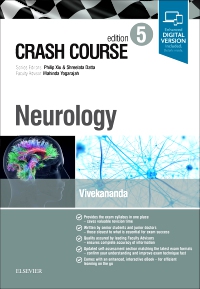

Crash Course Neurology Elsevier eBook on VitalSource, 5th Edition
Elsevier eBook on VitalSource
Now $30.59
Crash Course Neurology, Fifth Edition– your effective every-day study companion PLUS the perfect antidote for exam stress! Save time and be assured you have the essential information you need in one place to excel on your course and achieve exam success.
A winning formula now for over 20 years, each series volume has been fine-tuned and fully updated – with an improved full-colour layout tailored to make your life easier. Especially written by senior students or junior doctors – those who understand what is essential for exam success – with all information thoroughly checked and quality assured by expert Faculty Advisers, the result are books which exactly meet your needs and you know you can trust.
Each chapter guides you succinctly through the full range of curriculum topics, integrating clinical considerations with the relevant basic science and avoiding unnecessary or confusing detail. A range of text boxes help you get to the hints, tips and key points you need fast! A fully revised self-assessment section matching the latest exam formats is included to check your understanding and aid exam preparation. The accompanying enhanced, downloadable eBook completes this invaluable learning package.
Series volumes have been honed to meet the requirements of today’s medical students, although the range of other health students and professionals who need rapid access to the essentials of neurology will also love the unique approach of Crash Course. Whether you need to get out of a fix or aim for a distinction Crash Course is for you!
-
- Provides the exam syllabus in one place - saves valuable revision time
- Written by senior students and recent graduates - those closest to what is essential for exam success
- Quality assured by leading Faculty Advisors - ensures complete accuracy of information
- Features the ever popular 'Hints and Tips' boxes and other useful aide-mémoires - distilled wisdom from those in the know
- Updated self-assessment section matching the latest exam formats – confirm your understanding and improve exam technique fast
-
Section 1: History, Examination and Common Investigations
1. Taking a History
2. The Neurological Examination
3. Further Investigations
Section 2: The Patient Presents With:
4. Disturbances of Consciousness
5. Disorders of Higher Cerebral Function
6. Headache
7. Disorders of Smell and Taste
8. Visual Impairment
9. Disorders of the Pupils and Eye Movements
10. Facial Sensory Loss and Weakness
11. Deafness, Tinnitus and Vertigo
12. Dysarthria, Dysphonia and Dysphagia
13. Cerebellar Dysfunction
14. Movement Disorders
15. Limb Weakness
16. Limb Sensory Symptoms
17. Disorders of Gait
Section 3: Diseases and Disorders
18. Dementia
19. Epilepsy
20. Parkinson’s disease, other extrapyramidal disorders, and myoclonus
21. Diseases Affecting the Spinal Cord (Myelopathy)
22. Motor Neuron Disease
23. Radiculopathy and Plexopathy
24. Disorders of the Peripheral Nerve
25. Disorders of the Neuromuscular junction
26. Disorders of skeletal muscle
27. Vascular Diseases of the Nervous System
28. Intracranial Tumours
29. Infections of the nervous system
30. Multiple Sclerosis
31. The Effects of Vitamin Deficiencies and Toxins on the Nervous System
32. Autoimmune conditions affecting the Nervous System
33. Hereditary Conditions Affecting the Nervous System -
-
Ways of Reading
- The appearance of the text and page layout can be modified according to the capabilities of the reading system (font family and font size, spaces between paragraphs, sentences, words, and letters, as well as color of background and text)
- This e-publication is accessible to the full extent that the file format and types of content allow, on a specific reading device, by default, without necessarily including any additions such as textual descriptions of images or enhanced navigation
- No information about nonvisual reading is available
-
Conformance
- No information is available
-
Navigation
- Table of contents to all chapters of the text via links
- Page list to go to pages from the print source version
-
Rich Content
- No information is available
-
Hazards
- No information is available
-
Product Content
- No information is available
-
Legal Considerations
- No information is available
-
Additional Accessibility Information
- Page breaks included from the original print source
- For readers with color vision deficiency, use of color (e.g., in diagrams, graphics and charts, in prompts, or on buttons inviting a response) is not the sole means of graphical distinction or of conveying information
- E-publication includes basic navigation (usually less detailed than TOC-based navigation)
- Where links, controls or buttons are included in the content, the purpose or functionality of each link, control or button is apparent from the associated text alone - or where it is unclear, separate link, control or button descriptions are provided
- All (or substantially all) textual matter is arranged in a single logical reading order (including text that is visually presented as separate from the main text flow, e.g., in boxouts, captions, tables, footnotes, endnotes, citations, etc.). Non-textual content is also linked from within this logical reading order. (Purely decorative non-text content can be ignored).
- The language of the text has been specified (e.g., via the HTML or XML lang attribute) to optimise text-to-speech (and other alternative renderings), both at the whole document level and, where appropriate, for individual words, phrases or passages in a different language.
-
Ways of Reading

 as described in our