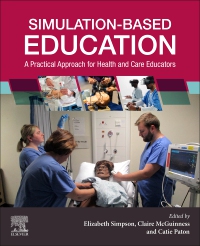

Simulation-Based Education - Elsevier E-Book on VitalSource, 1st Edition
Elsevier eBook on VitalSource
Now $45.59
With an increasing focus on Simulation-Based Education (SBE) in health care, this new book is a step-by-step guide to becoming an effective SBE educator.
Simulation-Based Education: A Practical Approach for Health and Care Educators provides practical advice for undergraduate and postgraduate educators on how to plan and deliver SBE across a range of health and social care disciplines. It covers the planning, delivery and evaluation of SBE, hints and tips for success, and interactive immersive simulation in a variety of education settings.
Written by SBE specialists from across the healthcare disciplines, the book uses a ‘workshop’ approach that encourages readers to evaluate their current practice and apply new knowledge to develop their strengths, making it invaluable for the entire SBE team.
-
- NEW! Nora AI - an AI-powered learning assistant exclusive to Elsevier ebooks on VitalSource's Bookshelf® platform - offers built-in AI learning support that provides personalized answers based on content from the Elsevier ebook
- Practical guide suitable for all types and levels of faculty, including teaching staff, technicians, technologists and simulated patients
- Offers an experiential, workshop-based approach - can be used as a guide for educators to develop their own SBE
- Expert contributors drawn from across the healthcare disciplines
- Interactive sections and ‘next steps’ encourage the reader to hone their current practice
- Aligns with the dimensions of Advance Higher Education (HE) – can be used as a faculty development tool and as a facilitator for application to the HEA for fellowship
- Each chapter maps to the Association of Medical Educators (AoME) domains; General Medical Council (GMC) trainer domains; the Association for Simulated Practice in Healthcare (ASPIH) themes; United Kingdom Professional Standards Framework (UKPSF) domains
-
-
 Simulation-Based EducationPaperback
-
-
1. Introduction to Simulation-based Education in Health and Care
2. Interactive Reusable Learning Objects
3. Developing a Faculty for Effective Immersive Simulation
4. Scenario Writing for Simulation-based Education
5. Simulation for Skills Acquisition
6. Interprofessional Simulation
7. Large Group Simulation
8. Major Incident Simulation
9. Measuring the Impact of Simulation-based Education -
-
Ways of Reading
- The appearance of the text and page layout can be modified according to the capabilities of the reading system (font family and font size, spaces between paragraphs, sentences, words, and letters, as well as color of background and text)
- This e-publication is accessible to the full extent that the file format and types of content allow, on a specific reading device, by default, without necessarily including any additions such as textual descriptions of images or enhanced navigation
- No information about nonvisual reading is available
-
Conformance
- No information is available
-
Navigation
- Table of contents to all chapters of the text via links
- Page list to go to pages from the print source version
-
Rich Content
- No information is available
-
Hazards
- No information is available
-
Product Content
- No information is available
-
Legal Considerations
- No information is available
-
Additional Accessibility Information
- Content is enhanced with ARIA roles to optimize organization and facilitate navigation
- Page breaks included from the original print source
- For readers with color vision deficiency, use of color (e.g., in diagrams, graphics and charts, in prompts, or on buttons inviting a response) is not the sole means of graphical distinction or of conveying information
- E-publication includes basic navigation (usually less detailed than TOC-based navigation)
- Where links, controls or buttons are included in the content, the purpose or functionality of each link, control or button is apparent from the associated text alone - or where it is unclear, separate link, control or button descriptions are provided
- All (or substantially all) textual matter is arranged in a single logical reading order (including text that is visually presented as separate from the main text flow, e.g., in boxouts, captions, tables, footnotes, endnotes, citations, etc.). Non-textual content is also linked from within this logical reading order. (Purely decorative non-text content can be ignored).
- The language of the text has been specified (e.g., via the HTML or XML lang attribute) to optimise text-to-speech (and other alternative renderings), both at the whole document level and, where appropriate, for individual words, phrases or passages in a different language.
-
Ways of Reading

 as described in our