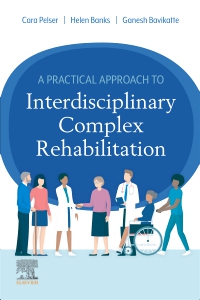

A Practical Approach to Interdisciplinary Complex Rehabilitation Elsevier eBook on VitalSource, 1st Edition
Elsevier eBook on VitalSource
Now $33.59
An interdisciplinary team (IDT) approach is most effective in complex physical rehabilitation, but implementing a successful IDT can be challenging. This new book will help readers to understand more about the variety of professions that contribute to successful IDT working and how team members collaborate for the benefit of the rehabilitation patient and their personalised goals.
This is a comprehensive, practical, evidence-based guide to complex rehabilitation from an IDT perspective, exploring the dynamic and diverse roles and challenges of the team. The fifteen chapters are written by clinicians who are highly experienced across a range of disciplines and settings, from early acute rehabilitation to community rehabilitation.
A Practical Approach to Interdisciplinary Complex Rehabilitation will be an invaluable resource for all members of the team, including medical, nursing, dietetics, neuropsychiatry, occupational therapy, physiotherapy, psychology, rehabilitation coordination, speech and language therapy, and vocational rehabilitation therapy.
-
- Covers a wide range of different complex rehabilitation settings and clinical conditions
- Reflective questions in each chapter to inform practice within an IDT
- User-friendly and easy to read
- Case studies explore how a successful IDT works in practice
-
1 Complex rehabilitation in an interdisciplinary team context
Jo Haworth and Helen O’Leary
2 Medical management in rehabilitation
Helen Banks and Ganesh Bavikatte
3 The role, impact, and reflections of the rehabilitation nurse
Nicola Hill
4 Prolonged disorders of consciousness
Mary Ankers
5 24-hour approach to physical management
Emily Wilson-Meredith and Emily Low
6 Adjusting to life after illness or injury
Cara Pelser
7 Mental health in complex rehabilitation
Antonio Swaraj DaCosta and Jon Alan Smith
8 Working with behaviour that challenges
Peter Kinsella
9 Cognition; an assessment and rehabilitation
Nicola Branscombe, Stephen Mullin, Cara Pelser, and Wendy Owen
10 Communication disorders in rehabilitation: an interdisciplinary approach
Elaine Bailey and Lisa Barklin
11 Dysphagia in rehabilitation: an interdisciplinary approach
Elaine Bailey and Lisa Barklin
12 Nutrition and dietetics in rehabilitation
Joanne Sim and Rachel K. Taylor
13 Early vocational rehabilitation within an interdisciplinary context
Ray Langford
14 A patient’s perspective
Elly Milton and Marie Milton
15 Supporting the socioeconomic needs of patients and their families within the context of a complex rehabilitation setting: creating opportunities through collaboration, rehabilitation, and beyond
Claire Hendry and Erin M. Beal
16 Conclusion
Cara Pelser, Angela Harrison, Ganesh Bavikatte, and Helen Banks -
-
Ways of Reading
- The appearance of the text and page layout can be modified according to the capabilities of the reading system (font family and font size, spaces between paragraphs, sentences, words, and letters, as well as color of background and text)
- This e-publication is accessible to the full extent that the file format and types of content allow, on a specific reading device, by default, without necessarily including any additions such as textual descriptions of images or enhanced navigation
- All content can be read as read aloud speech or dynamic braille
- Has alternative text descriptions for images
-
Conformance
- The certifier's credential is https://bornaccessible.benetech.org/certified-publishers/
- The publication was certified on 24-03-2026
-
Navigation
- Table of contents to all chapters of the text via links
- Index with links to referenced entries
- Elements such as headings, tables, etc. for structured navigation
- Page list to go to pages from the print source version
-
Rich Content
- Information-rich images are described by extended descriptions
-
Hazards
- The publication contains no hazards
-
Product Content
- Content includes any type of illustrations.
- The primary content is text.
- Content includes maps and/or other cartographic content.
- Content includes a significant number of actionable (clickable) web links to external content, downloadable resources, supplementary material, etc.
- Content includes a significant number of actionable (clickable) cross-references, hyperlinked notes and annotations, or with other actionable links between largely textual elements (e.g., quiz/test questions, 'choose your own ending', etc.).
- Content includes photographs, whether in a plate section / insert or not.
- Content includes figures, diagrams, charts and/or graphs, including other 'mechanical' (i.e. non-photographic) illustrations.
- Content includes images displayed in a specific order for the purpose of graphic storytelling or giving information (e.g. graphic novels, comics and manga). May include text integrated into the image (as speech and thought bubbles, textual 'sound' effects, captions etc.).
- Content includes text within images, including text-as-text embedded in diagrams, charts, or within images containing speech balloons, thought bubbles, captions, etc.
- Content includes visual content that is purely decorative and is not necessary to understanding of the content.
- At least some text - including text within other images - is 'text as an image' (i.e., a picture of text).
-
Legal Considerations
- No information is available
-
Additional Accessibility Information
- Content is enhanced with ARIA roles to optimize organization and facilitate navigation
- Page breaks included from the original print source
- For readers with color vision deficiency, use of color (e.g., in diagrams, graphics and charts, in prompts, or on buttons inviting a response) is not the sole means of graphical distinction or of conveying information
- The body text is presented with a contrast ratio of at least 4.5:1 (or 3:1 for large/heading text)
- Ultra-high contrast between text and background
- E-publication includes basic navigation (usually less detailed than TOC-based navigation)
- Where links, controls or buttons are included in the content, the purpose or functionality of each link, control or button is apparent from the associated text alone - or where it is unclear, separate link, control or button descriptions are provided
- All (or substantially all) textual matter is arranged in a single logical reading order (including text that is visually presented as separate from the main text flow, e.g., in boxouts, captions, tables, footnotes, endnotes, citations, etc.). Non-textual content is also linked from within this logical reading order. (Purely decorative non-text content can be ignored).
- Content provides explanations for unusual words, abbreviations, acronyms, idioms, jargon in an accessible form, such as glossaries, scripted pop-ups.
- Where interactive content is included in the product, controls are provided (e.g., for speed, pause and resume, reset) and labelled to make their use clear.
- The language of the text has been specified (e.g., via the HTML or XML lang attribute) to optimise text-to-speech (and other alternative renderings), both at the whole document level and, where appropriate, for individual words, phrases or passages in a different language.
-
Ways of Reading


 as described in our