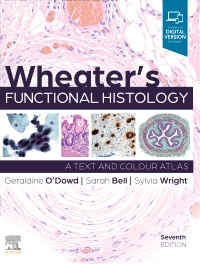

Wheater's Functional Histology Elsevier eBook on VitalSource, 7th Edition
Elsevier eBook on VitalSource
Now $63.89
Now in its seventh edition, Wheater's Functional Histology is designed to give students a working knowledge of histology, including the basic histological structures, tissue types and organ systems.
You will learn to recognise the microscopic structure of normal human tissues and understand how this relates to function. The book shows you how to apply histology in a clinical context through coverage of common clinical conditions in each chapter.
This must-have book is written clearly and concisely, designed for those studying histology for the first time. Packed with a wealth of illustrations and learning aids, it is a must-have for every medical and health science student.
-
- Concise and easy to digest text – easy to follow for those new to histology
- More than 900 high quality histology images and illustrations, plus detailed explanations to support understanding
- End of chapter review tables summarising important points
- Self-assessment questions and rationales to support exam preparation
- Appendix outlining the basics of microscopy and histological staining techniques
- Basic glossary
- An enhanced eBook version is included with purchase. The eBook allows you to access all the text, figures and references, with the ability to search, customize your content, make notes and highlights, and have content read aloud
-
PART I THE CELL
1. Cell structure and function
2. Cell cycle and replication
PART II BASIC TISSUE TYPES
3. Blood, haematopoiesis and bone marrow
4. Supporting/connective tissues
5. Epithelial tissues
6. Muscle
7. Nervous tissues
PART III ORGAN SYSTEMS
8. Circulatory system
9. Skin
10. Skeletal tissues
11. Immune system
12. Respiratory system
13. Oral tissues
14. Gastrointestinal tract
15. Liver and pancreas
16. Urinary system
17. Endocrine system
18. Male reproductive system
19. Female reproductive system
20. Central nervous system
21. Special sense organs
PART IV APPENDICES
1: Introduction to microscopy
2: Notes on staining techniques
3: Glossary of terms -
-
Ways of Reading
- The appearance of the text and page layout can be modified according to the capabilities of the reading system (font family and font size, spaces between paragraphs, sentences, words, and letters, as well as color of background and text)
- This e-publication is accessible to the full extent that the file format and types of content allow, on a specific reading device, by default, without necessarily including any additions such as textual descriptions of images or enhanced navigation
- No information about nonvisual reading is available
-
Conformance
- No information is available
-
Navigation
- Table of contents to all chapters of the text via links
- Page list to go to pages from the print source version
-
Rich Content
- No information is available
-
Hazards
- No information is available
-
Product Content
- No information is available
-
Legal Considerations
- No information is available
-
Additional Accessibility Information
- Page breaks included from the original print source
- For readers with color vision deficiency, use of color (e.g., in diagrams, graphics and charts, in prompts, or on buttons inviting a response) is not the sole means of graphical distinction or of conveying information
- E-publication includes basic navigation (usually less detailed than TOC-based navigation)
- Where links, controls or buttons are included in the content, the purpose or functionality of each link, control or button is apparent from the associated text alone - or where it is unclear, separate link, control or button descriptions are provided
- All (or substantially all) textual matter is arranged in a single logical reading order (including text that is visually presented as separate from the main text flow, e.g., in boxouts, captions, tables, footnotes, endnotes, citations, etc.). Non-textual content is also linked from within this logical reading order. (Purely decorative non-text content can be ignored).
- The language of the text has been specified (e.g., via the HTML or XML lang attribute) to optimise text-to-speech (and other alternative renderings), both at the whole document level and, where appropriate, for individual words, phrases or passages in a different language.
-
Ways of Reading



 as described in our