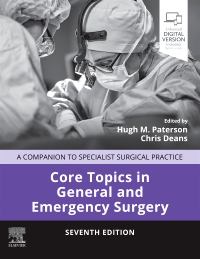

Core Topics in General and Emergency Surgery - Elsevier E-Book on VitalSource, 7th Edition
Elsevier eBook on VitalSource
Now $79.79
Core Topics in General & Emergency Surgery provides a short, up-to-date and practical reference guide for surgical trainees and established consultants needing a refresher.
The seventh edition has been edited and fully revised by respected experts in their fields, and provides a full list of current references and relevant resources. It covers a range of topics relevant to all areas of surgical practice – beyond surgical knowledge – that are essential for enhanced patient outcomes. These include quality improvement in emergency surgery, evaluation of new technology, evaluation of surgical literature, and human factors.
This volume is part of the Companion to Specialist Surgical Practice series, the pre-eminent reference for trainees in general surgery and those preparing for the FRCS examinations. Each volume summarises key issues within each surgical sub-specialty and provides evidence-based recommendations to support practice.
-
- NEW! Nora AI - an AI-powered learning assistant exclusive to Elsevier ebooks on VitalSource's Bookshelf® platform - offers built-in AI learning support that provides personalized answers based on content from the Elsevier ebook
- Covers relevant topics not found in other surgical textbooks – essential to improve surgical outcomes
- Concise and easy to follow – ideal for exam revision or as a refresher aid
- Fully updated with latest evidence on recent developments, management issues and operative procedures
- International authorship offers a world view
- Evidence-based recommendations to support practice
- Key references to support content, plus a comprehensive list of references in the accompanying eBook
- Links to recommended online videos for further learning
-
1. Evaluation of surgical literature
2. Peri-operative care and enhanced recovery
3. Quality improvement in emergency surgery
4. Patient assessment and surgical risk
5. Perioperative intensive care management of the surgical patient
6. Surgical nutrition
7. Abdominal hernias
8. Neck surgery for the general surgeon
9. Human factors and patient safety in surgery
10. Principles of organ donation and transplantation
11. The acute abdomen: early assessment and investigation
12. Perforations of the upper gastrointestinal tract
13. Acute non-variceal upper gastrointestinal bleeding
14. Pancreaticobiliary emergencies
15. Acute conditions of the small bowel and appendix
16. Colonic emergencies
17. Anorectal emergencies
18. Paediatric surgical emergencies
19. Management of trauma for the general surgeon
20. Abdominal sepsis and abdominal compartment syndrome
21. Operating on the obese patient and complications of bariatric surgery
22. Introduction of new technologies into Surgical practice -
-
Ways of Reading
- The appearance of the text and page layout can be modified according to the capabilities of the reading system (font family and font size, spaces between paragraphs, sentences, words, and letters, as well as color of background and text)
- This e-publication is accessible to the full extent that the file format and types of content allow, on a specific reading device, by default, without necessarily including any additions such as textual descriptions of images or enhanced navigation
- No information about nonvisual reading is available
-
Conformance
- No information is available
-
Navigation
- Table of contents to all chapters of the text via links
- Page list to go to pages from the print source version
-
Rich Content
- No information is available
-
Hazards
- No information is available
-
Product Content
- No information is available
-
Legal Considerations
- No information is available
-
Additional Accessibility Information
- Content is enhanced with ARIA roles to optimize organization and facilitate navigation
- Page breaks included from the original print source
- For readers with color vision deficiency, use of color (e.g., in diagrams, graphics and charts, in prompts, or on buttons inviting a response) is not the sole means of graphical distinction or of conveying information
- E-publication includes basic navigation (usually less detailed than TOC-based navigation)
- Where links, controls or buttons are included in the content, the purpose or functionality of each link, control or button is apparent from the associated text alone - or where it is unclear, separate link, control or button descriptions are provided
- All (or substantially all) textual matter is arranged in a single logical reading order (including text that is visually presented as separate from the main text flow, e.g., in boxouts, captions, tables, footnotes, endnotes, citations, etc.). Non-textual content is also linked from within this logical reading order. (Purely decorative non-text content can be ignored).
- The language of the text has been specified (e.g., via the HTML or XML lang attribute) to optimise text-to-speech (and other alternative renderings), both at the whole document level and, where appropriate, for individual words, phrases or passages in a different language.
-
Ways of Reading


 as described in our