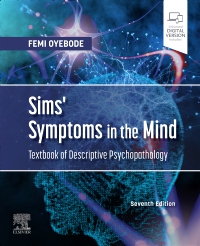

Sims' Symptoms in the Mind: Textbook of Descriptive Psychopathology - Elsevier E-Book on VitalSource, 7th Edition
Elsevier eBook on VitalSource
Now $56.69
Psychopathology – the study of abnormal mental states – is a foundational discipline of psychiatry that is formidable to master. Since 1988, Sims’ Symptoms in the Mind has been the leading introductory textbook in this area and provides the conceptual backbone needed by every psychiatrist in training. It defines and explains the main symptoms and syndromes of mental illness encountered in clinical practice.
Now in its seventh edition, the text has been fully revised and updated by renowned psychiatry professor Femi Oyebode. It provides a masterful introduction to this difficult area that will challenge the reader intellectually, while at the same time supporting his or her learning.
With a combination of accessible text and audiovisual materials in the online ebook, this is the standard postgraduate text for psychiatric trainees as well as a valued reference for academics, clinical psychiatrists and psychologists, allied health professionals, and researchers.
-
- Complete and practical overview of clinical psychopathology
- New chapter on the emerging area of abnormalities of aesthetic sense
- Expanded information on musical hallucinations, erotomania, abnormalities of the form of thinking, and the intriguing nature of gesture and its disturbance
- Online videos and podcasts covering interviewing techniques and tips
- Multiple choice questions and extended answers, offering different ways to learn
- Fully updated with new knowledge, concepts and theoretical and explanatory models
-
Preface to the Seventh Edition
Additional Materials Within Accompanying Electronic Version
Section I CONCEPTS AND METHOD
1. Fundamental Concepts of Descriptive Psychopathology
2. Eliciting the Symptoms of Mental Illness
Section II CONSCIOUSNESS AND COGNITION
3. Consciousness and Disturbed Consciousness
4. Attention, Concentration, Orientation and Sleep
5. Disturbance of Memory
Section III AWARENESS OF REALITY: TIME, PERCEPTION AND JUDGEMENT
6. Disorder of Time
7. Pathology of Perception
8. Delusions and Other Erroneous Ideas
9. Disorder of the Thinking Process
10. Disorder of Speech and Language
11. Insight,
Section IV SELF AND BODY
12. The Disordered Self
13. Depersonalization
14. Disorder of the Awareness of the Body
15. The Psychopathology of Pain
Section V EMOTIONS AND ACTION
16. Affect and Emotional Disorders
17. Anxiety, Panic, Irritability, Phobia and Obsession
18. Disorders of Volition and Execution
19. Disorder of Aesthetic Perception and Praxis
Section VI VARIATIONS OF HUMAN NATURE
20. The Expression of Disordered Personality
Section VII DIAGNOSIS
21 Psychopathology and Diagnosis
Self-Assessment 1
Self-Assessment 2
Self-Assessment 1: Answers
Self-Assessment 2: Answers -
-
Ways of Reading
- The appearance of the text and page layout can be modified according to the capabilities of the reading system (font family and font size, spaces between paragraphs, sentences, words, and letters, as well as color of background and text)
- This e-publication is accessible to the full extent that the file format and types of content allow, on a specific reading device, by default, without necessarily including any additions such as textual descriptions of images or enhanced navigation
- No information about nonvisual reading is available
-
Conformance
- For detailed accessibility information, see Elsevier's website at https://www.elsevier.com/about/accessibility
- For queries regarding accessibility information, contact [email protected]
- The publication was certified on 18-11-2025
-
Navigation
- Table of contents to all chapters of the text via links
-
Rich Content
- No information is available
-
Hazards
- No information is available
-
Product Content
- No information is available
-
Legal Considerations
- No information is available
-
Additional Accessibility Information
- For readers with color vision deficiency, use of color (e.g., in diagrams, graphics and charts, in prompts, or on buttons inviting a response) is not the sole means of graphical distinction or of conveying information
- E-publication includes basic navigation (usually less detailed than TOC-based navigation)
- Where links, controls or buttons are included in the content, the purpose or functionality of each link, control or button is apparent from the associated text alone - or where it is unclear, separate link, control or button descriptions are provided
- All (or substantially all) textual matter is arranged in a single logical reading order (including text that is visually presented as separate from the main text flow, e.g., in boxouts, captions, tables, footnotes, endnotes, citations, etc.). Non-textual content is also linked from within this logical reading order. (Purely decorative non-text content can be ignored).
- The language of the text has been specified (e.g., via the HTML or XML lang attribute) to optimise text-to-speech (and other alternative renderings), both at the whole document level and, where appropriate, for individual words, phrases or passages in a different language.
-
Ways of Reading


 as described in our