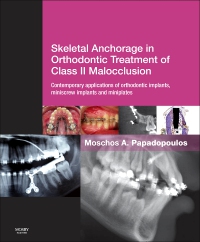

Skeletal Anchorage in Orthodontic Treatment of Class II Malocclusion - Elsevier eBook on VitalSource, 1st Edition
Elsevier eBook on VitalSource
Now $161.49
Richly illustrated throughout, this brand new book examines all aspects of a more efficient use of skeletal anchorage devices, including biological and biomechanical considerations, and also features an in-depth discussion of possible complications and risk management. Divided into nine sections, Skeletal Anchorage in Orthodontic Treatment of Class II Malocclusion addresses the issues at the heart of current orthodontic treatment and practice, giving a comprehensive overview from a global perspective.
"...a comprehensive review of contemporary technological development, biomechanics and handling of orthodonticimplants, miniscrew implants, and miniplates." Reviewed by European Journal of Orthodontics, Feb 2015
"..the first of its kind, as there is currently no published text detailing all of the available orthodontic anchorage devices." Reviewed by G. Wilson on behalf of British Dental Journal, July 2015
-
• Provides an introduction to the conventional and noncompliance treatment of Class II malocclusion
• Provides an introduction to the use of skeletal anchorage reinforcement approaches in orthodontics
• Outlines the clinical considerations required for the use of skeletal anchorage devices in orthodontics
• Explains the insertion and removal procedures of orthodontic implants, miniscrew
implants and mini plates
• Discusses the use of orthodontic implants for the treatment of Class II malocclusion
• Explains the use of mini plates and zygomatic anchorage for the treatment of Class II malocclusion
• Discusses the use of mini-screw implants for the treatment of Class II malocclusion
• Explains the use of skeletal anchorage reinforcement of the noncompliance devices used for the treatment of Class II malocclusion
• Explores the efficiency of skeletal anchorage and its risk management
-
Section I Introduction to orthodontic treatment of Class II malocclusion
Section II Introduction to skeletal anchorage in orthodontics
Section III Clinical considerations for the use of skeletal anchorage devices in orthodontics
Section IV Surgical considerations in the use of skeletal anchorage devices in orthodontics
Section V Orthodontic implants for the treatment of Class II malocclusion
Section VI Miniplates for the treatment of Class II malocclusion
Section VII Miniscrew implants for the treatment of Class II malocclusion
Section VIII Treatment of Class II malocclusion with temporary anchorage devices
Section IX Efficiency of skeletal anchorage and risk management
-
-
Ways of Reading
- The appearance of the text and page layout can be modified according to the capabilities of the reading system (font family and font size, spaces between paragraphs, sentences, words, and letters, as well as color of background and text)
- This e-publication is accessible to the full extent that the file format and types of content allow, on a specific reading device, by default, without necessarily including any additions such as textual descriptions of images or enhanced navigation
- No information about nonvisual reading is available
-
Conformance
- No information is available
-
Navigation
- Table of contents to all chapters of the text via links
- Page list to go to pages from the print source version
-
Rich Content
- No information is available
-
Hazards
- No information is available
-
Product Content
- No information is available
-
Legal Considerations
- No information is available
-
Additional Accessibility Information
- Page breaks included from the original print source
- For readers with color vision deficiency, use of color (e.g., in diagrams, graphics and charts, in prompts, or on buttons inviting a response) is not the sole means of graphical distinction or of conveying information
- E-publication includes basic navigation (usually less detailed than TOC-based navigation)
- Where links, controls or buttons are included in the content, the purpose or functionality of each link, control or button is apparent from the associated text alone - or where it is unclear, separate link, control or button descriptions are provided
- All (or substantially all) textual matter is arranged in a single logical reading order (including text that is visually presented as separate from the main text flow, e.g., in boxouts, captions, tables, footnotes, endnotes, citations, etc.). Non-textual content is also linked from within this logical reading order. (Purely decorative non-text content can be ignored).
- The language of the text has been specified (e.g., via the HTML or XML lang attribute) to optimise text-to-speech (and other alternative renderings), both at the whole document level and, where appropriate, for individual words, phrases or passages in a different language.
-
Ways of Reading

 as described in our