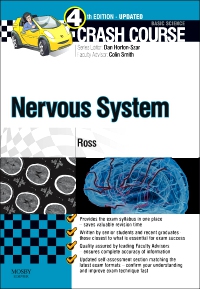

Crash Course Nervous System Updated Edition: Elsevier eBook on VitalSource, 4th Edition
Elsevier eBook on VitalSource
$34.99
The (printed) ‘Updated Edition’ now comes with added value access to the complete, downloadable eBook version via Student Consult. Search, read and revise whilst on the move and use the interactive self-assessment to test your understanding. Crash Course - a more flexible, practical learning package than ever before.
Crash Course – your effective every day study companion PLUS the perfect antidote for exam stress! Save time and be assured you have all the core information you need in one place to excel on your course and achieve exam success.
A winning formula now for over 15 years, each series volume has been fine tuned and fully updated, with an improved layout tailored to make your life easier. Especially written by senior medical students or recent graduates – those who have just been in the exam situation – with all information thoroughly checked and quality assured by expert faculty advisers, the result are books which exactly meet your needs and you know you can trust.
This highly accessible volume provides a strong foundation in understanding the essential basic neurosciences and the clinical investigation of the nervous system. Commencing with 'Learning Objectives', every chapter guides you succinctly through the topic, giving full coverage of the curriculum whilst avoiding unnecessary and often confusing detail.
-
- More than 160 illustrations present clinical, diagnostic and practical information in an easy-to-follow manner
- Friendly and accessible approach to the subject makes learning especially easy
- Written by students for students - authors who understand exam pressures
- Contains ‘Hints and Tips’ boxes, and other useful aide-mémoires
- Succinct coverage of the subject enables ‘sharp focus’ and efficient use of time during exam preparation
- Contains a fully updated self-assessment section - ideal for honing exam skills and self-testing
-
Part I: Basic Medical Science of the Nervous System- Overview of the nervous system, cellular Physiology of the nervous system, Pharmacology of the central nervous system, The spinal cord, Somatosensation and the perception of pain, Motor control, Vision, Hearing, Olfaction and taste (gustation), The brainstem, Neuroendocrinology, The autonomic nervous system, The anatomy of higher function, Introduction to neuropsychology, Functional aspects of higher functions, Basic pathology, Pathology of the peripheral nerves and muscle, Neurogenetics;
Part II: Clinical Assessment- Common presentations of neurological disease, The neurological assessment, Further investigations;
Part III: Self-assessment- MCQs, SAQs, EMQs
-
-
Ways of Reading
- The appearance of the text and page layout can be modified according to the capabilities of the reading system (font family and font size, spaces between paragraphs, sentences, words, and letters, as well as color of background and text)
- This e-publication is accessible to the full extent that the file format and types of content allow, on a specific reading device, by default, without necessarily including any additions such as textual descriptions of images or enhanced navigation
- No information about nonvisual reading is available
-
Conformance
- No information is available
-
Navigation
- Table of contents to all chapters of the text via links
- Page list to go to pages from the print source version
-
Rich Content
- No information is available
-
Hazards
- No information is available
-
Product Content
- No information is available
-
Legal Considerations
- No information is available
-
Additional Accessibility Information
- Page breaks included from the original print source
- For readers with color vision deficiency, use of color (e.g., in diagrams, graphics and charts, in prompts, or on buttons inviting a response) is not the sole means of graphical distinction or of conveying information
- E-publication includes basic navigation (usually less detailed than TOC-based navigation)
- Where links, controls or buttons are included in the content, the purpose or functionality of each link, control or button is apparent from the associated text alone - or where it is unclear, separate link, control or button descriptions are provided
- All (or substantially all) textual matter is arranged in a single logical reading order (including text that is visually presented as separate from the main text flow, e.g., in boxouts, captions, tables, footnotes, endnotes, citations, etc.). Non-textual content is also linked from within this logical reading order. (Purely decorative non-text content can be ignored).
- The language of the text has been specified (e.g., via the HTML or XML lang attribute) to optimise text-to-speech (and other alternative renderings), both at the whole document level and, where appropriate, for individual words, phrases or passages in a different language.
-
Ways of Reading

 as described in our