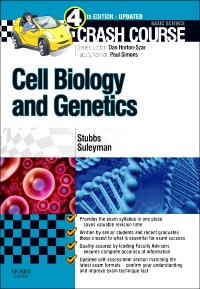

Crash Course Cell Biology and Genetics Updated Edition: Elsevier eBook on VitalSource, 4th Edition
Elsevier eBook on VitalSource
Now $25.89
The (printed) ‘Updated Edition’ now comes with added value access to the complete, downloadable eBook version via Student Consult. Search, read and revise whilst on the move and use the interactive self-assessment to test your understanding. Crash Course - a more flexible, practical learning package than ever before.
Crash Course – your effective everyday study companion PLUS the perfect antidote for exam stress! Save time and be assured you have all the core information you need in one place to excel on your course and achieve exam success.
A winning formula now for over 15 years, each series volume has been fine-tuned and fully updated, with an improved layout tailored to make your life easier. Specially written by senior medical students or recent graduates – those who have just been in the exam situation – with all information thoroughly checked and quality assured by expert faculty advisors, the result is books which exactly meet your needs and you know you can trust.
The subject of cell biology and genetics has never been more essential to the medical curriculum and to modern medicine – yet is widely feared by students. This fully revised edition aims to make it as easy to understand and remember as possible, to ensure a solid grounding in the essential underlying principles and how they relate to clinical practice. It incorporates the latest developments in this fascinating and fast-moving field – including the human genome project and spin-offs such as the thousand genome project – as well as discussion of important ethical issues. Emerging molecular tools and laboratory techniques are explained so that you can appreciate where new treatments for genetic disease and screening technologies have arisen. An updated self-assessment section matching the latest exam formats then allows you to assess your progress and test your performance.
-
- NEW! Nora AI - an AI-powered learning assistant exclusive to Elsevier ebooks on VitalSource's Bookshelf® platform - offers built-in AI learning support that provides personalized answers based on content from the Elsevier ebook
- More than 180 illustrations present clinical, diagnostic and practical information in an easy-to-follow manner
- Friendly and accessible approach to the subject makes learning especially easy
- Written by students for students - authors who understand exam pressures
- Contains ‘Hints and Tips’ boxes, and other useful aide-mémoires
- Succinct coverage of the subject enables ‘sharp focus’ and efficient use of time during exam preparation
- Contains a fully updated self-assessment section - ideal for honing exam skills and self-testing
-
-
 Crash Course Anatomy Updated Edition: Elsevier eBook on VitalSourceElsevier eBook on VitalSource
 -

-
-
-
Ways of Reading
- The appearance of the text and page layout can be modified according to the capabilities of the reading system (font family and font size, spaces between paragraphs, sentences, words, and letters, as well as color of background and text)
- This e-publication is accessible to the full extent that the file format and types of content allow, on a specific reading device, by default, without necessarily including any additions such as textual descriptions of images or enhanced navigation
- No information about nonvisual reading is available
-
Conformance
- No information is available
-
Navigation
- Table of contents to all chapters of the text via links
- Page list to go to pages from the print source version
-
Rich Content
- No information is available
-
Hazards
- No information is available
-
Product Content
- No information is available
-
Legal Considerations
- No information is available
-
Additional Accessibility Information
- Page breaks included from the original print source
- For readers with color vision deficiency, use of color (e.g., in diagrams, graphics and charts, in prompts, or on buttons inviting a response) is not the sole means of graphical distinction or of conveying information
- E-publication includes basic navigation (usually less detailed than TOC-based navigation)
- Where links, controls or buttons are included in the content, the purpose or functionality of each link, control or button is apparent from the associated text alone - or where it is unclear, separate link, control or button descriptions are provided
- All (or substantially all) textual matter is arranged in a single logical reading order (including text that is visually presented as separate from the main text flow, e.g., in boxouts, captions, tables, footnotes, endnotes, citations, etc.). Non-textual content is also linked from within this logical reading order. (Purely decorative non-text content can be ignored).
- The language of the text has been specified (e.g., via the HTML or XML lang attribute) to optimise text-to-speech (and other alternative renderings), both at the whole document level and, where appropriate, for individual words, phrases or passages in a different language.
-
Ways of Reading

 as described in our