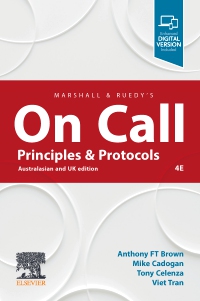
Marshall & Ruedy’s On Call, 4th Edition
Paperback
$0.00
Marshall and Ruedy's On Call: Principles & Protocols, Australasian and UK 4th edition offers a carefully structured, risk-based approach to the initial assessment, investigation, differential diagnosis and short-term management of a wide variety of on-call ward problems.
This fourth edition has been completely revised, with the addition of a new author, new chapters and updated content based on the latest evidence-based guidelines. The layout is in a succinct, easy-to-read format that outlines a practical, fast, efficient and effective bedside approach to clinical problem-solving on call. Clinical reasoning has never been made so explicit and exciting!
-
- General principles: Overview of the professional, organisational, ethical and social traits required of the junior doctor on call
- Emergency calls: Risk-stratified approach to life-threatening airway, breathing, circulation, neurological disability and environment factors (ABCDE)
- Common calls: Explicit detail on how to deal with every call from urgent to non-life threatening, based on a standardised, reproducible clinical reasoning approach
- Investigations: How to interpret an ECG, common imaging, acid base, electrolyte and haematological tests when on call
- Practical procedures: How to perform a large array of practical procedures that may be needed when on call
- Formulary: Quick reference for the indications, actions, adverse effects, cautions, doses and routes of administration of the vast array of drugs encountered in ward patients
- Laboratory values: Normal values for all the common tests
This edition includes the full eBook on eBooks+ with additional reading material, high-quality images, procedural videos and references available on https://litfl.com. -
-
 Marshall & Ruedy's On Call - E-Book VBKElsevier eBook on VitalSource
-
-
Section A – General Principles
- Approach to the diagnosis and management of on-call problems
- Professionalism and teamwork
- Documentation and communication
- Ethical and legal considerations
- Death, dying and breaking bad news
- Transferring the unwell patient
- Junior doctors’ health and wellbeing
- Critically ill patient
- Cardiac arrest
- Acute airway failure
- Acute respiratory failure
- Acute circulatory failure
- Disability: acute neurological failure
- Environment, exposure and examination
- Hospital-based emergency response codes
- Shortness of breath, cough and haemoptysis
- Chest pain
- Heart rate and rhythm disorders
- Hypotension
- Hypertension
- Altered mental status
- Collapse including syncope
- Falls
- Headache
- Seizures
- Weakness and dizziness
- Abdominal pain
- Postoperative ward calls
- Altered bowel habit
- Gastrointestinal bleeding
- Haematuria
- Decreased urine output and acute kidney injury
- Frequency and polyuria
- Leg pain
- Febrile patient
- Skin rashes
- Transfusion reactions
- Electrocardiogram
- Urinalysis
- Arterial and venous blood gases
- Chest X-ray
- Abdominal X-ray
- CT head scan
- Hyper- and hypoglycaemia
- Hyper- and hyponatraemia
- Hyper- and hypokalaemia
- Hyper- and hypocalcaemia
- Anaemia
- Coagulation disorders
- General preparation for a practical procedure
- Infection control and standard precautions
- Blood cultures
- Peripheral venous cannulation
- Basic ultrasound and difficult peripheral cannulation
- Arterial puncture
- Administering an injection
- Local anaesthetic infiltration
- Nasogastric tube insertion
- Urinary catheterisation
- Paracentesis
- Pleural tap
- Chest drain insertion and removal
- Lumbar puncture
- Joint aspiration
- Cardiac monitoring and the electrocardiograph
- Defibrillation
- Electrical cardioversion (DC reversion)
- Transthoracic cardiac pacing
- On-call formulary
Analgesics and local anaesthetics
Section G – Laboratory Values
Cardiovascular
Respiratory and allergy
Gastrointestinal
Neurological
Psychotropics
Antimicrobials
Endocrine and metabolic
Genitourinary
Antidotes- Normal laboratory ranges
-
No accessibility information is available for this product.

 as described in our