ISBN:
9780729583619
Copyright:
2017
Publication Date:
12-16-2016
Page Count:
384
Imprint:
Elsevier
List Price:
$52.99

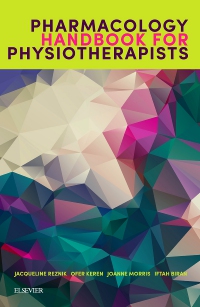
Pharmacology Handbook for Physiotherapists, 1st Edition
by Jacqueline E. Reznik, B. App. Sc. (Physiotherapy), M.A.P.A., M.C.S.P., Dip. T.P., Grad Dip (Neurology), PhD, Ofer Keren, MD, Joanne Morris, BSc (Hons) Physiotherapy, MSc (Hons) Clinical Biomechanics, Grad Dip Extended Scope Physiotherapy, Doctoral Candidate and Iftah Biran, MD
Elsevier eBook on VitalSource
ISBN:
9780729583619
Copyright:
2017
Publication Date:
12-16-2016
Page Count:
384
Imprint:
Elsevier
List Price:
$52.99
Was
$52.99
Now $37.09
Or $0.00 with a valid access code
Pharmacology Handbook for Physiotherapists is an essential quick-reference guide to common medications, designed specifically for student and professional physiotherapists to assist in their everyday practice.
Providing practical and accessible evidence-based information, the handbook will equip physiotherapists with the right knowledge to maximise the benefit of pharmacology and physiotherapy treatments. Written by a multidisciplinary team of specialists, the text is designed to be comprehensive and easy-to-read, set out by body system format to allow quick retrieval of useful information related to the particular condition and medications involved.
-
- Written specifically for physiotherapists to assist their understanding of pharmacology principles in conjunction with physiotherapy treatment
- Each chapter is written by 3 experts in their field: a physiotherapist, a physician and a pharmacist
- ‘Physiotherapy practice points’ explain the effects that drugs may have on treatment and provide valuable information on the actions of medications and how this interacts with physiotherapy treatment
- 11 chapters covering basic pharmacology principles, legal and ethical issues, the body systems, women and men’s health, as well as a final chapter on medication issues in the young and elderly
-
Chapter 1 - Introduction and background conceptsChapter 2 - Cardiovascular systemChapter 3 - Respiratory systemChapter 4 - Women's and men's healthChapter 5 - Orthopaedic and musculoskeletal systemsChapter 6 - Neurological systemChapter 7 - Pain and analgesiaChapter 8 - Endocrine systemChapter 9 - HaematologicalsystemChapter 10 - Mental healthChapter 11 - Medication issues for specific age groups and conditions
-
-
Ways of Reading
- The appearance of the text and page layout can be modified according to the capabilities of the reading system (font family and font size, spaces between paragraphs, sentences, words, and letters, as well as color of background and text)
- This e-publication is accessible to the full extent that the file format and types of content allow, on a specific reading device, by default, without necessarily including any additions such as textual descriptions of images or enhanced navigation
- No information about nonvisual reading is available
-
Conformance
- No information is available
-
Navigation
- Table of contents to all chapters of the text via links
- Page list to go to pages from the print source version
-
Rich Content
- No information is available
-
Hazards
- No information is available
-
Product Content
- No information is available
-
Legal Considerations
- No information is available
-
Additional Accessibility Information
- Page breaks included from the original print source
- For readers with color vision deficiency, use of color (e.g., in diagrams, graphics and charts, in prompts, or on buttons inviting a response) is not the sole means of graphical distinction or of conveying information
- E-publication includes basic navigation (usually less detailed than TOC-based navigation)
- Where links, controls or buttons are included in the content, the purpose or functionality of each link, control or button is apparent from the associated text alone - or where it is unclear, separate link, control or button descriptions are provided
- All (or substantially all) textual matter is arranged in a single logical reading order (including text that is visually presented as separate from the main text flow, e.g., in boxouts, captions, tables, footnotes, endnotes, citations, etc.). Non-textual content is also linked from within this logical reading order. (Purely decorative non-text content can be ignored).
- The language of the text has been specified (e.g., via the HTML or XML lang attribute) to optimise text-to-speech (and other alternative renderings), both at the whole document level and, where appropriate, for individual words, phrases or passages in a different language.
-
Ways of Reading
Was
$52.99
Now $37.09
Or $0.00 with a valid access code

 as described in our