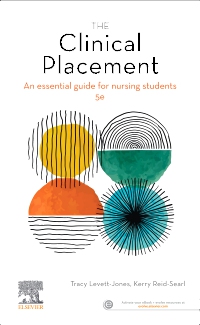

The Clinical Placement - E-Book VST, 5th Edition
Elsevier eBook on VitalSource
Now $30.59
Clinical placements are wonderful learning experiences but they can also be daunting. This book is written specifically for nursing students undertaking a Diploma or Bachelor of Nursing. It will help you prepare for clinical placements and enhance your knowledge and confidence.
Written by leading academics Tracy Levett-Jones and Kerry Reid-Searl, The Clinical Placement will give you the knowledge, strategies, practical tips and insights you need to excel in your placements. It has a strong focus on both person-centred care, self-care, professional and personal responsibilities.
With a supporting video series containing a wealth of practical ideas from expert nurses and recently graduated students, this book will empower you to complete your clinical placements feeling confident and capable as you undertake your journey to becoming a registered nurse.
-
- Written specifically for students undertaking a Diploma or Bachelor of Nursing
- Tips to maximise learning opportunities in a range of different clinical settings
- Practical strategies for dealing with difficult and challenging situations
- 13 engaging videos provide expert insights
-
CHAPTER 1: THE RULES OF ENGAGEMENT
Introduction
Know the Lie of the Land
The Clinical Placement—What It Is and Why It Matters
Person-Centred Care
Models of Care
Safe and Effective Practice
Working Within Your Scope of Practice
Supervision and Support
Working Hard to Belong
First Impressions Last
Mandatory Requirements for Clinical Placements
The Roles and Responsibilities of the Interprofessional Healthcare Team
References/AcknowledgementsCHAPTER 2 : GREAT EXPECTATIONS
Introduction
Patients’ Expectations
Clinicians’ Expectations
Nurse Managers’ Expectations
Professional Expectations
Legal Requirements
Nursing Students’ Expectations
Speak Up, Speak Out
Don’t Take Things Personally
Compliance and Compromise
Exercise Your Rights
References/AcknowledgementsCHAPTER 3 : HOW YOU ACT
Introduction
Cultural Competence and cultural safety
Patient Safety
Clinical Governance
Evidence-Based Practice
Advocacy
Managing Conflict
Dealing with Horizontal Violence
Dealing with Sexual Harassment
Self-Care
Putting Work Ahead of Your Studies
Clinical Placements in Organisations Where You Are Employed
Clinical Placements at Distant Locations
Clinical Learning Objectives
Student Assessment
Giving and Receiving Gifts
Visitors During Clinical Placements
Using Supplies From the Healthcare Organisation
Punctuality and Reliability
References/AcknowledgementsCHAPTER 4 : HOW YOU THINK AND FEEL
Introduction
Empathic Nursing Practice
Reflective Practice
Reality Check and Seeking Feedback
Emotional Intelligence
Critical Thinking and Clinical Reasoning
Ethical Dilemmas in Nursing
Crossing the Line
References/AcknowledgementsCHAPTER 5 : HOW YOU COMMUNICATE
Introduction
Therapeutic Communication
Interprofessional and Intraprofessional Communication
Communicating as a Professional Nurse
Diversity and its Impact on Clinical Communication
Using Professional Language
Documentation and Legal Issues
Patient Handover
Telephones and the Internet
Use of Social Media
Self-Disclosure
Receiving and Providing Effective Feedback
References/AcknowledgementsCHAPTER 6: INSIGHTS FROM EXPERTS
Introduction
Intensive Care Nursing
Paediatric Nursing
Prison Nursing
Trauma Nursing
Medical Surgical Nursing
Older Person Nursing
Community Nursing
Drug and Alcohol Nursing
Mental Health Nursing
Practice Nursing
Palliative Care
Clinical Research in Nursing -
-
Ways of Reading
- The appearance of the text and page layout can be modified according to the capabilities of the reading system (font family and font size, spaces between paragraphs, sentences, words, and letters, as well as color of background and text)
- This e-publication is accessible to the full extent that the file format and types of content allow, on a specific reading device, by default, without necessarily including any additions such as textual descriptions of images or enhanced navigation
- No information about nonvisual reading is available
-
Conformance
- No information is available
-
Navigation
- Table of contents to all chapters of the text via links
- Page list to go to pages from the print source version
-
Rich Content
- No information is available
-
Hazards
- No information is available
-
Product Content
- No information is available
-
Legal Considerations
- No information is available
-
Additional Accessibility Information
- Page breaks included from the original print source
- For readers with color vision deficiency, use of color (e.g., in diagrams, graphics and charts, in prompts, or on buttons inviting a response) is not the sole means of graphical distinction or of conveying information
- E-publication includes basic navigation (usually less detailed than TOC-based navigation)
- Where links, controls or buttons are included in the content, the purpose or functionality of each link, control or button is apparent from the associated text alone - or where it is unclear, separate link, control or button descriptions are provided
- All (or substantially all) textual matter is arranged in a single logical reading order (including text that is visually presented as separate from the main text flow, e.g., in boxouts, captions, tables, footnotes, endnotes, citations, etc.). Non-textual content is also linked from within this logical reading order. (Purely decorative non-text content can be ignored).
- The language of the text has been specified (e.g., via the HTML or XML lang attribute) to optimise text-to-speech (and other alternative renderings), both at the whole document level and, where appropriate, for individual words, phrases or passages in a different language.
-
Ways of Reading


 as described in our