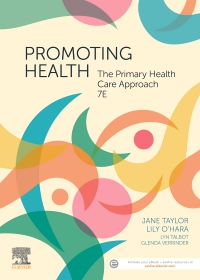

Promoting Health - eBook VST, 7th Edition
Elsevier eBook on VitalSource
With a new author team featuring Jane Taylor and Lily O’Hara, the book explores the socio-ecological determinants of health and wellbeing as a foundation for holistic, ecological, salutogenic health promotion practice. The health promotion practice cycle, including evidence-based community assessment, program planning, implementation and evaluation, is described in detail. The book also includes chapters on five health promotion action areas.
Promoting Health is a comprehensive, easy-to-understand resource that students and practitioners will find themselves returning to throughout their studies and professional practice.
New Edition Expected Availability: 05-01-2025

-
- Grounded in internationally recognised WHO health promotion frameworks including the Ottawa Charter for Health Promotion and subsequent charters and declarations
- The role of systemic determinants of health and wellbeing including the social, economic, cultural, political, natural and built environments for a sustainable future
- Sets of questions on putting the Ottawa Charter into practice
- Tables that map chapter content to relevant International Union for Health Promotion and Education core competencies
- More to Explore sections with additional resources
- Reflective questions that enable consolidation of learning through practice activities
- An eBook included with all print purchases
Additional resources on evolve
• eBook on VitalSource
Instructor resources:
• Chapter reflective questions and model responses
• Chapter quiz questions with correct responses
• Image Gallery
• Weblinks
Student resources:
• Chapter reflective questions
• Chapter quiz questions
• Weblinks -
Part 1: Health promotion development and concepts
1. Health promotion in context
2. Core concepts informing health promotion practice
3. Ecological sustainability and human health and wellbeing
Part 2: Health promotion practice
4. Program development and evaluation
5. Healthy public policy: creating environments and settings that support wellbeing and health promotion
6. Community development action for social and environmental change
7. Health education and health literacy
8. Health information and social marketing
9. Immunisation, screening, risk assessment and surveillance -
-
Ways of Reading
- The appearance of the text and page layout can be modified according to the capabilities of the reading system (font family and font size, spaces between paragraphs, sentences, words, and letters, as well as color of background and text)
- This e-publication is accessible to the full extent that the file format and types of content allow, on a specific reading device, by default, without necessarily including any additions such as textual descriptions of images or enhanced navigation
- No information about nonvisual reading is available
-
Conformance
- No information is available
-
Navigation
- Table of contents to all chapters of the text via links
- Page list to go to pages from the print source version
-
Rich Content
- No information is available
-
Hazards
- No information is available
-
Product Content
- No information is available
-
Legal Considerations
- No information is available
-
Additional Accessibility Information
- Page breaks included from the original print source
- For readers with color vision deficiency, use of color (e.g., in diagrams, graphics and charts, in prompts, or on buttons inviting a response) is not the sole means of graphical distinction or of conveying information
- E-publication includes basic navigation (usually less detailed than TOC-based navigation)
- Where links, controls or buttons are included in the content, the purpose or functionality of each link, control or button is apparent from the associated text alone - or where it is unclear, separate link, control or button descriptions are provided
- All (or substantially all) textual matter is arranged in a single logical reading order (including text that is visually presented as separate from the main text flow, e.g., in boxouts, captions, tables, footnotes, endnotes, citations, etc.). Non-textual content is also linked from within this logical reading order. (Purely decorative non-text content can be ignored).
- The language of the text has been specified (e.g., via the HTML or XML lang attribute) to optimise text-to-speech (and other alternative renderings), both at the whole document level and, where appropriate, for individual words, phrases or passages in a different language.
-
Ways of Reading

 as described in our