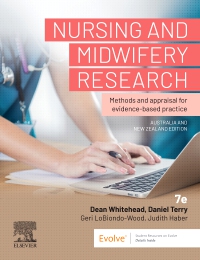

Nursing and Midwifery Research - E-Book VBK, 7th Edition
Elsevier eBook on VitalSource
Now $45.75
An indispensable guide to understanding, applying and conducting research in practice
It is essential that nurses and midwives are able to understand, interpret, synthesise and apply research for effective practice. Nursing and Midwifery Research is a well-established, highly regarded and comprehensive resource that covers all the key fundamentals needed to become and be an evidence-based practitioner.
This book provides an accessible and user-friendly roadmap of the entire research journey, from the conception of a research idea or question through to planning, implementation, evaluation and dissemination of findings. Readers will develop strong skills in research literacy and critical appraisal, and thus build confidence to embark on research projects of their own – an aim of developing research awareness and knowledge.
Written by research experts in their fields specifically for undergraduate and postgraduate students and clinicians in Australia and New Zealand, and fully updated in its seventh edition, this book is a perfect introduction and long-term resource to support research methods and evidence-based practice throughout their professional careers.
-
- Helps build students’ confidence and skills to understand, use and apply research in all healthcare settings.
-
Logically sequenced from theory through to practical application – case studies and tutorials help the reader apply theory to practice.
-
Easy to read and accessible for both undergraduate and postgraduate students and clinicians.
-
Features the most recent Australasian healthcare research, data, clinical practice, procedures and guidelines.
-
Written by Australasian academic and clinical research topic experts at the forefront of nursing and midwifery practice, it draws on the Australasian context throughout.
-
Includes specific detail on evidence-based practice and Indigenous research methods.
-
A variety of supporting teaching methods and pedagogy support learning across all years of the Bachelor of Nursing/Bachelor of Midwifery curriculum, and into postgraduate curricula.
-
Additional online teaching resources include PowerPoint presentations, Glossary, Research in Brief articles and questions, answer guides to Tutorial Trigger, An Unexpected Hurdle, Learning Activities and Time to Reflect activities.
New to this edition
-
Fully updated with the latest data, research studies and developments.
-
Fully updated chapters on writing research proposals and grant applications, and evidence-based practice.
-
Inclusion of a latest research project journey from conception to completion, providing readers with tangible experience of the research process through the entire process.
Instructor resources on Evolve:
-
Answer guides to Tutorial Trigger
-
PowerPoint presentations
Student and Instructor resources on Evolve:
-
Answer guides to An Unexpected Hurdle
-
Answers to Learning Activities
-
Research in Brief articles and questions
-
Answer guides to Time to Reflect
-
Glossary
-
Section 1: What you need to know about research to appreciate it and get started
1 The Significance of Nursing and Midwifery Research and Evidence-Based Practice
2 An overview of Research Theory, Process and Design
3 Critically Searching and Reviewing the Research Literature
4 Identifying Research Ideas, Questions, Statements and Hypotheses
Section 2: What you need to know about research to understand how it is applied
5 Common Qualitative Methods
6 Data Collection and Sampling in Qualitative Research
7 Analysing Data in Qualitative Research
8 Common Quantitative Methods
9 Data Collection and Sampling in Quantitative Research
10 Assessing Measuring Instruments
11 Analysing Data in Quantitative Research
12 Mixed-Methods Research
13 Ethical and Legal Issues in Research
14 Indigenous Peoples and Research
15 Applying Research Knowledge: Implementing Evidence into Practice and Policy
Section 3: What you need to know about research if you want to conduct research
16 Writing Research Proposals and Grant Applications
17 Managing a Research Project : Roles and Processes
18 Writing and Presenting Research Findings
19 A Research Project Journey : From Conception to Completion -
-
Ways of Reading
- The appearance of the text and page layout can be modified according to the capabilities of the reading system (font family and font size, spaces between paragraphs, sentences, words, and letters, as well as color of background and text)
- This e-publication is accessible to the full extent that the file format and types of content allow, on a specific reading device, by default, without necessarily including any additions such as textual descriptions of images or enhanced navigation
- No information about nonvisual reading is available
-
Conformance
- No information is available
-
Navigation
- Table of contents to all chapters of the text via links
- Page list to go to pages from the print source version
-
Rich Content
- No information is available
-
Hazards
- No information is available
-
Product Content
- No information is available
-
Legal Considerations
- No information is available
-
Additional Accessibility Information
- Content is enhanced with ARIA roles to optimize organization and facilitate navigation
- Page breaks included from the original print source
- For readers with color vision deficiency, use of color (e.g., in diagrams, graphics and charts, in prompts, or on buttons inviting a response) is not the sole means of graphical distinction or of conveying information
- E-publication includes basic navigation (usually less detailed than TOC-based navigation)
- Where links, controls or buttons are included in the content, the purpose or functionality of each link, control or button is apparent from the associated text alone - or where it is unclear, separate link, control or button descriptions are provided
- All (or substantially all) textual matter is arranged in a single logical reading order (including text that is visually presented as separate from the main text flow, e.g., in boxouts, captions, tables, footnotes, endnotes, citations, etc.). Non-textual content is also linked from within this logical reading order. (Purely decorative non-text content can be ignored).
- The language of the text has been specified (e.g., via the HTML or XML lang attribute) to optimise text-to-speech (and other alternative renderings), both at the whole document level and, where appropriate, for individual words, phrases or passages in a different language.
-
Ways of Reading



 as described in our