ISBN:
9780729598286
Copyright:
2024
Publication Date:
11-03-2023
Page Count:
1136
Imprint:
Elsevier
List Price:
$74.99

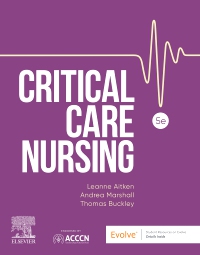
Critical Care Nursing -E-Book VBK, 5th Edition
by Leanne Aitken, RN, PhD, GCertMgt, GDipScMed(ClinEpi), GCertAcadPrac, BHSc(Nurs)Hons, FACCCN, FACN, FAAN, Life Member – ACCCN, Andrea Marshall, RN, PhD, MN(Research), Grad Cert Ed Studies (Higher Ed), BN, IC Cert, FACCCN, FACN, Life Member – ACCCN and Thomas Buckley, RN, PhD, GradCertHPol, MN(Research), BSc(Health)Hons, Cert(ICU), Member ACCCN
Elsevier eBook on VitalSource
ISBN:
9780729598286
Copyright:
2024
Publication Date:
11-03-2023
Page Count:
1136
Imprint:
Elsevier
List Price:
$74.99
Was
$74.99
Now $52.49
Or $0.00 with a valid access code
The internationally acclaimed text Critical Care Nursing is designed to support undergraduate and postgraduate students and critical care nurses in practice to develop the knowledge and skills necessary to deliver high quality patient care to contribute to improved patient outcomes.
The fifth edition has been fully updated with the latest evidence, resources and tools designed to help you master a range of competencies, from patient monitoring to delivering multidimensional interventions, using complex lifesaving equipment, and managing the deteriorating patient. There is a focus on the scope and principles of practice, quality and safety standards, ethical considerations, and increased support for nurses.
Highly regarded by clinicians and students around the world, this book will encourage and challenge you to develop world-class practice and ensure the delivery of the higest quality care.
The fifth edition has been fully updated with the latest evidence, resources and tools designed to help you master a range of competencies, from patient monitoring to delivering multidimensional interventions, using complex lifesaving equipment, and managing the deteriorating patient. There is a focus on the scope and principles of practice, quality and safety standards, ethical considerations, and increased support for nurses.
Highly regarded by clinicians and students around the world, this book will encourage and challenge you to develop world-class practice and ensure the delivery of the higest quality care.
-
- Latest research, technologies and care considerations collated by an internationally respected team of editors and contributors
- Case studies, research vignettes and learning activities to support further learning
- Practice tips, case studies and learning activities link theory to practice
- Endorsed by the Australian College of Critical Care Nurses (ACCCN), the peak professional organisation representing critical care nurses in Australia
- Accompanying adaptive quizzing to support students with assessment preparation
- Case Study suggested responses
- Learning Activity suggested responses
- Additional Case Study answers
- Image, Table, Box collection
- Additional Case Studies
-
SECTION 1: SCOPE OF CRITICAL CARE
1. Scope of critical care practice (p.3)
2. Systems and resources (p.18)
3. Quality and safety (p.47)
4. Ethical issues in critical care (p.78)
SECTION 2: PRINCIPLES AND PRACTICE OF CRITICAL CARE
5. Essential nursing care of the critically ill patient (p.105)
6. Patient comfort and psychological care (p.147)
7. Family and cultural care of the critically ill patient (p.180)
8. Recovery and rehabilitation (p.217)
9. Cardiovascular assessment and monitoring (p.249)
10. Cardiovascular alterations and management (p.288)
11. Cardiac rhythm assessment and management (p.332)
12. Cardiac surgery and transplantation (p.391)
13. Respiratory assessment and monitoring (p. 439)
14. Respiratory alterations and management (p.477)
15. Ventilation and oxygenation management (p.521)
16. Neurological assessment and monitoring (p.567)
17. Neurological alterations and management (p.605)
18. Support of renal function (p.644)
19. Nutrition assessment and therapeutic management (p.681)
20. Gastrointestinal, metabolic and liver alterations (p.715)
21. Pathophysiology and management of shock (p.759)
22. Multiple organ dysfunction syndrome (p.801)
SECTION 3: SPECIALTY PRACTICE
23. Emergency presentations (p.827)
24. Trauma management (p.883)
25. Resucitation (p.926)
26. Postanesthesia recovery (p.953)
27. Paediatric considerations in critical care (p.983)
28. Pregnancy and postpartum considerations (p.1024)
29. Organ donation and transplantation (p.1072) -
-
Ways of Reading
- The appearance of the text and page layout can be modified according to the capabilities of the reading system (font family and font size, spaces between paragraphs, sentences, words, and letters, as well as color of background and text)
- This e-publication is accessible to the full extent that the file format and types of content allow, on a specific reading device, by default, without necessarily including any additions such as textual descriptions of images or enhanced navigation
- No information about nonvisual reading is available
-
Conformance
- No information is available
-
Navigation
- Table of contents to all chapters of the text via links
- Page list to go to pages from the print source version
-
Rich Content
- No information is available
-
Hazards
- No information is available
-
Product Content
- No information is available
-
Legal Considerations
- No information is available
-
Additional Accessibility Information
- Content is enhanced with ARIA roles to optimize organization and facilitate navigation
- Page breaks included from the original print source
- For readers with color vision deficiency, use of color (e.g., in diagrams, graphics and charts, in prompts, or on buttons inviting a response) is not the sole means of graphical distinction or of conveying information
- E-publication includes basic navigation (usually less detailed than TOC-based navigation)
- Where links, controls or buttons are included in the content, the purpose or functionality of each link, control or button is apparent from the associated text alone - or where it is unclear, separate link, control or button descriptions are provided
- All (or substantially all) textual matter is arranged in a single logical reading order (including text that is visually presented as separate from the main text flow, e.g., in boxouts, captions, tables, footnotes, endnotes, citations, etc.). Non-textual content is also linked from within this logical reading order. (Purely decorative non-text content can be ignored).
- The language of the text has been specified (e.g., via the HTML or XML lang attribute) to optimise text-to-speech (and other alternative renderings), both at the whole document level and, where appropriate, for individual words, phrases or passages in a different language.
-
Ways of Reading

Was
$74.99
Now $52.49
Or $0.00 with a valid access code

 as described in our