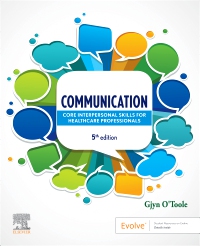

Communication - E-Book VBK, 5th Edition
Elsevier eBook on VitalSource
Now $31.49
Essential guide to better communication in practice
Communication is a core skill for all healthcare professionals, regardless of their specific discipline. The fifth edition of Communication: Core Interpersonal Skills for Healthcare Professionals provides a comprehensive introduction that will be invaluable for students undertaking any training program in health.
The book guides students toward an understanding of all the basic communication techniques and skills they will need in practice. They will learn to develop self-awareness about the impact their words and actions might have on others, use a person-centred model to reconstruct their communication style and approach, and then apply their new knowledge and skills to real-life scenarios.
Easy to read and logically ordered over four sections, this book will guide students towards developing lifelong communication skills that will ultimately enable optimal person-centred care, successful therapeutic relationships and positive patient outcomes.
-
- A focus on person-centred care and culturally responsive communication
- Assists students to reflect on their personal communication style and habits, then learn and practise strategies and skills to enhance future communication in practice
- Builds confidence in communication through activities, scenarios and case studies
- Explores communication with Indigenous peoples to improve healthcare outcomes
- Includes digital communication – overviews and tips on navigating professional and personal electronic media
- Scenarios, case studies, individual and group activities, role-plays and end-of-chapter questions support learning
- Straightforward language makes learning accessible for students in all health disciplines
- Student and instructor resources, including a quiz, semester planner and a tutorial guide contribute to engaging students
- New chapter on the requirements of communication within multidisciplinary or interprofessional teams
- Fully updated to reflect the latest research
- Updated references throughout the text to reflect current discussion and requirements of communication in healthcare
Instructor resources on Evolve:
- PowerPoint slides
- Semester planner
- Tutorial activities
- Testbank (MCQs)
- Image collection
Student and Instructor resources on Evolve:
- Answers to end-of-chapter review questions
- Student quiz (MCQ + T/F)
*This text is supported by Stories in Health Communication, 1st Edition, a collection of 12 short videos demonstrating effective and ineffective scenarios of communication.
-
-
 Elsevier Adaptive Quizzing for Communication: Core Interpersonal Skills for Health Professionals - NextGen VersionElsevier Adaptive Quizzing - Next Generation
 -
 Evolve Resources for CommunicationResources
 -
 CommunicationPaperback
-
-
Section One The Significance of Effective Interpersonal Communication in the Healthcare Professional
Chapter One Effective communication for healthcare professionals: A model to guide communication
Chapter Two The overarching goal of communication for healthcare professionals: Person-centred Care
Chapter Three The specific goals of communication for healthcare professionals: 1 Introductions and providing information
Chapter Four The specific goals of communication for healthcare professionals: 2 Questioning, comforting and confronting
Chapter Five The specific goals of communication for healthcare professionals: 3 Effective conclusions of interactions and services: Negotiating closure
Section Two Achieving Effective Communication by Developing Awareness within the Healthcare Professional
Chapter Six Awareness of and the need for reflective practice in healthcare communication
Chapter Seven Awareness of self to enhance healthcare communication
Chapter Eight Awareness of how personal assumptions affect healthcare communication
Chapter Nine Awareness of the whole ‘Person/s’ for healthcare communication
Chapter Ten Awareness of the effects of non-verbal communication for the healthcare professional
Chapter Eleven Awareness of listening to facilitate Person/s-centred communication in healthcare
Chapter Twelve Awareness of the effects of different environments upon healthcare communication
Section Three Managing the Realities of Communication as a Healthcare Professional
Chapter Thirteen Holistic Communication contributing to holistic healthcare
Chapter Fourteen Effective interpersonal communication within multidisciplinary teams
Chapter Fifteen Managing conflict when communicating as a healthcare professional
Chapter Sixteen Culturally responsive communication to accommodate cultural diversity in healthcare
Chapter Seventeen Communicating with Indigenous Peoples as a healthcare professional
Chapter Eighteen Misunderstandings and communication for the healthcare professional
Chapter Nineteen Ethical communication in healthcare
Chapter Twenty Remote or long-distance healthcare communication: 1 The unseen healthcare professional
Chapter 21 Remote telecommunication or telehealth: 2 The seen, but not-in-the-room healthcare professional
Chapter 22 Documentation: ‘one-way’ professional healthcare communication
Chapter 23 Social media or ‘not present in person’ communication and the healthcare professional
Section Four Scenarios to Guide Communication: Opportunities for the Healthcare Professional to Practise Communicating Effectively with ‘the Person/s’
Chapter 24 Person/s experiencing strong negative emotions
Chapter 25 Person/s in particular stages of the lifespan
Chapter 26 Person/s fulfilling particular life roles
Chapter 27 Person/s experiencing particular conditions
Chapter 28 Person/s in particular contexts
-
-
Ways of Reading
- The appearance of the text and page layout can be modified according to the capabilities of the reading system (font family and font size, spaces between paragraphs, sentences, words, and letters, as well as color of background and text)
- This e-publication is accessible to the full extent that the file format and types of content allow, on a specific reading device, by default, without necessarily including any additions such as textual descriptions of images or enhanced navigation
- No information about nonvisual reading is available
-
Conformance
- No information is available
-
Navigation
- Table of contents to all chapters of the text via links
- Page list to go to pages from the print source version
-
Rich Content
- No information is available
-
Hazards
- No information is available
-
Product Content
- No information is available
-
Legal Considerations
- No information is available
-
Additional Accessibility Information
- Content is enhanced with ARIA roles to optimize organization and facilitate navigation
- Page breaks included from the original print source
- For readers with color vision deficiency, use of color (e.g., in diagrams, graphics and charts, in prompts, or on buttons inviting a response) is not the sole means of graphical distinction or of conveying information
- E-publication includes basic navigation (usually less detailed than TOC-based navigation)
- Where links, controls or buttons are included in the content, the purpose or functionality of each link, control or button is apparent from the associated text alone - or where it is unclear, separate link, control or button descriptions are provided
- All (or substantially all) textual matter is arranged in a single logical reading order (including text that is visually presented as separate from the main text flow, e.g., in boxouts, captions, tables, footnotes, endnotes, citations, etc.). Non-textual content is also linked from within this logical reading order. (Purely decorative non-text content can be ignored).
- The language of the text has been specified (e.g., via the HTML or XML lang attribute) to optimise text-to-speech (and other alternative renderings), both at the whole document level and, where appropriate, for individual words, phrases or passages in a different language.
-
Ways of Reading

 as described in our