ISBN:
9780729598552
Copyright:
2024
Publication Date:
09-05-2023
Imprint:
Elsevier
List Price:
$55.99

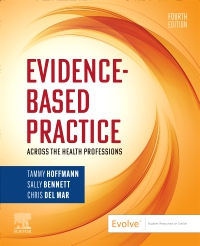
Evidence-Based Practice Across the Health Professions - E-Book, 4th Edition
by Tammy Hoffmann, OAM, BOccThy (Hons 1), PhD, FOTARA, FAHMS, Sally Bennett, BOccThy (Hons), PhD, FOTARA and Christopher Del Mar, BSc, MA, MB BChir, MD, FRACGP, FAFPHM, FAHMS
Elsevier eBook on VitalSource
ISBN:
9780729598552
Copyright:
2024
Publication Date:
09-05-2023
Imprint:
Elsevier
List Price:
$55.99
Was
$55.99
Now $50.39
Or $0.00 with a valid access code
Making decisions informed by evidence means that healthcare can be provided responsibly, collaboratively, effectively, and sustainably. Evidence-Based Practice Across the Health Professions is designed to guide and support students and clinicians to learn how to make evidence-informed decisions.
This book will help you learn how to decide what clinical questions to ask, search for research evidence to answer them, and analyse the evidence to decide if the results are believable, important, and applicable. You will learn how to talk with patients about evidence and make collaborative decisions and how to approach evidence implementation at an individual and organisational level.
Written by international and discipline leaders in evidence-based practice across a range of health professions, the fourth edition has been fully updated in line with the latest developments in this field from around the world.
This book will help you learn how to decide what clinical questions to ask, search for research evidence to answer them, and analyse the evidence to decide if the results are believable, important, and applicable. You will learn how to talk with patients about evidence and make collaborative decisions and how to approach evidence implementation at an individual and organisational level.
Written by international and discipline leaders in evidence-based practice across a range of health professions, the fourth edition has been fully updated in line with the latest developments in this field from around the world.
-
- Updated clinical scenarios woven through the chapters to bring theory to life
- Suitable for evidence-based practice teaching in a wide range of undergraduate and postgraduate professional courses, including: nursing, midwifery, physiotherapy, occupational therapy, speech pathology, exercise science, nutrition and dietetics, paramedicine, medicine, optometry, pharmacy, medical imaging and radiation therapy, psychology, podiatry, and complementary and alternative medicine
• Image collection
• PowerPoint slides
• Short answer and tutorial questions
• Clinical scenarios
• Test bank
Student and Instructor resources on Evolve:
• Interactive Quiz
• Worksheets -
1. Introduction to Evidence-Based Practice
2. Information Needs, Asking Questions, and Some Basics of Research Studies
3. Finding the Evidence
4. Evidence About Effects of Interventions
5. Questions About the Effects of Interventions
6. Evidence About Diagnosis
7. Questions About Diagnosis
8. Evidence About Prognosis
9. Questions About Prognosis
10. Understanding Evidence From Qualitative Research
11. Understanding Evidence From Qualitative Research
12. Appraising and Interpreting Systematic Reviews
13. Clinical Practice Guidelines
14. Shared Decision Making
15. Clinical Reasoning and Evidence-Based Practice
16. Implementing Evidence and Closing Research–Practice Gaps
17. Embedding Evidence-Based Practice into Routine Clinical Care -
-
Ways of Reading
- The appearance of the text and page layout can be modified according to the capabilities of the reading system (font family and font size, spaces between paragraphs, sentences, words, and letters, as well as color of background and text)
- This e-publication is accessible to the full extent that the file format and types of content allow, on a specific reading device, by default, without necessarily including any additions such as textual descriptions of images or enhanced navigation
- No information about nonvisual reading is available
-
Conformance
- No information is available
-
Navigation
- Table of contents to all chapters of the text via links
- Page list to go to pages from the print source version
-
Rich Content
- No information is available
-
Hazards
- No information is available
-
Product Content
- No information is available
-
Legal Considerations
- No information is available
-
Additional Accessibility Information
- Content is enhanced with ARIA roles to optimize organization and facilitate navigation
- Page breaks included from the original print source
- For readers with color vision deficiency, use of color (e.g., in diagrams, graphics and charts, in prompts, or on buttons inviting a response) is not the sole means of graphical distinction or of conveying information
- E-publication includes basic navigation (usually less detailed than TOC-based navigation)
- Where links, controls or buttons are included in the content, the purpose or functionality of each link, control or button is apparent from the associated text alone - or where it is unclear, separate link, control or button descriptions are provided
- All (or substantially all) textual matter is arranged in a single logical reading order (including text that is visually presented as separate from the main text flow, e.g., in boxouts, captions, tables, footnotes, endnotes, citations, etc.). Non-textual content is also linked from within this logical reading order. (Purely decorative non-text content can be ignored).
- The language of the text has been specified (e.g., via the HTML or XML lang attribute) to optimise text-to-speech (and other alternative renderings), both at the whole document level and, where appropriate, for individual words, phrases or passages in a different language.
-
Ways of Reading


Was
$55.99
Now $50.39
Or $0.00 with a valid access code

 as described in our