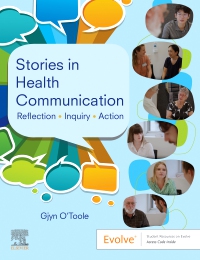

Stories in Health Communication - E-Book VBK, 1st Edition
Elsevier eBook on VitalSource
Now $34.19
Video scenarios of effective and ineffective communication
Effective communication is a prerequisite for safe and high-quality health care. Stories in Health Communication consists of a series of videos and accompanying text designed to support readers to develop their communication skills to pass their assessments and to communicate more effectively in practice.
The Stories book includes 12 short videos demonstrating effective and ineffective interactions between health practitioners and individuals. Students are encouraged to first watch each video, then complete the related activities to develop their own understanding and competence.
This book will help students critique different communication interactions, reflect on their own habits, consider new skills for communicating more effectively to different people in different settings, and then apply what they learn to practice.
-
- Aligned to key concepts from Communication: Core Interpersonal Skills for Health Professionals 5e by Gjyn O’Toole
- Considers relevant aspects of communication including introducing, questioning, concluding, listening, non-verbal communication, holistic communication, navigating misunderstandings and communicating using telecommunication
- Discusses the implications of inappropriate use of social media
- Considers the relevance of self-reflection and how your assumptions may affect your ability to communicate effectively
-
-

-
 Stories in Health CommunicationPaperback
-
-
1. Introduction and initial information provision
2. Gathering relevant information by questioning leading to comforting, and confronting
3. Effective closure of interaction and services
4. Using Reflection to improve communication
5. Personal Assumptions affecting communication
6. Non-verbal communication
7. Listening to achieve understanding
8. Considering and managing different environments when communicating
9. Holistic communication: Considering the Whole Person/s
10. Misunderstandings and Conflict
13. Telehealth or Telecommunication to deliver healthcare
14. Social media -
-
Ways of Reading
- The appearance of the text and page layout can be modified according to the capabilities of the reading system (font family and font size, spaces between paragraphs, sentences, words, and letters, as well as color of background and text)
- This e-publication is accessible to the full extent that the file format and types of content allow, on a specific reading device, by default, without necessarily including any additions such as textual descriptions of images or enhanced navigation
- No information about nonvisual reading is available
-
Conformance
- No information is available
-
Navigation
- Table of contents to all chapters of the text via links
- Page list to go to pages from the print source version
-
Rich Content
- No information is available
-
Hazards
- No information is available
-
Product Content
- No information is available
-
Legal Considerations
- No information is available
-
Additional Accessibility Information
- Content is enhanced with ARIA roles to optimize organization and facilitate navigation
- Page breaks included from the original print source
- For readers with color vision deficiency, use of color (e.g., in diagrams, graphics and charts, in prompts, or on buttons inviting a response) is not the sole means of graphical distinction or of conveying information
- E-publication includes basic navigation (usually less detailed than TOC-based navigation)
- Where links, controls or buttons are included in the content, the purpose or functionality of each link, control or button is apparent from the associated text alone - or where it is unclear, separate link, control or button descriptions are provided
- All (or substantially all) textual matter is arranged in a single logical reading order (including text that is visually presented as separate from the main text flow, e.g., in boxouts, captions, tables, footnotes, endnotes, citations, etc.). Non-textual content is also linked from within this logical reading order. (Purely decorative non-text content can be ignored).
- The language of the text has been specified (e.g., via the HTML or XML lang attribute) to optimise text-to-speech (and other alternative renderings), both at the whole document level and, where appropriate, for individual words, phrases or passages in a different language.
-
Ways of Reading

 as described in our