ISBN:
9780729598835
Copyright:
2024
Publication Date:
09-29-2023
Page Count:
480
Imprint:
Elsevier
List Price:
$49.99

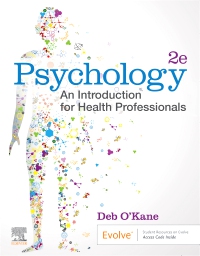
Psychology: An Introduction for Health Professionals - E-Book, 2nd Edition
by Debra O'Kane, RMN, ENB603, Grad Dip CN, MN, Grad Cert Ed (Higher Ed)
Elsevier eBook on VitalSource
ISBN:
9780729598835
Copyright:
2024
Publication Date:
09-29-2023
Page Count:
480
Imprint:
Elsevier
List Price:
$49.99
Was
$49.99
Now $44.99
Understanding the basics of psychology – what drives human choices and behaviours – underpins good practice in health. Psychology: An Introduction for Health Professionals presents the latest relevant theories and concepts, as well as their application to specific health issues and clinical practice.
Written by Deb O’Kane and other leading experts in the field, this book will help you understand more about why people act in certain ways related to their health and wellbeing, from diagnoses, health interventions and outcomes. For example, why does a person not complete a full course of antibiotics, or how can you expect a someone to respond to stress, loss or pain? Scenarios and reflection questions help to bring important psychology concepts to life.
The book is written specifically for health science and nursing students undertaking discreet units of study in psychology, but will also be applicable to practitioners in their daily work.
Written by Deb O’Kane and other leading experts in the field, this book will help you understand more about why people act in certain ways related to their health and wellbeing, from diagnoses, health interventions and outcomes. For example, why does a person not complete a full course of antibiotics, or how can you expect a someone to respond to stress, loss or pain? Scenarios and reflection questions help to bring important psychology concepts to life.
The book is written specifically for health science and nursing students undertaking discreet units of study in psychology, but will also be applicable to practitioners in their daily work.
-
- Includes relevant theories and concepts in psychology, incorporating latest evidence
- Focus on application to practice – suitable for both students and health practitioners
- Covers the lifespan, from birth to ageing
- Suite of 55 scenarios with reflection questions (additional 55 available on Evolve) bringing theory to life
- Suitable for students in multiple different health disciplines
Instructor resources on Evolve
• PowerPoints
• Testbank
• Image Collection
• Answer Key
• Student Practice Questions
• Additional Discipline-specific Case Studies -
-
 Elsevier Adaptive Quizzing for Psychology: An Introduction for Health Professionals 2E - NextGen VersionElsevier Adaptive Quizzing - Next Generation
-
-
SECTION 1
Theoretical approaches to psychology in healthcare practice
Chapter 1 Psychology: an introduction 3
Chapter 2 Research-informed practice 29
Chapter 3 Lifespan: the early years (birth to adolescence) 65
Chapter 4 Lifespan: middle and later years (adulthood to ageing) 93
Chapter 5 Health and health psychology 125
Chapter 6 The social context of behaviour 155
Chapter 7 Behaviour change 177
SECTION 2
Aspects of psychology in healthcare practice
Chapter 8 Communication in healthcare practice 209
Chapter 9 Stress and coping 235
Chapter 10 Loss 265
Chapter 11 Pain 299
Chapter 12 Partnerships in health 335
Chapter 13 Health promotion 359
SECTION 3
Application of psychology in healthcare practice
Chapter 14 Psychology in practice 387
Glossary 439
Index 453 -
-
Ways of Reading
- The appearance of the text and page layout can be modified according to the capabilities of the reading system (font family and font size, spaces between paragraphs, sentences, words, and letters, as well as color of background and text)
- This e-publication is accessible to the full extent that the file format and types of content allow, on a specific reading device, by default, without necessarily including any additions such as textual descriptions of images or enhanced navigation
- No information about nonvisual reading is available
-
Conformance
- No information is available
-
Navigation
- Table of contents to all chapters of the text via links
- Page list to go to pages from the print source version
-
Rich Content
- No information is available
-
Hazards
- No information is available
-
Product Content
- No information is available
-
Legal Considerations
- No information is available
-
Additional Accessibility Information
- Content is enhanced with ARIA roles to optimize organization and facilitate navigation
- Page breaks included from the original print source
- For readers with color vision deficiency, use of color (e.g., in diagrams, graphics and charts, in prompts, or on buttons inviting a response) is not the sole means of graphical distinction or of conveying information
- E-publication includes basic navigation (usually less detailed than TOC-based navigation)
- Where links, controls or buttons are included in the content, the purpose or functionality of each link, control or button is apparent from the associated text alone - or where it is unclear, separate link, control or button descriptions are provided
- All (or substantially all) textual matter is arranged in a single logical reading order (including text that is visually presented as separate from the main text flow, e.g., in boxouts, captions, tables, footnotes, endnotes, citations, etc.). Non-textual content is also linked from within this logical reading order. (Purely decorative non-text content can be ignored).
- The language of the text has been specified (e.g., via the HTML or XML lang attribute) to optimise text-to-speech (and other alternative renderings), both at the whole document level and, where appropriate, for individual words, phrases or passages in a different language.
-
Ways of Reading
Was
$49.99

 as described in our