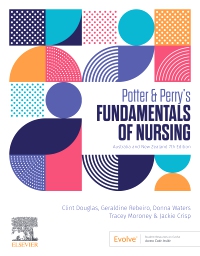

Potter & Perry's Fundamentals of Nursing - ANZ edition - E-Book VBK, 7th Edition
Elsevier eBook on VitalSource
-
- An essential ‘bookshelf’ reference for all students of nursing, clinicians and educators – includes information on the full range of learning required to register as a nurse
- Written by highly experienced nursing leaders, each contributing years of professional practice and experience to contextualise learning
- An emphasis on clinical reasoning, critical thinking and reflection – shows students how to apply theory to practice and to consider pragmatic aspects of implementation
- Learning is supported by inclusion of key information, Clinical Reasoning in Action processes (including framework, pathway and case studies), scenarios, evidence, critical reflection points, and links to NSQHS Standards in each chapter
- Essential part of the Potter & Perry suite – complemented by the Workbook and Student and Instructor assets, including clinical skills videos.
New to this edition
- New chapter on sustainability and planetary health
- Enhanced focus on clinical reasoning through inclusion of Clinical Reasoning in Action Framework, embedded within new Clinical Reasoning in Action Case Studies throughout the text
Instructor resources on Evolve:- NEW Teaching Tool
- Test bank
- Critical Reflection Points and answers
- PowerPoints
- Image collection
Students and Instructor resources on Evolve:- Clinical Skills videos
- Clinical Cases: Fundamentals of Nursing Case Studies
-
Section 11. Creating a proactive and dynamic nursing profession
Francine Douce2. Building nursing practice: the Fundamentals of Care Framework
Tiffany Conroy, Alison Lydia Kitson, Rebecca Feo, Sylvie Rey and Jan Alderman3. Engaging patients and keeping them safe
Rebecca Feo, Tiffany Conroy, Alison Lydia Kitson and Jan Alderman4. Enabling cultural safety
Leonie Cox, Ali Drummond, Chris Taua and Jacquie Kidd5. Partnering in care
Nicola Brown and Yun-Hee Jeon6. Sustainable health care
Lorraine Fields and Suzanne Bowdler
Section 2
7. Developing clinical reasoning for nursing practice
Sally-Anne Bessell, Jan Alderman and Elyce Pate8. Gathering relevant information and making decisions
Jan Alderman, Elyce Pate and Sally-Anne Bessell9. Collaborative priority setting, delivering care and evaluating outcomes
Jan Alderman, Elyce Pate and Sally-Anne Bessell10. Generating and using nursing knowledge
Lynn Sinclair11. Collaborating for integrated care
Alexa Buliak, Keith Jones, Louise Connolly, Margaret Martin, Sally Peters and Suzanne Murray12. Examining the ethical practice of nursing
Megan-Jane Johnstone13. Practicing within regulatory frameworks
Elaine Papps and Sally Ann Robertson14. Placing communication at the heart of person-centred care
Jane Stein-Parbury, Mark Andrew Goodhew and Fiona Orr
Section 315. The vital signs: Using a primary survey approach for patient assessment
Clint Douglas16. Undertaking a focused assessment: Physical assessment of body systems
Clint Douglas17. Preventing and controlling infection
Vanessa Sparke and Andrea Grimes18. Optimising skin integrity and wound care
Christina Narelle Parker and Kim Kaim19. Ensuring medication safety
Jacqueline Bloomfield and Astrid Frotjold20. Promoting mobility
Evan Plowman and Krishna Lambert21. Assessing and managing pain
Anthony Schoenwald22. Supporting oxygenation and perfusion
Sharon Maclean23. Balancing fluid, electrolyte and acid-base
Georgina Willetts and Laurina Schmidt24. Meeting nutritional needs
Andrea P. Marshall and Shelley Roberts25. Maintaining hygiene
Lise Duggan26. Managing continence: urinary
Elizabeth Watt27. Managing continence: bowel
Elizabeth Watt28. Fostering sleep
Christopher Gordon
Section 429. Care across the lifespan: conception to adulthood
Donna Waters30. Considering the older person
Samuel Lapkin and Lynette L. Chenoweth31. Considering the person with disability
Julie Pryo, Murray John Fisher and Angela Davenport32. Considering sexuality and sexual health
Donna Margaret Tilley and Jo Perks33. Managing mental health and wellbeing
Deb O'Kane34. Considering end of life care
Patsy Yates and John Patrick Rosenberg
Section 535. Working in the aged care sector
Lynette L. Chenoweth and Anna Williams36. Working in primary and community health sectors
Ailsa Munns37. Working in the acute care sector
Debbie Massey and Leisa Swift38. Working in mental health
Anthony O'Brien -
-
Ways of Reading
- The appearance of the text and page layout can be modified according to the capabilities of the reading system (font family and font size, spaces between paragraphs, sentences, words, and letters, as well as color of background and text)
- This e-publication is accessible to the full extent that the file format and types of content allow, on a specific reading device, by default, without necessarily including any additions such as textual descriptions of images or enhanced navigation
- No information about nonvisual reading is available
-
Conformance
- No information is available
-
Navigation
- Table of contents to all chapters of the text via links
- Page list to go to pages from the print source version
-
Rich Content
- No information is available
-
Hazards
- No information is available
-
Product Content
- No information is available
-
Legal Considerations
- No information is available
-
Additional Accessibility Information
- Content is enhanced with ARIA roles to optimize organization and facilitate navigation
- Page breaks included from the original print source
- For readers with color vision deficiency, use of color (e.g., in diagrams, graphics and charts, in prompts, or on buttons inviting a response) is not the sole means of graphical distinction or of conveying information
- E-publication includes basic navigation (usually less detailed than TOC-based navigation)
- Where links, controls or buttons are included in the content, the purpose or functionality of each link, control or button is apparent from the associated text alone - or where it is unclear, separate link, control or button descriptions are provided
- All (or substantially all) textual matter is arranged in a single logical reading order (including text that is visually presented as separate from the main text flow, e.g., in boxouts, captions, tables, footnotes, endnotes, citations, etc.). Non-textual content is also linked from within this logical reading order. (Purely decorative non-text content can be ignored).
- The language of the text has been specified (e.g., via the HTML or XML lang attribute) to optimise text-to-speech (and other alternative renderings), both at the whole document level and, where appropriate, for individual words, phrases or passages in a different language.
-
Ways of Reading



 as described in our