ISBN:
9780729599252
Copyright:
2027
Publication Date:
03-11-2026
Page Count:
1746
Imprint:
Elsevier
List Price:
$52.99

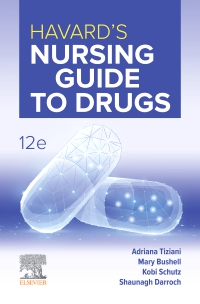
Havard’s Nursing Guide to Drugs - E-Book VBK, 12th Edition
by Adriana Tiziani, RN, BSc(Mon), Dip Ed(Melb), MEdSt(Mon), MRCNA, Mary Bushell, BPharm (Hons), GCLTHE, PhD, Kobi Schutz, BN, MPubHlth, GradCertEd and Shaunagh Darroch, BSc, MPharm,GradCertAcaPrac
Elsevier eBook on VitalSource
ISBN:
9780729599252
Copyright:
2027
Publication Date:
03-11-2026
Page Count:
1746
Imprint:
Elsevier
List Price:
$52.99
Was
$52.99
Now $50.34
Or $0.00 with a valid access code
Havard’s Nursing Guide to Drugs is an indispensable guide for nurses and nursing students that can be used both as a quick reference for medicine information and to acquire a deeper understanding for safe and effective drug administration by nurses.
The guide is accessible and user friendly. It provides all the information you need for safe administration of medication, with drugs classified by both therapeutic class and body system for easy navigation.
The twelfth edition has been comprehensively reviewed and updated to ensure that usage, dose, side-effects, contraindications and precautions are consistent with current Australian pharmaceutical guidelines.
-
- Easy-to-use format – search for drugs by therapeutic class or body system
- All the important information nurses need – poisons information, formulae for calculations of drug doses and drip rates
- Nursing considerations such as patient safety, administration advice and cautions
- Drug monographs include active ingredient and trade names, available forms, action, use, dosage, adverse effects and interactions
- Patient education and advice notes to improve patient care and outcomes
- A separate durable pocket card suitable for attaching to a lanyard with formulae, useful units and concentrations, and common abbreviations
- Available in print and eBook
New to this edition
- Each drug reviewed to ensure its relevance for nurses in Australia
- Chapter introductions updated citing the latest evidence, in a language that promotes nurse and nursing student understanding
- Updated icons offering a quick visual guide, helping readers locate key drug information including pregnancy and breastfeeding safety, crushability, dosage adjustments, and considerations for older adults and in sports
- Therapeutic Goods Administration drug scheduling incorporated specifically for Schedule 8 medications
-
-
 Havard’s Nursing Guide to Drugs 12ePaperback
-
-
1. Acne treatment
2. Analgesics and nonsteroidal anti‐inflammatory drugs NSAID
3. Anorectics and weight-loss agents
4. Anthelmintics
5. Antialzheimer's agents
6. Antianginal agents
7. Antianxiety agents
8. Antiarrhythmic agents
9. Antiasthma agents, bronchodilators and respiratory agents
10. Antibacterial agents
11. Anticoagulant and antithrombotic agents
12. Antidepressants
13. Antidiabetic agents
14. Antidiarrhoeal agents
15. Antidotes, antagonists and chelating agents
16. Antiemetic agents
17. Antiepileptics
18. Antifungal agents
19. Antiglaucoma agents
20. Antigout and uricolytic agents
21. Antihistamines
22. Antihypertensive agents
23. Antimalarial agents
24. Antimigraine agents
25. Antimycobacterial agents
26. Antineoplastic agents
27. Antineoplastic support agents
28. Antiparkinson's agents
29. Antiplatelet agents
30. Antiprotozoal agents
31. Antipsychotic and mood stabilising agents
32. Antiulcer agents
33. Antiviral agents
34. Bladder function disorder agents
35. Bone and calcium regulating agents
36. Cardiac glycosides
37. Cholinergic and anticholinergic agents
38. Corticosteroids
39. Cough suppressants, expectorants and mucolytics
40. Dermatological agents
41. Disease modifying antirheumatic drugs
42. Diuretics
43. Drug dependence
44. Erectile dysfunction agents
45. Eye, ear, nose and throat agents
46. Fibrinolytic agents
47. Gastrointestinal agents miscellaneous
48. General anaesthetics
49. Haemopoietic agents
50. Haemostatics
51. Hypothalamic and pituitary hormones
52. Immunomodifiers
53. Laxatives
54. Lipid regulating agents
55. Local anaesthetics
56. Metabolic disorders agents
57. Movement disorders agents
58. Muscle relaxants
59. Neuromuscularblocking agents
60. Opioid analgesics
61. Pregnancy, childbirth and breastfeeding
62. Pulmonary hypertension agents
63. Sedatives and hypnotics
64. Sex hormones
65. Stimulants
66. Sympathomimetic agents
67. Thyroid and antithyroid agents
68. Vaccines, immunoglobulins and antivenoms
69. Vasodilators
70. Vitamins, minerals and electrolytes
71. Antacids
Miscellaneous agents
Appendix
1. Poisoning and its treatment
2. Poisons information centres
3. Changes to drug names -
-
Ways of Reading
- The appearance of the text and page layout can be modified according to the capabilities of the reading system (font family and font size, spaces between paragraphs, sentences, words, and letters, as well as color of background and text)
- This e-publication is accessible to the full extent that the file format and types of content allow, on a specific reading device, by default, without necessarily including any additions such as textual descriptions of images or enhanced navigation
- No information about nonvisual reading is available
-
Conformance
- No information is available
-
Navigation
- Table of contents to all chapters of the text via links
- Page list to go to pages from the print source version
-
Rich Content
- No information is available
-
Hazards
- No information is available
-
Product Content
- No information is available
-
Legal Considerations
- No information is available
-
Additional Accessibility Information
- Content is enhanced with ARIA roles to optimize organization and facilitate navigation
- Page breaks included from the original print source
- For readers with color vision deficiency, use of color (e.g., in diagrams, graphics and charts, in prompts, or on buttons inviting a response) is not the sole means of graphical distinction or of conveying information
- E-publication includes basic navigation (usually less detailed than TOC-based navigation)
- Where links, controls or buttons are included in the content, the purpose or functionality of each link, control or button is apparent from the associated text alone - or where it is unclear, separate link, control or button descriptions are provided
- All (or substantially all) textual matter is arranged in a single logical reading order (including text that is visually presented as separate from the main text flow, e.g., in boxouts, captions, tables, footnotes, endnotes, citations, etc.). Non-textual content is also linked from within this logical reading order. (Purely decorative non-text content can be ignored).
- The language of the text has been specified (e.g., via the HTML or XML lang attribute) to optimise text-to-speech (and other alternative renderings), both at the whole document level and, where appropriate, for individual words, phrases or passages in a different language.
-
Ways of Reading
Was
$52.99
Now $50.34
Or $0.00 with a valid access code

 as described in our