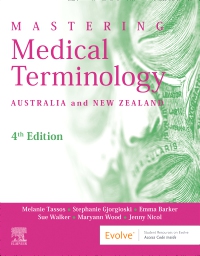

Mastering Medical Terminology - E-Book VBK, 4th Edition
Elsevier eBook on VitalSource
-
- Combines learning and application in one text – the only reference guide needed for the undergraduate and early clinical years
- Takes a ‘building blocks’ approach - learn the basics of word structures first, then the more complex terminology associated with the human body as a whole and then each body system
- Simple, non-technical explanations of medical terms, clinical procedures, laboratory tests and abbreviations
- Optimises learning with a wide variety of activities and exercises
- Includes a pronunciation guide and practice exercises, examples of terminology in context and diagrams and illustrations to enhance understanding
- Additional resources including multiple choice questions, Test bank, audio glossary and flash cards available online
New to this edition- Additional and updated information on COVID-19
- Common acronyms and abbreviations found in medical/health/patient records
- Medical terminology specific to robotic assisted procedures and artificial intelligence in healthcare
Instructor resources on Evolve:- Lesson plans
- Semester planner
- Power point presentations
- Image Library
- Test bank
Students and Instructor resources on Evolve:- Flashcards
- MCQ’s
- Audio Glossary
-
-

-
 Mastering Medical TerminologyPaperback
-
-
Preface
Acknowledgments
How to use this book
Module 1: IntroductionChapter 1: Basic Word Structure
Chapter 2: Building a Medical Vocabulary
Module 2: The Body as a FrameworkChapter 3: The Human Body
Chapter 4: Musculoskeletal System
Chapter 5: Integumentary System
Module 3: Internal Workings of the BodyChapter 6: Haematology
Chapter 7: Lymphatic and Immune Systems
Chapter 8: Endocrine System
Chapter 9: Cardiovascular System
Chapter 10: Respiratory System
Chapter 11: Digestive System
Chapter 12: Nervous System
Chapter 13: The Senses
Chapter 14: Urinary System
Chapter 15: Male Reproductive System
Chapter 16: Female Reproductive System
Chapter 17: Obstetrics and Neonatology
Chapter 18: Mental Health
Module 4: Systemic ConditionsChapter 19: Oncology
Chapter 20: Infectious and Parasitic Disease
Chapter 21: Radiology and Nuclear Medicine
Chapter 22: Pharmacology
Module 5: Special ApplicationsChapter 23: Complementary and Alternative Therapies
Chapter 24: Public Health, Epidemiology and Research Terms
Word element glossary
Glossary of medical terms
Specific word elements
Normal reference values for haematological testing
Abbreviations
Answer Guide
Picture credits
Index -
-
Ways of Reading
- The appearance of the text and page layout can be modified according to the capabilities of the reading system (font family and font size, spaces between paragraphs, sentences, words, and letters, as well as color of background and text)
- This e-publication is accessible to the full extent that the file format and types of content allow, on a specific reading device, by default, without necessarily including any additions such as textual descriptions of images or enhanced navigation
- No information about nonvisual reading is available
-
Conformance
- No information is available
-
Navigation
- Table of contents to all chapters of the text via links
- Page list to go to pages from the print source version
-
Rich Content
- No information is available
-
Hazards
- No information is available
-
Product Content
- No information is available
-
Legal Considerations
- No information is available
-
Additional Accessibility Information
- Content is enhanced with ARIA roles to optimize organization and facilitate navigation
- Page breaks included from the original print source
- For readers with color vision deficiency, use of color (e.g., in diagrams, graphics and charts, in prompts, or on buttons inviting a response) is not the sole means of graphical distinction or of conveying information
- E-publication includes basic navigation (usually less detailed than TOC-based navigation)
- Where links, controls or buttons are included in the content, the purpose or functionality of each link, control or button is apparent from the associated text alone - or where it is unclear, separate link, control or button descriptions are provided
- All (or substantially all) textual matter is arranged in a single logical reading order (including text that is visually presented as separate from the main text flow, e.g., in boxouts, captions, tables, footnotes, endnotes, citations, etc.). Non-textual content is also linked from within this logical reading order. (Purely decorative non-text content can be ignored).
- The language of the text has been specified (e.g., via the HTML or XML lang attribute) to optimise text-to-speech (and other alternative renderings), both at the whole document level and, where appropriate, for individual words, phrases or passages in a different language.
-
Ways of Reading

 as described in our