ISBN:
9781437706086
Copyright:
2010
Publication Date:
04-01-2009
Page Count:
608
Imprint:
Saunders
List Price:
$112.99

The Sectional Anatomy Learning System - Elsevier eBook on VitalSource, 3rd Edition
by Edith Applegate, MS
Elsevier eBook on VitalSource
ISBN:
9781437706086
Copyright:
2010
Publication Date:
04-01-2009
Page Count:
608
Imprint:
Saunders
List Price:
$112.99
Most review copies are eBooks – how fast!
A review copy request is most likely to be fulfilled as an eBook on VitalSource rather than a print product, unless no eBook is available. eBooks become available in as little as a few hours. Print products will take between 7 and 10 days to arrive. To request a print copy, please contact us through the Evolve Support Center for further assistance or contact your Elsevier Sales Rep.
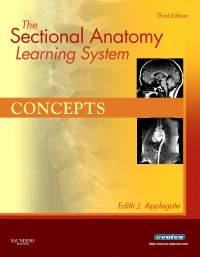
Designed to provide a thorough understanding of sectional anatomy, this unique, two-volume set is a complete, easy-to-use learning package. Volume 1, "Concepts," presents detailed, readable descriptions of sectional anatomy of the entire body broken down into body systems. It focuses on how different structures within a system are related, so your students can form a clear picture of how everything fits together. The text is highlighted with many new labeled diagnostic images, including radiographs, CT, MR, and sonograms. Volume 2, "Applications," is an interactive workbook with coloring, labeling, and other exercises designed to help students identify the structures most commonly encountered in various imaging techniques.
-
- Many more labeled, high-quality images, including MRI, CT and sonography help you learn anatomy using real-life images you’ll see in clinics and in practice.
- Quick Check Questions test your understanding of the material as you progress through the chapters.
- Important Anatomical Relationships section describes relationships between anatomical structures and refers you to relevant images.
- Working with Images sections in each body system chapter provide additional discussion and diagnostic images, helping you learn to identify anatomical structures with a variety of imaging modalities.
- List of Key Terms at the beginning of each chapter alert you to the terms you need to watch for before you read.
- More exercises with diagnostic images in the Applications volume, giving additional opportunities to identify and label anatomic structures on actual images.
- Answers to all Quick Check questions are given in the back of the book, allowing for immediate feedback; answers to the other questions and exercises are available online on Evolve.
- Evolve Online Resources contains images of cadaver sections, allowing you to see anatomy related to the line drawings in the book.
-
- Many more labeled, high-quality images, including MRI, CT and sonography help your students learn anatomy using real-life images you'll see in clinics and in practice.
- Quick Check Questions test your students' understanding of the material as they progress through the chapters.
- Important Anatomical Relationships section describes relationships between anatomical structures and refers students to relevant images.
- Working with Images sections in each body system chapter provide additional discussion and diagnostic images, helping your students learn to identify anatomical structures with a variety of imaging modalities.
- List of Key Terms at the beginning of each chapter alert students to the terms they need to watch for before they read.
- More exercises with diagnostic images in the Applications volume, giving additional opportunities to identify and label anatomic structures on actual images.
- Answers to all Quick Check questions are given in the back of the book, allowing for immediate feedback; answers to the other questions and exercises are available online on Evolve.
- Evolve Online Resources contains images of cadaver sections, allowing your students to see anatomy related to the line drawings in the book.
-
1. Introduction to Sectional Anatomy
2. The Thorax
3. The Abdomen
4. The Pelvis
5. The Head
6. The Vertebral Column, Spinal Cord, and Neck
7. The Upper Extremity
8. The Lower Extremity
Suggested Readings
Eponyms
Combining Forms
Glossary
Index -
-
Ways of Reading
- The appearance of the text and page layout can be modified according to the capabilities of the reading system (font family and font size, spaces between paragraphs, sentences, words, and letters, as well as color of background and text)
- This e-publication is accessible to the full extent that the file format and types of content allow, on a specific reading device, by default, without necessarily including any additions such as textual descriptions of images or enhanced navigation
- All content can be read as read aloud speech or dynamic braille
-
Conformance
- For detailed accessibility information, see Elsevier's website at https://www.elsevier.com/about/accessibility
- For queries regarding accessibility information, contact [email protected]
- The publication was certified on 07-04-2026
-
Navigation
- Table of contents to all chapters of the text via links
- Page list to go to pages from the print source version
-
Rich Content
- No information is available
-
Hazards
- No information is available
-
Product Content
- No information is available
-
Legal Considerations
- Elsevier is committed to making our eBooks accessible and complying with applicable laws. Given our vast library of titles, there are some cases where making an eBook fully accessible presents unique challenges, and including full features could transform its nature to no longer serve its primary purpose or result in a disproportionate burden for the publisher. As a result this eBook may have limited accessibility. See more at https://www.elsevier.com/en-gb/about/accessibility.
- Please refer to our disproportionate burden or fundamental modification statements.
-
Additional Accessibility Information
- Page breaks included from the original print source
- E-publication includes basic navigation (usually less detailed than TOC-based navigation)
- All (or substantially all) textual matter is arranged in a single logical reading order (including text that is visually presented as separate from the main text flow, e.g., in boxouts, captions, tables, footnotes, endnotes, citations, etc.). Non-textual content is also linked from within this logical reading order. (Purely decorative non-text content can be ignored).
- The language of the text has been specified (e.g., via the HTML or XML lang attribute) to optimise text-to-speech (and other alternative renderings), both at the whole document level and, where appropriate, for individual words, phrases or passages in a different language.
-
Ways of Reading


Most review copies are eBooks – how fast!
A review copy request is most likely to be fulfilled as an eBook on VitalSource rather than a print product, unless no eBook is available. eBooks become available in as little as a few hours. Print products will take between 7 and 10 days to arrive. To request a print copy, please contact us through the Evolve Support Center for further assistance or contact your Elsevier Sales Rep.

 as described in our