ISBN:
9781437708547
Copyright:
2010
Publication Date:
01-04-2010
Page Count:
1280
Imprint:
Saunders
List Price:
$100.99

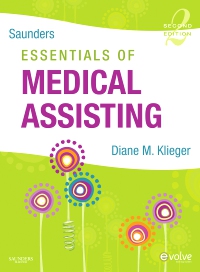
Saunders Essentials of Medical Assisting - Elsevier eBook on VitalSource, 2nd Edition
by Diane M. Klieger, RN, MBA, CMA (AAMA)
Elsevier eBook on VitalSource
ISBN:
9781437708547
Copyright:
2010
Publication Date:
01-04-2010
Page Count:
1280
Imprint:
Saunders
List Price:
$100.99
Was
$100.99
Now $70.69
Or $0.00 with a valid access code
Saunders Essentials of Medical Assisting, 2nd Edition, is designed to give you just the right amount of the essential information you need to prepare for your career as a medical assistant. It covers all of the need-to-know information in an organized, approachable format. The condensed information is perfect for shorter programs of study and as a review tool for certification or re-certification for practicing medical assistants. Full-color and visually oriented, this text presents information in manageable segments that give you all the relevant facts, without being overwhelming. With the most up-to-date information on basic body systems; foundational concepts such as medical terminology, nutrition, and full coverage of office concepts and procedures, you’ll have everything you need to know to begin your Medical Assisting career with confidence.
-
- UPDATED information on Medical Office Technology prepares students for jobs in today’s modern, and often hectic, medical offices.
- NEW Disaster Preparedness content demonstrates how medical offices can work closely with community and health departments during an emergency.
- Newly organized information emphasizes foundational areas of knowledge, with new chapters on Nutrition, Phlebotomy (Venipuncture), and Blood, Lymphatic, and Immune Systems.
-
- NEW! Nora AI - an AI-powered learning assistant exclusive to Elsevier ebooks on VitalSource's Bookshelf® platform - offers built-in AI learning support that provides personalized answers based on content from the Elsevier ebook
- Full-color design is visually stimulating and great for visual learners
- Helpful studying features guide students through the material, such as: Learning Objectives for every chapter, Key Information summarized in tables throughout the text, and emphasized Key Words!
- Practical Applications case studies at the beginning of each chapter quickly introduce students to real-life Medical Assisting
- Word Parts and Abbreviations at the end of the Anatomy and Physiology sections reinforce learned medical terminology
- Illustrated step-by-step Procedures, with charting examples and rationales, show how to perform and document administrative and clinical procedures
-
Section One: Strategies for Success
1. Successful Learning
2. Becoming a Professional
Section Two: Foundational Concepts
3. Diversity In Health Care Delivery
4. Law and Ethics in Health Care
5. Understanding Human Behavior
6. Understanding Patient Behavior
7. Effective Communicaton
8. Communicating with Patients
9. Nutrition (NEW)
10. Understanding Medical Terminology
Section Three: Anatomy and Physiology
11. Basic Anatomy and Physiology
12. The Circulatory System
13. Blood, Lymphatic, and Immune Systems (NEW – content split off from The Circulatory System)
14. Respiratory System
15. Digestive System
16. Nervous System
17. Sensory System
18. Skeletal System
19. Muscular System
20. Urinary System
21. Reproductive System
22. Endocrine System
23. Integumentary System
Section Four: Administrative Medical Assisting
24. The Medical Office
25. Computers in the Medical Office
26. Medical Office Communication
27. Medical Records and Chart Documentation
28. Financial Management
29. Medical Coding
30. Medical Insurance
Section Five: Clinical Medical Assisting
31. Infection Control and Asepsis
32. Preparing the Examination Room
33. Body Measurements and Vital Signs
34. Medical History Taking
35. Assisting with the Physical Examination
36. Electrocardiography
37. Radiography and Diagnostic Testing
38. Therapeutic Procedures
39. Specialty Diagnostic Testing
40. Introduction to the Physician’s Office Laboratory
41. Phlebotomy (NEW)
42. Laboratory Testing in the Physician's Office
43. Understanding Medications
44. Administering Medications
45. Minor Office Surgery
46. Basic First Aid and Medical Office Emergencies
Section Six: Employment and Beyond
47. Beginning Your Job Search
Appendices
A. Common Abbreviations and Symbols
B. Common Prefixes and Suffixes
C. Common Laboratory Test Values
D. English-to-Spanish Guide
Glossary -
-
Ways of Reading
- The appearance of the text and page layout can be modified according to the capabilities of the reading system (font family and font size, spaces between paragraphs, sentences, words, and letters, as well as color of background and text)
- This e-publication is accessible to the full extent that the file format and types of content allow, on a specific reading device, by default, without necessarily including any additions such as textual descriptions of images or enhanced navigation
- No information about nonvisual reading is available
-
Conformance
- No information is available
-
Navigation
- Table of contents to all chapters of the text via links
- Page list to go to pages from the print source version
-
Rich Content
- No information is available
-
Hazards
- No information is available
-
Product Content
- No information is available
-
Legal Considerations
- No information is available
-
Additional Accessibility Information
- Page breaks included from the original print source
- For readers with color vision deficiency, use of color (e.g., in diagrams, graphics and charts, in prompts, or on buttons inviting a response) is not the sole means of graphical distinction or of conveying information
- E-publication includes basic navigation (usually less detailed than TOC-based navigation)
- Where links, controls or buttons are included in the content, the purpose or functionality of each link, control or button is apparent from the associated text alone - or where it is unclear, separate link, control or button descriptions are provided
- All (or substantially all) textual matter is arranged in a single logical reading order (including text that is visually presented as separate from the main text flow, e.g., in boxouts, captions, tables, footnotes, endnotes, citations, etc.). Non-textual content is also linked from within this logical reading order. (Purely decorative non-text content can be ignored).
- The language of the text has been specified (e.g., via the HTML or XML lang attribute) to optimise text-to-speech (and other alternative renderings), both at the whole document level and, where appropriate, for individual words, phrases or passages in a different language.
-
Ways of Reading

Was
$100.99
Now $70.69
Or $0.00 with a valid access code

 as described in our