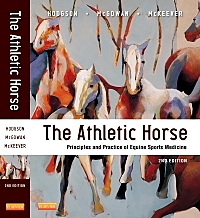

The Athletic Horse - Elsevier eBook on VitalSource, 2nd Edition
Elsevier eBook on VitalSource
Now $131.39
Showing how to maximize performance in horses, The Athletic Horse: Principles and Practice of Equine Sports Medicine, 2nd Edition describes sports training regimens and how to reduce musculoskeletal injuries. Practical coverage addresses the anatomical and physiological basis of equine exercise and performance, centering on evaluation, imaging, pharmacology, and training recommendations for sports such as racing and show jumping. Now in full color, this edition includes new rehabilitation techniques, the latest imaging techniques, and the best methods for equine transportation. Written by expert educators Dr. David Hodgson, Dr. Catherine McGowan, and Dr. Kenneth McKeever, with a panel of highly qualified contributing authors.
-
- NEW full-color photographs depict external clinical signs, allowing more accurate clinical recognition.
- NEW and improved imaging techniques maximize your ability to assess equine performance.
- UPDATED drug information is presented as it applies to treatment and to new regulations for drug use in the equine athlete.
- NEW advances in methods of transporting equine athletes ensure that the amount of stress on the athlete is kept to a minimum.
- NEW rehabilitation techniques help to prepare the equine athlete for a return to the job.
- Two NEW authors, Dr. Catherine McGowan and Dr. Kenneth McKeever, are highly recognized experts in the field.
-
- Expert international contributors provide cutting-edge equine information from the top countries in performance-horse research: the U.S., Australia, U.K., South Africa, and Canada.
- The latest nutritional guidelines maximize the performance of the equine athlete.
- Extensive reference lists at the end of each chapter provide up-to-date resources for further research and study.
-
-
 The Athletic HorseHardcover
-
-
Section I: Structure Considerations in Equine Sports Medicine
1. An Overview of Performance and Sports Medicine
2. Comparative Aspects of Exercise Physiology
Section II: Physiology of Exercise and Performance
3. Energetic Considerations of Exercise
4. Nutrition of the Performance Horse
5. Hematology and Biochemistry
6. Physiology of Acid-Base Balance and Fluid Shifts with Exercise
7. Endocrine and Immune Responses to Exercise and Training
8. Thermoregulation
9. The Respiratory System: Anatomy, Physiology, and Adaptations to Exercise and Training
10. Transport of Horses
11. The Cardiovascular System: Anatomy, Physiology, and Adaptations to Exercise and Training
12. Muscle: Anatomy, Physiology, and Adaptations to Exercise and Training
13. Tendon, Ligament, Bone, and Cartilage: Anatomy, Physiology, and Adaptations to Exercise and Training
14. Age and Disuse in Athletes: Effects of Detraining, Spelling, Injury, and Age
Section III: Biomechanics/Kinematics and Performance
15. Conformation
16. The Biomechanics of Equine Locomotion
17. Kinematics of the Equine Back and Pelvis
18. Functional Biomechanics: The Effect of the Rider and Track
Section IV: Practical Exercise Physiology
19. Training Regimens: Physiologic Adaptations to Training
20. Training Tthe Thoroughbred Racehorse
21. Training Standardbred Trotters and Pacers
22. Training Endurance Horses
23. Training the Event Horse
24. Dressage Tests, Movements, and Training: A Primer
25. Training Show Jumpers
26. Training the Working Horse
27. Training the Racing Quarterhorse
28. Evaluation of Performance Potential
29. Clinical Exercise Testing and Investigation of Poor Performance -
-
Ways of Reading
- The appearance of the text and page layout can be modified according to the capabilities of the reading system (font family and font size, spaces between paragraphs, sentences, words, and letters, as well as color of background and text)
- This e-publication is accessible to the full extent that the file format and types of content allow, on a specific reading device, by default, without necessarily including any additions such as textual descriptions of images or enhanced navigation
- No information about nonvisual reading is available
-
Conformance
- No information is available
-
Navigation
- Table of contents to all chapters of the text via links
- Page list to go to pages from the print source version
-
Rich Content
- No information is available
-
Hazards
- No information is available
-
Product Content
- No information is available
-
Legal Considerations
- No information is available
-
Additional Accessibility Information
- Page breaks included from the original print source
- For readers with color vision deficiency, use of color (e.g., in diagrams, graphics and charts, in prompts, or on buttons inviting a response) is not the sole means of graphical distinction or of conveying information
- E-publication includes basic navigation (usually less detailed than TOC-based navigation)
- Where links, controls or buttons are included in the content, the purpose or functionality of each link, control or button is apparent from the associated text alone - or where it is unclear, separate link, control or button descriptions are provided
- All (or substantially all) textual matter is arranged in a single logical reading order (including text that is visually presented as separate from the main text flow, e.g., in boxouts, captions, tables, footnotes, endnotes, citations, etc.). Non-textual content is also linked from within this logical reading order. (Purely decorative non-text content can be ignored).
- The language of the text has been specified (e.g., via the HTML or XML lang attribute) to optimise text-to-speech (and other alternative renderings), both at the whole document level and, where appropriate, for individual words, phrases or passages in a different language.
-
Ways of Reading

 as described in our