ISBN:
9781437711783
Copyright:
2009
Publication Date:
03-27-2009
Page Count:
336
Imprint:
Saunders
List Price:
$118.99

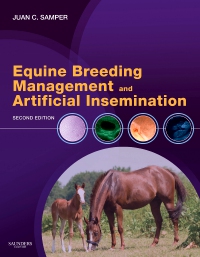
Equine Breeding Management and Artificial Insemination - Elsevier eBook on VitalSource, 2nd Edition
by Juan C. Samper, DVM, MSc, PhD, DiplACT
Elsevier eBook on VitalSource
ISBN:
9781437711783
Copyright:
2009
Publication Date:
03-27-2009
Page Count:
336
Imprint:
Saunders
List Price:
$118.99
Was
$118.99
Now $107.09
Or $0.00 with a valid access code
Put the principles of good breeding management into practice with Equine Breeding Management and Artificial Insemination, 2nd Edition for reproductive success! Practical information on the reproductive management of both thoroughbred and warmblood breeding operations prepares you to effectively breed even problem mares and stallions. Plus, detailed content on techniques, procedures, reproductive physiology, and more help you increase reproductive efficiency as well as track and improve your results throughout each breeding season.
-
- Vibrant full-color design and photographs show accurate representations of clinical appearance.
- Chapters covering the latest reproductive techniques improve chances of successful breeding, and improve survival rates after the birth of the foal.
- Vital chapters with information on recognizing potential problems help you quickly identify warning signs before fertility is negatively affected.
-
- A section on reproduction efficiency evaluation includes a worksheet to evaluate the performance of both mares and stallions during each breeding season, and helps you compare reproductive performance with previous breeding seasons.
- Detailed descriptions of procedures and techniques including embryo transfer, artificial insemination, and more enable you to implement the methods for better breeding results.
- Practical information on reproductive management of both thoroughbred and warmblood breeding operations enhance the fertility of problem mares and stallions.
- World-renowned authors and contributors with years of practical knowledge and experience provide cutting-edge information.
-
1. Anatomy and Physical Examination of the Stallion
2. Endocrinology of the Stallion
3. Semen Collection
4. Stallion Behavior
5. Sperm Physiology
6. Semen Evaluation
7. Breeding Management of the Thoroughbred Stallion (Shuttle)
8. Breeding Management of the Warmblood Stallion
9. Hormonal Manipulation of the Mare
10. Microbiology and Diseases of Semen
11. Anatomy and Physiology of the Mare
12. Uterine Edema of the Mare
13. Breeding Management of the Mare
14. Artificial Insemination With Cooled Semen
15. Artificial Insemination With Frozen Semen
16. Embryo Transfer
17. Preservation of Equine Embryos
18. Assisted Reproductive Techniques in the Mare
19. The Early Pregnancy
20. Evaluation of the Foal In-Utero
21. Infectious Problems in the Last Trimester of Pregnancy
22. Parturition and Evaluation of the Placenta
23. The New Born Foal
24. Breeding the Post-partum Mare
25. Preventive Medicine of the Brood Mare
26. Evaluation of Reproductive Efficiency
27. Significance of the Equine Genome on the Horse Industry -
-
Ways of Reading
- The appearance of the text and page layout can be modified according to the capabilities of the reading system (font family and font size, spaces between paragraphs, sentences, words, and letters, as well as color of background and text)
- This e-publication is accessible to the full extent that the file format and types of content allow, on a specific reading device, by default, without necessarily including any additions such as textual descriptions of images or enhanced navigation
- All content can be read as read aloud speech or dynamic braille
-
Conformance
- For detailed accessibility information, see Elsevier's website at https://www.elsevier.com/about/accessibility
- For queries regarding accessibility information, contact [email protected]
- The publication was certified on 07-04-2026
-
Navigation
- Table of contents to all chapters of the text via links
- Page list to go to pages from the print source version
-
Rich Content
- No information is available
-
Hazards
- No information is available
-
Product Content
- No information is available
-
Legal Considerations
- Elsevier is committed to making our eBooks accessible and complying with applicable laws. Given our vast library of titles, there are some cases where making an eBook fully accessible presents unique challenges, and including full features could transform its nature to no longer serve its primary purpose or result in a disproportionate burden for the publisher. As a result this eBook may have limited accessibility. See more at https://www.elsevier.com/en-gb/about/accessibility.
- Please refer to our disproportionate burden or fundamental modification statements.
-
Additional Accessibility Information
- Page breaks included from the original print source
- E-publication includes basic navigation (usually less detailed than TOC-based navigation)
- All (or substantially all) textual matter is arranged in a single logical reading order (including text that is visually presented as separate from the main text flow, e.g., in boxouts, captions, tables, footnotes, endnotes, citations, etc.). Non-textual content is also linked from within this logical reading order. (Purely decorative non-text content can be ignored).
- The language of the text has been specified (e.g., via the HTML or XML lang attribute) to optimise text-to-speech (and other alternative renderings), both at the whole document level and, where appropriate, for individual words, phrases or passages in a different language.
-
Ways of Reading

Was
$118.99
Now $107.09
Or $0.00 with a valid access code

 as described in our