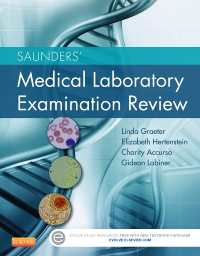

Elsevier's Medical Laboratory Science Examination Review - Elsevier eBook on VitalSource, 1st Edition
Elsevier eBook on VitalSource
The newest exam prep resource to enter MLS education, Elsevier's Medical Laboratory Science Examination Review gives your students all the review, practice, and support they need to prepare for the both the MLS and MLT certification examinations. Each chapter offers a thorough review on one of the core areas of Medical Laboratory Science as outlined by the ASCP Board of Certification. Practice questions are also offered at the end of each chapter and explanations and rationales for each correct answer appear at the end of the text. Plus, an eight-page full-color insert features photomicrographs of hematological and microbiological specimens exactly as they appear under the microscope and on the MLS and MLT certification exams. A mock certifications exam is included in the print book as well as online at the companion Evolve website – which also houses additional questions for student practice – totaling 1,000 questions in all.
-
- Online mock exams on the companion Evolve website include all the practice questions from the book plus additional unique questions that can be used to create mock exams for extra practice.
- Content reviews in outline form enables each topic to be easily reviewed but covered in an appropriate depth.
- Print mock exam at the end of the book contains 100 certification examination preparation questions.
- Test-taking tips and suggestions discuss the exam, how it’s set up and scored, when to answer, guess and not answers questions, how to identify distracters, and more.
- Eight-page full-color insert within the book features 50 illustrations that show hematological and microbiological photomicrographs.
- Inclusion of both MLS and MLT level content and questions enables the book to be used for both certification exams.
-
1. Microbiology
2. Mycology/Virology and Parasitology
3. Hematology
4. Hemostasis
5. Urinalysis and Body Fluids
6. Immunology and Serology
7. Immunohematology
8. Clinical Chemistry
9. Molecular Diagnostics
10. Laboratory Operations
11. Laboratory CalculationsAppendix A: Rationales for Certification Preparation Questions
Appendix B: Mock Examination -
-
Ways of Reading
- The appearance of the text and page layout can be modified according to the capabilities of the reading system (font family and font size, spaces between paragraphs, sentences, words, and letters, as well as color of background and text)
- This e-publication is accessible to the full extent that the file format and types of content allow, on a specific reading device, by default, without necessarily including any additions such as textual descriptions of images or enhanced navigation
- No information about nonvisual reading is available
-
Conformance
- No information is available
-
Navigation
- Table of contents to all chapters of the text via links
- Page list to go to pages from the print source version
-
Rich Content
- No information is available
-
Hazards
- No information is available
-
Product Content
- No information is available
-
Legal Considerations
- No information is available
-
Additional Accessibility Information
- Page breaks included from the original print source
- For readers with color vision deficiency, use of color (e.g., in diagrams, graphics and charts, in prompts, or on buttons inviting a response) is not the sole means of graphical distinction or of conveying information
- E-publication includes basic navigation (usually less detailed than TOC-based navigation)
- Where links, controls or buttons are included in the content, the purpose or functionality of each link, control or button is apparent from the associated text alone - or where it is unclear, separate link, control or button descriptions are provided
- All (or substantially all) textual matter is arranged in a single logical reading order (including text that is visually presented as separate from the main text flow, e.g., in boxouts, captions, tables, footnotes, endnotes, citations, etc.). Non-textual content is also linked from within this logical reading order. (Purely decorative non-text content can be ignored).
- The language of the text has been specified (e.g., via the HTML or XML lang attribute) to optimise text-to-speech (and other alternative renderings), both at the whole document level and, where appropriate, for individual words, phrases or passages in a different language.
-
Ways of Reading



 as described in our