ISBN:
9781455757060
Copyright:
2008
Publication Date:
06-05-2007
Page Count:
336
Imprint:
Saunders
List Price:
$61.99

Beard's Massage - Elsevier eBook on VitalSource, 5th Edition
by Giovanni De Domenico, Grad Dip(Physiotherapy), Dip TP, MSc, PhD, MCSP, MAPA, MCPA
Elsevier eBook on VitalSource
ISBN:
9781455757060
Copyright:
2008
Publication Date:
06-05-2007
Page Count:
336
Imprint:
Saunders
List Price:
$61.99
Most review copies are eBooks – how fast!
A review copy request is most likely to be fulfilled as an eBook on VitalSource rather than a print product, unless no eBook is available. eBooks become available in as little as a few hours. Print products will take between 7 and 10 days to arrive. To request a print copy, please contact us through the Evolve Support Center for further assistance or contact your Elsevier Sales Rep.
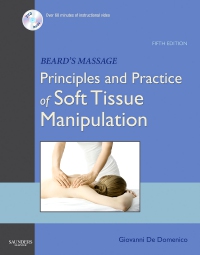
First published in 1964, Beard's Massage is a classic physical therapy massage text originally authored by Gertrude Beard, a pioneering physical therapist in the 1920s who treated patients using soft tissue massage techniques that remain the basis of practice today.
Now in its fifth edition, with a new title, this classic text has been expanded and updated throughout to provide students with an overview of massage, a description of massage techniques, information on the benefits of massage, and specific techniques for a variety of conditions.
-
- The new companion DVD with narrated video clips demonstrates each of the various techniques discussed in the text allowing you to visually comprehend proper timing and techniques.
- Icons in the text link the text to the DVD so they can function together as a complete learning tool.
- New chapter on Anatomical Landmarks for Soft Tissue Massage demonstrates the important anatomical landmarks and structures involved during the application of soft tissue massage techniques.
- New chapter on Focal Massage Sequences describes the use of various massage techniques for specific pathologies to help enhance your assessment skills for those clients who present with specific injuries and/or conditions.
- New chapter on Decongestive Therapy for the Treatment of Lymphedema shows how massage can be an effective part of lymphedema treatment.
- New chapter on Massage in Sport explains the different strokes and methods required for sports massage in rehabilitation.
- New chapter on Massage for the Baby and Infant describes different methods for safe massage.
- New chapter on Massage in Palliative Care explains the role of massage, especially pain relief and relaxation, in the care of the terminally ill.
- New chapter on Soft Tissue Manipulation in Complementary/Alternative Medicine (CAM) describes different massage techniques in CAM therapies.
-
- The new companion DVD with narrated video clips demonstrates each of the various techniques discussed in the text allowing your students to visually comprehend proper timing and techniques.
- Icons in the text link the text to the DVD so they can function together as a complete learning tool.
- New chapter on Anatomical Landmarks for Soft Tissue Massage demonstrates the important anatomical landmarks and structures involved during the application of soft tissue massage techniques.
- New chapter on Focal Massage Sequences describes the use of various massage techniques for specific pathologies to help enhance your students' assessment skills for those clients who present with specific injuries and/or conditions.
- New chapter on Decongestive Therapy for the Treatment of Lymphedema shows how massage can be an effective part of lymphedema treatment.
- New chapter on Massage in Sport explains the different strokes and methods required for sports massage in rehabilitation.
- New chapter on Massage for the Baby and Infant describes different methods for safe massage.
- New chapter on Massage in Palliative Care explains the role of massage, especially pain relief and relaxation, in the care of the terminally ill.
- New chapter on Soft Tissue Manipulation in Complementary/Alternative Medicine (CAM) describes different massage techniques in CAM therapies.
- Practical step-by-step guidance to help your students develop massage sequences that best meet the needs of your patients.
- Sections on massage strokes show the direction and sequence of each stroke, allowing your students the benefit of using one comprehensive resource instead of several texts.
- Includes guidance in Swedish Remedial Massage techniques to help your students develop proper massage techniques and sequences that best meet the needs of each individual client.
- Nearly 500 line drawings and photos demonstrate how to perform all of the basic strokes, the physiologic and therapeutic effects of each technique, and how to apply the most appropriate massage sequences to specific regions of the body.
- Photos include directional arrows that show hand position and movement across the patient.
- Updated references facilitate further study and demonstrate currency of the text.
-
-
 Beard's MassagePaperback
-
-
PART I: GENERAL PRINCIPLES
1. Historic Perspectives
2. Anatomical Landmarks for Soft Tissue Massage – NEW!
3. Essential Requirements for Soft Tissue Manipulation
4. Classification, Definitions, and Descriptions of the Basic Massage Strokes and Relaxed Passive Movements
5. Mechanical, Physiological, Psychological, and Therapeutic Effects of Soft Tissue Manipulation
PART II: PRACTICE
6. Soft Tissue Manipulation Techniques as an Evaluation Tool
7. General Massage Sequences
8. Local Massage Sequences
9. Focal Massage Sequences – NEW!
10. Massage for the Patient with a Respiratory Condition
11. Connective Tissue Massage (CTM)
12. Decongestive Therapy for the Treatment of Lymphedema – NEW!
13. Massage in Sport – NEW!
14. Massage for the Baby and Infant – NEW!
15. Massage in Palliative Care – NEW!
16. Soft Tissue Manipulation in Complementary/Alternative Medicine (CAM) – NEW!
17. Eastern Systems of Soft Tissue Manipulation
Appendix: Closed Chest (External) Cardiac Massage
Index -
-
Ways of Reading
- No information about appearance modifiability is available
- All content can be read as read aloud speech or dynamic braille
- Has alternative text descriptions for images
-
Conformance
- The publication contains a conformance statement that it meets the EPUB Accessibility 1.1, WCAG 2.1, Level AA standard. Please see https://bornaccessible.benetech.org/certified-publishers/ for further details of our compatibility testing.
- The certifier's credential is https://bornaccessible.benetech.org/certified-publishers/
- The publication was certified on 06-02-2026
-
Navigation
- Index with links to referenced entries
- Elements such as headings, tables, etc. for structured navigation
- Page list to go to pages from the print source version
-
Rich Content
- Math formulas in accessible format (MathML)
- Information-rich images are described by extended descriptions
-
Hazards
- The publication contains no hazards
-
Product Content
- The primary content is text.
- Content includes a significant number of actionable (clickable) web links to external content, downloadable resources, supplementary material, etc.
- Content includes a significant number of actionable (clickable) cross-references, hyperlinked notes and annotations, or with other actionable links between largely textual elements (e.g., quiz/test questions, 'choose your own ending', etc.).
- Content includes additional textual content such as an interview, feature article, essay, bibliography, quiz/test, other background material, or text that is not included in a primary or 'unenhanced' version.
- Content includes photographs, whether in a plate section / insert or not.
- Content includes figures, diagrams, charts and/or graphs, including other 'mechanical' (i.e. non-photographic) illustrations.
- Content includes images displayed in a specific order for the purpose of graphic storytelling or giving information (e.g. graphic novels, comics and manga). May include text integrated into the image (as speech and thought bubbles, textual 'sound' effects, captions etc.).
- Content includes text within images, including text-as-text embedded in diagrams, charts, or within images containing speech balloons, thought bubbles, captions, etc.
- Content includes mathematical notations, formulae.
- At least some text - including text within other images - is 'text as an image' (i.e., a picture of text).
-
Legal Considerations
- No information is available
-
Additional Accessibility Information
- Content is enhanced with ARIA roles to optimize organization and facilitate navigation
- Page breaks included from the original print source
- The body text is presented with a contrast ratio of at least 4.5:1 (or 3:1 for large/heading text)
- Ultra-high contrast between text and background
- Content provides explanations for unusual words, abbreviations, acronyms, idioms, jargon in an accessible form, such as glossaries, scripted pop-ups.
- Where interactive content is included in the product, controls are provided (e.g., for speed, pause and resume, reset) and labelled to make their use clear.
-
Ways of Reading
Most review copies are eBooks – how fast!
A review copy request is most likely to be fulfilled as an eBook on VitalSource rather than a print product, unless no eBook is available. eBooks become available in as little as a few hours. Print products will take between 7 and 10 days to arrive. To request a print copy, please contact us through the Evolve Support Center for further assistance or contact your Elsevier Sales Rep.

 as described in our