ISBN:
9781455757220
Copyright:
2005
Publication Date:
11-03-2004
Page Count:
448
Imprint:
Saunders
List Price:
$115.99

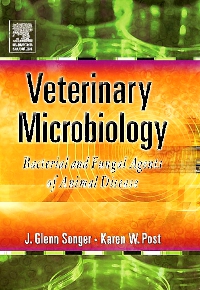
Veterinary Microbiology - Elsevier eBook on VitalSource, 1st Edition
by J. Glenn Songer, PhD and Karen W. Post
Elsevier eBook on VitalSource
ISBN:
9781455757220
Copyright:
2005
Publication Date:
11-03-2004
Page Count:
448
Imprint:
Saunders
List Price:
$115.99
Was
$115.99
Now $104.39
Or $0.00 with a valid access code
Containing the latest information on pathogenesis and diagnosis, Veterinary Microbiology addresses both specific, defined problems, as well as trends in host/parasite interaction. This book is a complete reference on microbial biology, diseases, diagnosis, prevention, and control. It also provides a foundation of knowledge on pathogens and how they interact with hosts.
-
- Contains a comprehensive, up-to-date overview of bacterial and fungal agents that cause animal disease, including recently identified organisms as well as the pathogenesis of emerging diseases.
- Features more than 100 full-color illustrations to visually reinforce key concepts.
- The book is logically organized for ease of use and quick reference in the clinical setting.
- Addresses diseases that can affect animal productivity, both for individual animals as well as herd health.
- Discusses the implications of various organisms in biological warfare and bioterrorism.
-
SECTION 1: INTRODUCTION
1. Evolution of virulence
2. General principles of diagnosis
3. Antimicrobial susceptibility testing and principles of antimicrobial therapy
SECTION 2: VETERINARY BACTERIOLOGY
Gram positive aerobic cocci
4. Staphylococcus
5. Streptococcus and Enterococcus
Gram positive aerobic rods
6. Actinomyces and Arcanobacterium
7. Bacillus
8. Corynebacterium
9. Dermatophilus and Nocardia
10. Listeria and Erysipelothrix
11. Mycobacterium
12. Rhodococcus
Gram negative bacteria
Enterobacteriaceae
13. Escherichia and Shigella
14. Klebsiella
15. Proteus
16. Salmonella
17. Yersinia
18. Bordetella
19. Burkholderia and Pseudomonas
20. Aeromonas and Vibrio
21. Moraxella and Neisseria
22. Actinobacillus
23. Mannheimia and Pasteurella
24. Haemophilus and Taylorella
25. Brucella
26. Francisella
27. Infrequently-encountered Gram-negative rods: Ornithobacterium rhinotracheale, Streptobacillus moniliformis, Legionella spp, Riemerella spp, Bartonella spp, and Chromobacterium spp
Curved and spiral-shaped bacteria
28. Campylobacter, Helicobacter, and Arcobacter
29. Brachyspira and Serpulina
30. Lawsonia
31. Leptospira
32. Treponema and Borrelia
Anaerobic bacteria
Anaerobic Gram positive rods and cocci
33. Clostridium
34. Other Gram-positive anaerobes
Anaerobic Gram negative rods
35. Bacteroides
36. Dichelobacter
37. Fusobacterium
38. Prevotella and Porphyromonas
Bacteria without cell walls
39. Mycoplasma and Ureaplasma
Obligate intracellular bacteria
40. Anaplasma, Eperythrozoon, and Hemobartonella
41. Chlamydia and Chlamydophila
42. Coxiella and Cowdria
43. Ehrlichia
44. Rickettsia and Neorickettsia
SECTION 3: VETERINARY MYCOLOGY
45. Introduction to veterinary mycology
46. Cutaneous mycoses
47. Subcutaneous mycoses
48. Systemic mycoses
49. Opportunistic mycoses
50. Fungal-like agents -
-
Ways of Reading
- The appearance of the text and page layout can be modified according to the capabilities of the reading system (font family and font size, spaces between paragraphs, sentences, words, and letters, as well as color of background and text)
- This e-publication is accessible to the full extent that the file format and types of content allow, on a specific reading device, by default, without necessarily including any additions such as textual descriptions of images or enhanced navigation
- All content can be read as read aloud speech or dynamic braille
-
Conformance
- For detailed accessibility information, see Elsevier's website at https://www.elsevier.com/about/accessibility
- For queries regarding accessibility information, contact [email protected]
- The publication was certified on 07-04-2026
-
Navigation
- Table of contents to all chapters of the text via links
- Page list to go to pages from the print source version
-
Rich Content
- No information is available
-
Hazards
- No information is available
-
Product Content
- No information is available
-
Legal Considerations
- Elsevier is committed to making our eBooks accessible and complying with applicable laws. Given our vast library of titles, there are some cases where making an eBook fully accessible presents unique challenges, and including full features could transform its nature to no longer serve its primary purpose or result in a disproportionate burden for the publisher. As a result this eBook may have limited accessibility. See more at https://www.elsevier.com/en-gb/about/accessibility.
- Please refer to our disproportionate burden or fundamental modification statements.
-
Additional Accessibility Information
- Page breaks included from the original print source
- E-publication includes basic navigation (usually less detailed than TOC-based navigation)
- All (or substantially all) textual matter is arranged in a single logical reading order (including text that is visually presented as separate from the main text flow, e.g., in boxouts, captions, tables, footnotes, endnotes, citations, etc.). Non-textual content is also linked from within this logical reading order. (Purely decorative non-text content can be ignored).
- The language of the text has been specified (e.g., via the HTML or XML lang attribute) to optimise text-to-speech (and other alternative renderings), both at the whole document level and, where appropriate, for individual words, phrases or passages in a different language.
-
Ways of Reading
Was
$115.99
Now $104.39
Or $0.00 with a valid access code

 as described in our