ISBN:
9781455757329
Copyright:
2008
Publication Date:
03-04-2008
Page Count:
560
Imprint:
Saunders
List Price:
$107.99

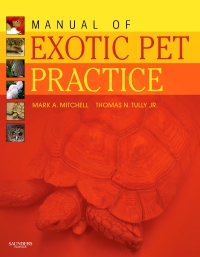
Manual of Exotic Pet Practice - Elsevier eBook on VitalSource, 1st Edition
by Mark Mitchell, DVM, MS, PhD, DECZM (Herpetology) and Thomas N. Tully, DVM, MS, DABVP (Avian), DECZM (Avian)
Elsevier eBook on VitalSource
ISBN:
9781455757329
Copyright:
2008
Publication Date:
03-04-2008
Page Count:
560
Imprint:
Saunders
List Price:
$107.99
Was
$107.99
Now $97.19
Or $0.00 with a valid access code
The only book of its kind with in-depth coverage of the most common exotic species presented in practice, this comprehensive guide prepares you to treat invertebrates, fish, amphibians and reptiles, birds, marsupials, North American wildlife, and small mammals such as ferrets, rabbits, and rodents. Organized by species, each chapter features vivid color images that demonstrate the unique anatomic, medical, and surgical features of each species. This essential reference also provides a comprehensive overview of biology, husbandry, preventive medicine, common disease presentations, zoonoses, and much more. Other key topics include common health and nutritional issues as well as restraint techniques, lab values, drug dosages, and special equipment needed to treat exotics.
-
- Brings cutting-edge information on all exotic species together in one convenient resource
- Offers essential strategies for preparing your staff to properly handle and treat exotic patients
- Features an entire chapter on equipping your practice to accommodate exotic species, including the necessary equipment for housing, diagnostics, pathology, surgery, and therapeutics
- Provides life-saving information on CPR, drugs, and supportive care for exotic animals in distress
- Discusses wildlife rehabilitation, with valuable information on laws and regulations, establishing licensure, orphan care, and emergency care
- Includes an entire chapter devoted to the emergency management of North American wildlife
- Offers expert guidance on treating exotics for practitioners who may not be experienced in exotic pet care
-
-
 Manual of Exotic Pet PracticeHardcover
-
-
1. History of Exotic Pets
2. Preparing Your Hospital for Exotics
3. Invertebrates
4. Fish
5. Amphibians
6. Crocodilians
7. Snakes
8. Lizards
9. Chelonians
10. Birds
11. Marsupials
12. Mice and rats
13. Ferrets
14. Rabbits
15. Hamsters and gerbils
16. Hedgehogs
17. Guinea Pigs
18. Chinchillas
19. North American Wildlife -
-
Ways of Reading
- The appearance of the text and page layout can be modified according to the capabilities of the reading system (font family and font size, spaces between paragraphs, sentences, words, and letters, as well as color of background and text)
- This e-publication is accessible to the full extent that the file format and types of content allow, on a specific reading device, by default, without necessarily including any additions such as textual descriptions of images or enhanced navigation
- All content can be read as read aloud speech or dynamic braille
-
Conformance
- For detailed accessibility information, see Elsevier's website at https://www.elsevier.com/about/accessibility
- For queries regarding accessibility information, contact [email protected]
- The publication was certified on 07-04-2026
-
Navigation
- Table of contents to all chapters of the text via links
- Page list to go to pages from the print source version
-
Rich Content
- No information is available
-
Hazards
- No information is available
-
Product Content
- No information is available
-
Legal Considerations
- Elsevier is committed to making our eBooks accessible and complying with applicable laws. Given our vast library of titles, there are some cases where making an eBook fully accessible presents unique challenges, and including full features could transform its nature to no longer serve its primary purpose or result in a disproportionate burden for the publisher. As a result this eBook may have limited accessibility. See more at https://www.elsevier.com/en-gb/about/accessibility.
- Please refer to our disproportionate burden or fundamental modification statements.
-
Additional Accessibility Information
- Page breaks included from the original print source
- E-publication includes basic navigation (usually less detailed than TOC-based navigation)
- All (or substantially all) textual matter is arranged in a single logical reading order (including text that is visually presented as separate from the main text flow, e.g., in boxouts, captions, tables, footnotes, endnotes, citations, etc.). Non-textual content is also linked from within this logical reading order. (Purely decorative non-text content can be ignored).
- The language of the text has been specified (e.g., via the HTML or XML lang attribute) to optimise text-to-speech (and other alternative renderings), both at the whole document level and, where appropriate, for individual words, phrases or passages in a different language.
-
Ways of Reading
Was
$107.99
Now $97.19
Or $0.00 with a valid access code

 as described in our