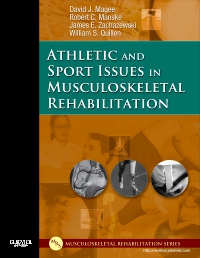

Athletic and Sport Issues in Musculoskeletal Rehabilitation - Elsevier eBook on VitalSource, 1st Edition
Elsevier eBook on VitalSource
Now $80.99
Part of David J. Magee's Musculoskeletal Rehabilitation Series, Athletic and Sport Issues in Musculoskeletal Rehabilitation provides expert insight and clear rehabilitation guidelines to help you manage injuries and special medical needs unique to athletic clients. Contributions from leading physical therapists, athletic trainers, and orthopedic surgeons give you a comprehensive, clinically relevant understanding of common sports-related injuries and help you ensure the most effective therapeutic outcomes.
-
- Addresses a broad range of sports-related injuries and conditions
- Reinforces key concepts with highlighted content and hundreds of detailed illustrations
- Summarizes essential information for fast, easy reference in class or in clinical settings
-
SECTION I: PREPARATION AND PREVENTION IN SPORTS MEDICINE
1. Role of Sports Medicine Team
2. Preparticipation Evaluation and Physical Fitness Profiling
Part A: Preparticipation Evaluation
Part B: Physical Fitness Profiling
3. Psychosocial Aspects of Youth Sports
4. Nutrition Counseling and Athletes
5. Environmental Considerations for Sports
6. Use of Ergogenic Aids in Sport
7. Sports Drug Testing
SECTION II: APPLIED BIOMECHANICS OF SELECTED SPORT ACTIVITIES
8. Applied Biomechanics of Cycling
9. Applied Biomechanics of Golf
10. Applied Biomechanics of Jumping
11. Applied Biomechanics of Tennis
12. Applied Biomechanics of Soccer
13. Applied Biomechanics of Running
14. Applied Biomechanics of Swimming
15. Applied Biomechanics of Baseball Pitching
16. Applied Biomechanics of Common Weight Training Exercises
SECTION III: MANAGEMENT OF SPORTS INJURY AND ILLNESS
17. Delayed-Onset Muscle Soreness
18. Medical Conditions in Sport
19. Dermatologic Considerations in Athletics
20. Protective Equipment in Sports
21. Taping for Athletics and Rehabilitation
22. Sports-Related Concussion
23. Traumatic Sports Injuries to the Cervical Spine
24. Maxillofacial Injuries
25. Abdominal and Thoracic Injuries
SECTION IV: SPECIAL POPULATIONS AND EPIDEMIOLOGY
26. The Female Athlete
27. Musculoskeletal Dance Medicine and Science
28. The Athlete with Disability
29. Selected Rehabilitation Needs of the Masters Athlete
30. Applied Sports Injury Epidemiology
-
-
Ways of Reading
- The appearance of the text and page layout can be modified according to the capabilities of the reading system (font family and font size, spaces between paragraphs, sentences, words, and letters, as well as color of background and text)
- This e-publication is accessible to the full extent that the file format and types of content allow, on a specific reading device, by default, without necessarily including any additions such as textual descriptions of images or enhanced navigation
- No information about nonvisual reading is available
-
Conformance
- For detailed accessibility information, see Elsevier's website at https://www.elsevier.com/about/accessibility
- For queries regarding accessibility information, contact [email protected]
- The publication was certified on 07-04-2026
-
Navigation
- Table of contents to all chapters of the text via links
-
Rich Content
- No information is available
-
Hazards
- No information is available
-
Product Content
- No information is available
-
Legal Considerations
- No information is available
-
Additional Accessibility Information
- For readers with color vision deficiency, use of color (e.g., in diagrams, graphics and charts, in prompts, or on buttons inviting a response) is not the sole means of graphical distinction or of conveying information
- E-publication includes basic navigation (usually less detailed than TOC-based navigation)
- Where links, controls or buttons are included in the content, the purpose or functionality of each link, control or button is apparent from the associated text alone - or where it is unclear, separate link, control or button descriptions are provided
- All (or substantially all) textual matter is arranged in a single logical reading order (including text that is visually presented as separate from the main text flow, e.g., in boxouts, captions, tables, footnotes, endnotes, citations, etc.). Non-textual content is also linked from within this logical reading order. (Purely decorative non-text content can be ignored).
- The language of the text has been specified (e.g., via the HTML or XML lang attribute) to optimise text-to-speech (and other alternative renderings), both at the whole document level and, where appropriate, for individual words, phrases or passages in a different language.
-
Ways of Reading



 as described in our