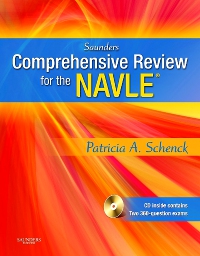

Saunders Comprehensive Review of the NAVLE - Elsevier eBook on VitalSource, 1st Edition
Elsevier eBook on VitalSource
-
- Exam-based structure familiarizes you with the content you willl see on the veterinary board exam and builds your knowledge step-by-step.
- Convenient, point-by-point outline format highlights the most essential data to streamline your NAVLE® exam preparation.
- Illustrations clarify and support key points.
- Case-based study questions test you on the clinical situations you will be challenged with on the exam and in practice.
- Answer key with rationales explains the logic behind each answer and reinforces important principles.
-
Section I: General Disciplines in Veterinary Medicine
1. Clinical Pathology: Clinical Chemistry
2. Clinical Pathology: Cytology
3. Clinical Pathology: Hematology
4. Dentistry
5. Diagnostic Imaging
6. Food Safety
7. Necropsy Techniques
8. Ophthalmology
9. Pharmacology
10. Toxicology
Section II: Small Animal
11. Anesthesia
12. Cardiovascular Disorders
13. Dermatology
14. Emergency Medicine
15. Endocrine Disorders
16. Gastrointestinal Disorders
17. Hematology
18. Infectious Diseases
19. Nervous System Disorders
20. Nutrition
21. Oncology
22. Orthopedic Disorders
23. Preventive Medicine
24. Reproductive Disorders
25. Respiratory Disorders
26. Restraint
27. Soft Tissue Surgery
28. Urinary System Disorders
Section III: Equine
29. Anesthesia
30. Behavior
31. Cardiovascular Disorders
32. Hematology
33. Dermatology
34. Diagnostic Imaging
35. Endocrine Disorders
36. Gastrointestinal Diseases
37. Infectious Diseases
38. Nervous System Disorders
39. Nutrition
40. Oncology
41. Ophthalmology
42. Orthopedic Disorders
43. Preventive Medicine
44. Reproductive Disorders
45. Respiratory Disorders
46. Restraint
47. Surgery
48. Urinary Disorders
Section VI: Food Animal
49. Bovine Medicine and Management
50. Camelid Medicine and Management
51. Ovine/Caprine Medicine and Management
52. Swine Medicine and Management
53. Poultry Medicine and Management
Section IV: Exotics
54. Pet Birds
55. Ferrets
56. Rabbits
57. Rodents
58. Reptiles
59. Zoo Animals
-
-
Ways of Reading
- The appearance of the text and page layout can be modified according to the capabilities of the reading system (font family and font size, spaces between paragraphs, sentences, words, and letters, as well as color of background and text)
- This e-publication is accessible to the full extent that the file format and types of content allow, on a specific reading device, by default, without necessarily including any additions such as textual descriptions of images or enhanced navigation
- All content can be read as read aloud speech or dynamic braille
-
Conformance
- For detailed accessibility information, see Elsevier's website at https://www.elsevier.com/about/accessibility
- For queries regarding accessibility information, contact [email protected]
- The publication was certified on 07-04-2026
-
Navigation
- Table of contents to all chapters of the text via links
- Page list to go to pages from the print source version
-
Rich Content
- No information is available
-
Hazards
- No information is available
-
Product Content
- No information is available
-
Legal Considerations
- Elsevier is committed to making our eBooks accessible and complying with applicable laws. Given our vast library of titles, there are some cases where making an eBook fully accessible presents unique challenges, and including full features could transform its nature to no longer serve its primary purpose or result in a disproportionate burden for the publisher. As a result this eBook may have limited accessibility. See more at https://www.elsevier.com/en-gb/about/accessibility.
- Please refer to our disproportionate burden or fundamental modification statements.
-
Additional Accessibility Information
- Page breaks included from the original print source
- E-publication includes basic navigation (usually less detailed than TOC-based navigation)
- All (or substantially all) textual matter is arranged in a single logical reading order (including text that is visually presented as separate from the main text flow, e.g., in boxouts, captions, tables, footnotes, endnotes, citations, etc.). Non-textual content is also linked from within this logical reading order. (Purely decorative non-text content can be ignored).
- The language of the text has been specified (e.g., via the HTML or XML lang attribute) to optimise text-to-speech (and other alternative renderings), both at the whole document level and, where appropriate, for individual words, phrases or passages in a different language.
-
Ways of Reading

 as described in our