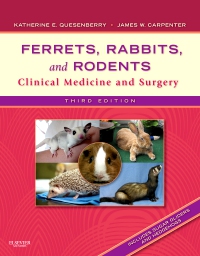

Ferrets, Rabbits and Rodents - Elsevier eBook on VitalSource, 3rd Edition
Elsevier eBook on VitalSource
Now $76.49
A concise guide to the care of small mammals, Ferrets, Rabbits, and Rodents: Clinical Medicine and Surgery covers the conditions seen most often in veterinary practice. The book emphasizes preventive medicine along with topics including disease management, ophthalmology, dentistry, and zoonosis. More than 400 illustrations demonstrate key concepts related to radiographic interpretation, relevant anatomy, and diagnostic, surgical, and therapeutic techniques. Now in full color, this edition adds coverage of more surgical procedures and expands coverage of zoonotic disease. From editors Katherine Quesenberry and James W. Carpenter, along with a team of expert contributors, the "Pink Book" provides an authoritative, single source of information that is hard to find elsewhere.
New Edition Expected Availability: 05-21-2020

Ferrets, Rabbits and Rodents - Elsevier eBook on VitalSource
-
- Expanded Zoonotic Diseases chapter adds more depth along with the latest information on the rising potential for disease transmission to humans as exotic pets become more popular.
- Additional surgical procedures for each species are included, some with step-by-step instructions accompanied by color photographs and line drawings.
- Full-color images show the sometimes minute structures of these small animals and make accurate diagnoses easier, especially for lymphoproliferative diseases of rabbits, endoscopy, cytology, and hematology.
-
- A logical organization makes it quick and easy to find important information, with each section devoted to a single animal and chapters within each section organized by body system.
- Over 400 photographs and illustrations highlight key concepts such as radiographic interpretation and the main points of diagnostic, surgical, and therapeutic techniques.
- A chapter on ophthalmology provides hard-to-find information on eye care for ferrets, rabbits, rodents, and other small mammals.
- Coverage of preventive medicine includes basic biology, husbandry, and routine care of the healthy animal.
- The drug formulary supplies dosage instructions for ferrets, rabbits, guinea pigs, chinchillas, hamsters, rats/mice, prairie dogs, hedgehogs, and sugar gliders.
- Chapter outlines offer at-a-glance overviews of the contents of each chapter.
- Handy tables and charts make it easy to find key information.
-
Section One: Ferrets
1. Basic Anatomy, Physiology, and Husbandry
2. Basic Approach to Veterinary Care
3. Gastrointestinal Diseases
4. Disorders of the Urinary and Reproductive Systems
5. Cardiovascular and Other Diseases
6. Respiratory Diseases
7. Endocrine Diseases
8. Neoplasia
9. Dermatologic Diseases
10. Muscoloskeletal and Neurologic Diseases
11. Soft Tissue Surgery
Section Two: Rabbits
12. Basic Anatomy, Physiology, and Husbandry
13. Basic Approach to Veterinary Care
14. Nutrition and Gastrointestinal Physiology
15. Gastrointestinal Diseases
16. Respiratory Disease and Pasteurellosis
17. Disorders of the Reproductive and Urinary Systems
18. Dermatologic Diseases
19. Neurologic and Musculoskeletal Diseases
20. Cardiovascular and Lymphoproliferative Diseases
21. Soft Tissue Surgery
Section Three: Guinea Pigs and Chinchillas
22. Biology, Husbandry, and Clinical Techniques of Guinea Pigs and Chinchillas
23. Diseases of Guinea Pigs
24. Diseases of Chinchillas
25. Soft Tissue Surgery
Section Four: Small Rodents
26. Basic Anatomy, Physiology, and Clinical Techniques of Small Rodents
27. Diseases of Small Rodents
28. Soft Tissue Surgery
Section Five: Other Small Mammals
29. Sugar Gliders
30. African Hedgehogs
Section Six: General Topics
31. Anesthesia, Analgesia, and Sedation of Small Mammals
32. Small Mammal Dentistry
33. Orthopedics in Small Mammals
34. Small Mammal Diagnostic and Surgical Endoscopy
35. Diagnostic Imaging
36. Cytology and Hematology of Small Mammals
37. Ophthalmologic Diseases in Small Pet Mammals
38. Emergency and Critical Care of Small Mammals
39. Behavior of Small Mammals
40. Zoonotic Diseases
Section Seven: Drug Formulary -
-
Ways of Reading
- The appearance of the text and page layout can be modified according to the capabilities of the reading system (font family and font size, spaces between paragraphs, sentences, words, and letters, as well as color of background and text)
- This e-publication is accessible to the full extent that the file format and types of content allow, on a specific reading device, by default, without necessarily including any additions such as textual descriptions of images or enhanced navigation
- No information about nonvisual reading is available
-
Conformance
- No information is available
-
Navigation
- Table of contents to all chapters of the text via links
- Page list to go to pages from the print source version
-
Rich Content
- No information is available
-
Hazards
- No information is available
-
Product Content
- No information is available
-
Legal Considerations
- No information is available
-
Additional Accessibility Information
- Page breaks included from the original print source
- For readers with color vision deficiency, use of color (e.g., in diagrams, graphics and charts, in prompts, or on buttons inviting a response) is not the sole means of graphical distinction or of conveying information
- E-publication includes basic navigation (usually less detailed than TOC-based navigation)
- Where links, controls or buttons are included in the content, the purpose or functionality of each link, control or button is apparent from the associated text alone - or where it is unclear, separate link, control or button descriptions are provided
- All (or substantially all) textual matter is arranged in a single logical reading order (including text that is visually presented as separate from the main text flow, e.g., in boxouts, captions, tables, footnotes, endnotes, citations, etc.). Non-textual content is also linked from within this logical reading order. (Purely decorative non-text content can be ignored).
- The language of the text has been specified (e.g., via the HTML or XML lang attribute) to optimise text-to-speech (and other alternative renderings), both at the whole document level and, where appropriate, for individual words, phrases or passages in a different language.
-
Ways of Reading

 as described in our