ISBN:
9781455775576
Copyright:
2014
Publication Date:
01-08-2014
Page Count:
912
Imprint:
Saunders
List Price:
$114.99

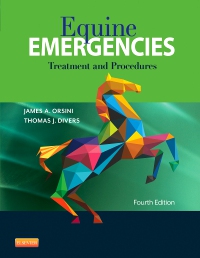
Equine Emergencies - Elsevier eBook on VitalSource, 4th Edition
by James A. Orsini, DVM, DACVS and Thomas J. Divers, DVM, DACVIM, DACVECC
Elsevier eBook on VitalSource
ISBN:
9781455775576
Copyright:
2014
Publication Date:
01-08-2014
Page Count:
912
Imprint:
Saunders
List Price:
$114.99
Was
$114.99
Now $80.49
Or $0.00 with a valid access code
Ideal for use in the clinic and in the field, Equine Emergencies: Treatment and Procedures, 4th Edition, offers practical step-by-step guidelines for effectively managing a wide range of emergency situations. Thoroughly updated content keeps you informed of the latest advances in horse care in a portable, convenient format.
-
- NEW! Chapter covering bacterial and viral diseases arms you with critical information on diagnostic labs, collection, submission, and interpretation
- NEW! Chapter on emergency diagnostic procedures keeps you up-to-date on all the tests needed to determine the most effective treatment
- NEW! Chapter on gene testing provides information on which gene tests and labs should be performed
- NEW! Chapter on biopsy techniques highlights the different instruments available, endoscopic and laparoscopic techniques, as well as how to perform a pleuritis examination
- NEW! Chapter on laboratory submission offers the latest information on tests, laboratory charts, guidelines for making an appropriate submission, and blood drawing
- NEW! Chapters on feeding and starvation and flood injury supply the latest guidelines for nutrition, disaster medicine, and snake bites/envenomation
-
- Essential examination, diagnostic, and treatment information for each body system is presented in a logical format so you can quickly find answers during equine emergencies
- What to Do and What Not to Do boxes guide you through the step-by-step treatment of an emergency and draw your attention to important steps to take and those to avoid
- High-quality photographs and illustrations visually clarify key concepts and guide you through procedures step by step
-
-
 Equine EmergenciesHardcover
-
-
PART 1: EMERGENCY PROCEDURES AND DIAGNOSTICS
Section I: Important Diagnostic and Therapeutic Procedures for Emergency Care
1. Blood Collection
2. Medication Administration and Alternative Methods of Drug Administration
3. Intravenous Catheter Selection, Sites for Placement and Maintenance
4. Venous Cutdown
5. Intraosseous and Regional Perfusion
6. Biopsy Techniques
7. Hyperbaric Oxygen Indications in Emergencies
8. Alternative Therapies in Emergencies: Acupuncture
Section II: Emergency Imaging, Endoscopy, Laboratory Diagnostics and Monitoring
9. Bacterial, Fungal and Viral Diagnostic Samples
10. Critical and Emergency Care Monitoring Techniques
11. Cytology
12. Emergency Diagnostic Endoscopy
13. Gene Testing
14. Imaging Techniques and Indications for the Emergency Patient
15. Laboratory Tests and Point of Care Diagnostics
PART 2: EMERGENCY EXAMINATION AND MANAGEMENT OF ORGAN SYSTEMS
Section I: Body and Organ Systems
16. Blood Coagulation Disorders
17. Cardiovascular System
18. Gastrointestinal System
19. Integumentary System
20. Liver Failure, Anemia and Blood Transfusion
21. Musculoskeletal System
22. Nervous System
23. Ophthalmology
24. Reproduction System
25. Respiratory System
26. Urinary System
Section II: Pregnancy, Perinatal/Neonatal Period
27. Monitoring the Pregnant Mare
28. Emergency Foaling
29. Foal Resuscitation
30. Perinatology
31. Neonatology
Section III: Shock, Temperature Related Problems, Systemic Inflammatory Response Syndrome and Muti-Organ Dysfunction Syndrome
32. Shock, Systemic Inflammatory Response Syndrome (SIRS), Multi-Organ Dysfunction Syndrome (MODS)
33. Temperature Related Problems: Hypothermia and Hyperthermia
PART 3: TOXICOLOGY
34. Toxicology
PART 4: SPECIAL PROBLEM EMERGENCIES
Section I: Special Problems
35. Burns, Acute Soft Tissue Swellings. Pigeon Fever
36. Caring for the Down Horse
37. Disaster Medicine
38. Diseases Unique to Donkeys and Miniature Horses
39. Diseases Unique to Draft Horses
40. Emergency Diseases Unique to Countries Outside the Continental United States
41. Flood Injury
42. Foot Injuries
43. Laminitis
44. Orthopedic Emergencies of the Racing Athlete
45. Snake Envenomination
46. Thoracic Trauma
Section II: Anesthesia
47. Anesthesia for Out-of-Hospital Emergencies
48. Euthanasia/Humane Destruction
49. Pain Management
Section III: Nutrition
50. Approach to the Feed and Starvation Emergency
51. Nutritional Guidelines for the Injured, Hospitalized and Postsurgical Patient
Section IV: Biosecurity
52. Contagious and Zoonotic Diseases
53. Standard Precautions and Infectious Disease Management
APPENDICES
1: Commonly Used Formulas and Calculations in Emergency Care
2: Important Equivalents and Conversions for Clinical Practice
3: Miscellaneous Charts and Tables Useful in Clinical Practice
4: Reference Values
5: Clinical Pharmacology and Emergency Drug Facts
A. Emergency Drugs, Recommended Dosages and Adverse Drug Events
B. Drugs for Specific Emergencies, Protocols and Clinical Situations
Antibiotics – Concentration Dependent vs. Time Dependent Drugs
Anesthetic Induction
Cardio-Respiratory Resuscitation
Cardiac Arrhythmia Drugs and Protocols
Pharmacologic Adjuncts to Intubation
Physical and Chemical Restraint
Pressors
Prokinetics
Seizure Control
Sepsis
Shock
C. Adverse Drug Events and Management
D. Clinical Signs and Overdose Response of Commonly Used Medications and
Recommended Treatments -
-
Ways of Reading
- The appearance of the text and page layout can be modified according to the capabilities of the reading system (font family and font size, spaces between paragraphs, sentences, words, and letters, as well as color of background and text)
- This e-publication is accessible to the full extent that the file format and types of content allow, on a specific reading device, by default, without necessarily including any additions such as textual descriptions of images or enhanced navigation
- No information about nonvisual reading is available
-
Conformance
- No information is available
-
Navigation
- Table of contents to all chapters of the text via links
- Page list to go to pages from the print source version
-
Rich Content
- No information is available
-
Hazards
- No information is available
-
Product Content
- No information is available
-
Legal Considerations
- No information is available
-
Additional Accessibility Information
- Page breaks included from the original print source
- For readers with color vision deficiency, use of color (e.g., in diagrams, graphics and charts, in prompts, or on buttons inviting a response) is not the sole means of graphical distinction or of conveying information
- E-publication includes basic navigation (usually less detailed than TOC-based navigation)
- Where links, controls or buttons are included in the content, the purpose or functionality of each link, control or button is apparent from the associated text alone - or where it is unclear, separate link, control or button descriptions are provided
- All (or substantially all) textual matter is arranged in a single logical reading order (including text that is visually presented as separate from the main text flow, e.g., in boxouts, captions, tables, footnotes, endnotes, citations, etc.). Non-textual content is also linked from within this logical reading order. (Purely decorative non-text content can be ignored).
- The language of the text has been specified (e.g., via the HTML or XML lang attribute) to optimise text-to-speech (and other alternative renderings), both at the whole document level and, where appropriate, for individual words, phrases or passages in a different language.
-
Ways of Reading
Was
$114.99
Now $80.49
Or $0.00 with a valid access code

 as described in our