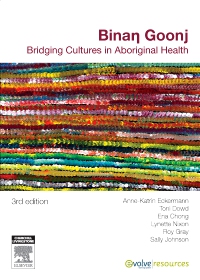

Binan Goonj - E-Book VBK, 3rd Edition
Elsevier eBook on VitalSource
Now $42.74
A newly-updated edition of the definitive textbook on Aboriginal Health issues
Binan Goonj, 3rd Edition: Bridging cultures in Aboriginal health is a comprehensive Indigenous health text which addresses key topics in a clear and accessible manner.
Thoroughly updated and revised, the latest edition of Binan Goonj sheds light upon the many multidisciplinary topics within the complex field of Indigenous health.
With chapter titles including Empowerment in Aboriginal Health and Aboriginal Communities Today, this authoritative health resource has been widely adopted as a teaching text across Australia.
Despite years of research, policy changes and interventions, it is widely documented that the health status of many Aboriginal people remains the poorest in Australia.
Binan Goonj, 3rd Edition: Bridging cultures in Aboriginal health explores the processes and practices underlying this situation, while providing practical strategies to work towards redressing it.
This latest edition will engage a diverse readership and challenge students and health professionals alike to examine their own values and the use of power in Australian society.
Elsevier’s Evolve website provides extensive support material for nursing and health professions faculty and students, including:
• discussion questions
• suggested reading on Aboriginal health and related topics
• web links
• an instructor’s manual featuring course delivery tips including topics such as adult learning, attitudinal change, colonisation, government policies, Indigenous media sites and cross-cultural education resources
• video links specific to chapters in this latest edition of Binan Goonj
-
• completely updated to reflect major Indigenous health policy changes since the second edition
• an in-depth exploration of the collaboration between Aboriginal and non-Aboriginal people
• the use of Aboriginal health case studies and critical incidences to bring academic discussion and analysis to life
• processes that have been successfully incorporated into 18 years of cross-cultural workshops -
-
 Evolve Resources for Binan GoonjResources
-
-
Preface
Introduction
About the authors
Acknowledgements
1 Background to Aboriginal/non-Aboriginal interactions in Australia
2 Aboriginal communities today
3 Coping with change and violence
4 Cultural vitality
5 Culture shock
6 People Centred Care
7 Empowerment in Aboriginal health
Index
-
-
Ways of Reading
- The appearance of the text and page layout can be modified according to the capabilities of the reading system (font family and font size, spaces between paragraphs, sentences, words, and letters, as well as color of background and text)
- This e-publication is accessible to the full extent that the file format and types of content allow, on a specific reading device, by default, without necessarily including any additions such as textual descriptions of images or enhanced navigation
- All content can be read as read aloud speech or dynamic braille
-
Conformance
- The certifier's credential is https://bornaccessible.benetech.org/certified-publishers/
- For detailed accessibility information, see Elsevier's website at https://www.elsevier.com/about/accessibility
- For queries regarding accessibility information, contact [email protected]
- The publication was certified on 10-06-2026
-
Navigation
- Table of contents to all chapters of the text via links
- Page list to go to pages from the print source version
-
Rich Content
- No information is available
-
Hazards
- No information is available
-
Product Content
- No information is available
-
Legal Considerations
- No information is available
-
Additional Accessibility Information
- Content is enhanced with ARIA roles to optimize organization and facilitate navigation
- Page breaks included from the original print source
- For readers with color vision deficiency, use of color (e.g., in diagrams, graphics and charts, in prompts, or on buttons inviting a response) is not the sole means of graphical distinction or of conveying information
- The body text is presented with a contrast ratio of at least 4.5:1 (or 3:1 for large/heading text)
- Ultra-high contrast between text and background
- E-publication includes basic navigation (usually less detailed than TOC-based navigation)
- Where links, controls or buttons are included in the content, the purpose or functionality of each link, control or button is apparent from the associated text alone - or where it is unclear, separate link, control or button descriptions are provided
- All (or substantially all) textual matter is arranged in a single logical reading order (including text that is visually presented as separate from the main text flow, e.g., in boxouts, captions, tables, footnotes, endnotes, citations, etc.). Non-textual content is also linked from within this logical reading order. (Purely decorative non-text content can be ignored).
- Where interactive content is included in the product, controls are provided (e.g., for speed, pause and resume, reset) and labelled to make their use clear.
- The language of the text has been specified (e.g., via the HTML or XML lang attribute) to optimise text-to-speech (and other alternative renderings), both at the whole document level and, where appropriate, for individual words, phrases or passages in a different language.
-
Ways of Reading

 as described in our