ISBN:
9781771720717
Copyright:
2018
Publication Date:
10-31-2017
Page Count:
96
Imprint:
Mosby Canada
List Price:
$13.99

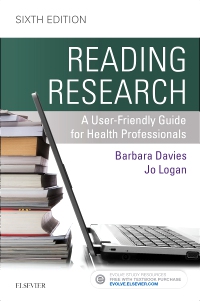
Reading Research - Elsevier eBook on VitalSource, 6th Edition
by Barbara Davies, RN, PhD, FCAHS and Jo Logan, BScN, PhD
Elsevier eBook on VitalSource
ISBN:
9781771720717
Copyright:
2018
Publication Date:
10-31-2017
Page Count:
96
Imprint:
Mosby Canada
List Price:
$13.99
Was
$13.99
Now $12.59
Or $0.00 with a valid access code
Ideal for both students and health professionals alike, Reading Research: A User-Friendly Guide for Nurses and Health Professionals, 6th Edition is a practical beginner-level introduction to health sciences research. The text is written in a manner that assumes you have little or no experience with analyzing published research, and provides guidelines for reading and understanding research articles. It also covers important elements of published research, such as research methods, common terminology, data analysis and results. All chapters have been updated. The book also briefly discusses common barriers to the application of research results in practice.
New Edition Expected Availability: 03-29-2021

-
- NEW! All chapters updated with the key terms and explanation of common research methods.
- NEW! Content on using the web, social media and avoiding predatory journals.
- NEW! Expansion on applying research to improve patient outcomes helps you to understand the importance of research.
- NEW! Introductory overview chapter gives you a better understanding of how the book is organized and how to utilize its content.
-
- Concise overview of health sciences-related research maximizes your study time by including all popular types of research methodologies.
- UNIQUE! Tips boxes provide easy-to-follow, practical suggestions for those who are new to the subject.
- UNIQUE! Alert! boxes warn of common assumptions made when reading research.
- Accompanying website provides up-to-date links for relevant research projects and other research-related sites, and offers Reader's Companion Worksheets for qualitative, quantitative, mixed method, and systematic reviews.
-
- Introduction
- Easy Steps for Reading Research
- Where to Find Interesting Research Results
- Using Research Results
Appendices
- Journals that Publish Peer-Reviewed Research
- Qualitative Research: The Reader’s Companion Worksheet
- Quantitative Research: The Reader’s Companion Worksheet
- Mixed Methods Research: The Reader’s Companion Worksheet
- Systematic Reviews: The Reader’s Companion Worksheet
- Using Research Results: The Reader’s Companion Worksheet
-
-
Ways of Reading
- The appearance of the text and page layout can be modified according to the capabilities of the reading system (font family and font size, spaces between paragraphs, sentences, words, and letters, as well as color of background and text)
- This e-publication is accessible to the full extent that the file format and types of content allow, on a specific reading device, by default, without necessarily including any additions such as textual descriptions of images or enhanced navigation
- No information about nonvisual reading is available
-
Conformance
- The publication was certified on 27-05-2026
-
Navigation
- Table of contents to all chapters of the text via links
- Page list to go to pages from the print source version
-
Rich Content
- No information is available
-
Hazards
- No information is available
-
Product Content
- No information is available
-
Legal Considerations
- No information is available
-
Additional Accessibility Information
- Page breaks included from the original print source
- For readers with color vision deficiency, use of color (e.g., in diagrams, graphics and charts, in prompts, or on buttons inviting a response) is not the sole means of graphical distinction or of conveying information
- E-publication includes basic navigation (usually less detailed than TOC-based navigation)
- Where links, controls or buttons are included in the content, the purpose or functionality of each link, control or button is apparent from the associated text alone - or where it is unclear, separate link, control or button descriptions are provided
- All (or substantially all) textual matter is arranged in a single logical reading order (including text that is visually presented as separate from the main text flow, e.g., in boxouts, captions, tables, footnotes, endnotes, citations, etc.). Non-textual content is also linked from within this logical reading order. (Purely decorative non-text content can be ignored).
- The language of the text has been specified (e.g., via the HTML or XML lang attribute) to optimise text-to-speech (and other alternative renderings), both at the whole document level and, where appropriate, for individual words, phrases or passages in a different language.
-
Ways of Reading
Was
$13.99
Now $12.59
Or $0.00 with a valid access code

 as described in our